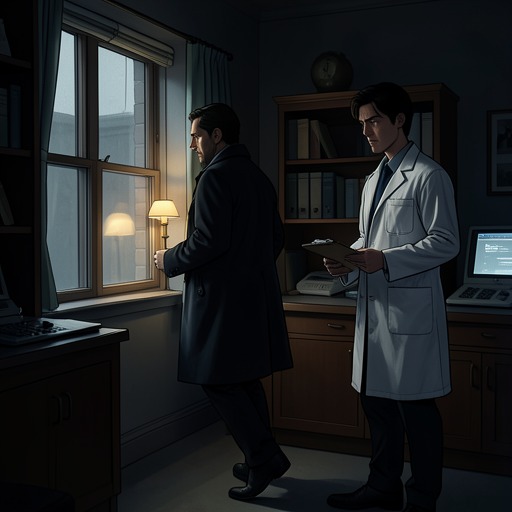
The Shop Kills Vicky and Kidnaps Charlie
FirestarterThe Shop Kills Vicky and Kidnaps Charlie is the decisive rupture in the McGee family’s flight: the Shop’s surveillance gives way to violence against Vicky Tomlinson McGee and the seizure of Charlie McGee. The event is presented through Andy McGee’s delayed reconstruction of what happened. Its force lies both in the loss itself and in the terrible misapprehension behind it: Charlie had been staying at a friend’s house, but the Shop treated her absence as evidence that the family had gone underground.
Background and Misunderstanding
By the time of the killing, the Shop had returned to Andy and Vicky’s lives after a long period in which the family had been running or trying to hide. Andy later remembers that they had been under surveillance, possibly for some time. When Charlie failed to come home from summer daycamp on Wednesday and was still absent the next day, the Shop apparently concluded that Andy and Vicky had recognized the surveillance and taken their daughter away. In fact, Charlie was at the home of her friend Terri Dugan, less than two miles away.
The ordinary explanation for Charlie’s absence is central to the event’s tragedy. She had spent two days and nights with Terri, and Vicky had been planning a reciprocal visit for the girls. What the family understood as a familiar arrangement, Vicky had even given a playful name: the Great Swap of 1980. The Shop’s mistaken reading transformed that harmless plan into an emergency. In Andy’s later account, the gap between what had happened and what the operatives believed had happened explains why Vicky was questioned about Charlie’s whereabouts and why the family’s prior concealment became immediate danger.
Vicky’s Death and Andy’s Discovery
Andy discovers Vicky in the laundry room of their house. She has been left beneath the ironing board, and a cleaning rag has been placed in her mouth. The room’s mundane contents—the washer and dryer, cleaning products, and the board—frame the discovery within the routines of home. The familiar domestic space has become the scene of an operation directed at the family. When Andy opens the door, the ironing board drops into place; the abrupt mechanical movement becomes inseparable in his memory from what he finds beneath it.
Andy’s first response is shock. The dryer starts when he strikes its controls, and he runs upstairs before he can steady himself. The narrative then returns to the discovery as an image that will recur in his dreams. Rather than presenting the event as something Andy can simply absorb and leave behind, the account shows it repeating: the opening door, the falling board, and the recognition of his wife’s body return to him in slowed, replay-like fragments. His effort to suppress a scream and regain composure marks the shift from stunned reaction to the practical attention the crisis demands.
What the Killing Reveals
Andy finds that Vicky’s fingernails have been pulled, and understands that the operatives were trying to learn where Charlie was. That detail converts his discovery from an unexplained murder into evidence of the Shop’s immediate objective. Charlie’s location, rather than any demonstrated act by Vicky, was the information they sought. Vicky had been killed while the Shop was trying to locate her daughter; Charlie’s absence from home had made her mother the target of the search.
The account identifies a fatal blow to Vicky’s neck. It does not establish exactly how the killing unfolded or whether it was ordered in advance. Andy considers several possibilities: the operatives may have feared Vicky was dangerous, may have received instructions to eliminate her if she interfered, or may have wanted to leave no witness. These remain his conjectures, not confirmed explanations. The distinction matters: the text makes the Shop’s pursuit and the search for Charlie clear, while leaving the precise decision that ended Vicky’s life uncertain.
Aftermath and Narrative Significance
The discovery changes the meaning of the family’s earlier fear. Andy remembers a telephone conversation with Quincey about the possibility that the authorities would take Charlie and confine her for their own purposes, but he recognizes that he had not understood the danger then. In retrospect, the fear becomes concrete in the murder of Vicky and Charlie’s capture. The danger was no longer an abstract prospect of institutional control; it had entered the family home.
Andy’s memory also places the violence against the life he shared with Vicky. He recalls their marriage, their affectionate play, and his care for her at a faculty party. These moments do not explain the killing; they establish what the Shop’s action has destroyed. The story’s movement from a planned visit between friends to Vicky’s death and Charlie’s removal turns an everyday family arrangement into a point of no return. For Andy, the discovery is at once an intimate bereavement and the instant he understands that finding Charlie is now inseparable from escaping the Shop’s reach.