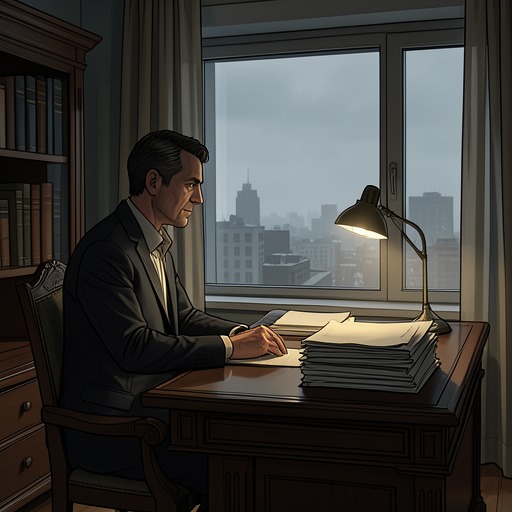
Andy Writes Letters Exposing the Shop
FirestarterAndy’s decision to write six letters is his first deliberate attempt to end the McGees’ flight by making the Shop’s actions public. The letters tell the story of the experiment at Jason Gearneigh Hall and the enforced isolation at Tashmore Pond, but the plan meets the same secretive power it is meant to expose: agents seize the mail before it can be sorted and sent onward.
The decision to break the silence
Andy reaches the decision during the winter at Tashmore Pond, where he often crosses the frozen lake to think. The silence and physical exertion clear his mind, but the stillness does not make their situation safer. He and Charlie have come to Granther McGee’s place for the winter and are still on the run; the unease he feels around the older men gathered by the stove confirms that hiding there has not ended their pursuit. He recognizes that they are cornered and that something must change.
His anger is sharpened by the gap between the protections he believes citizens should have and what has happened to his family. He and his family are American citizens in what he regards as an open society, yet Vicky McGee has been murdered, Charlie kidnapped, and the two of them hunted. Andy thinks that telling their story to someone—or several people—might expose the Shop and force the pursuit to stop.
He also understands that he has delayed. The hypnosis that followed the experiment had continued to some degree, and he had feared that publicity would make Charlie a spectacle or lead to her institutionalization. Even after seeing Vicky’s body hidden in the laundry ironing closet, he kept telling himself that they would eventually be left alone. The decision to write follows his recognition that this hope has been a mistake: the Shop will not simply give up, and he will not allow Charlie to be confined in the small room he fears for her.
Six accounts of the same history
Andy writes six nearly identical letters. Two are addressed to Ohio’s United States senators, one to the woman representing the district that includes Harrison, and the remaining three to The New York Times, the Chicago Tribune, and the Toledo Blade. The range of recipients makes the effort more than a private plea: Andy is trying to place the same account before elected representatives and newspapers, in the hope that multiple routes to public attention will make the story harder to contain.
The letters trace events from the experiment at Jason Gearneigh Hall to Andy and Charlie’s isolation at Tashmore Pond. Their sweep gives Charlie something she has not had before: the complete story of what happened to her family. Andy lets her read one of the letters, and she takes almost an hour to go through it carefully. Her reading changes the meaning of the letters from a father’s planned appeal into the first full explanation he has shared with his daughter.
Charlie asks whether he intends to mail them. Andy plans to do so the next day, but he is uncertain what will follow. He can only hope that once the story is public, the people pursuing them will have to stop. Charlie asks whether they will be kept together, and he reassures her, though he does not know what will happen after the letters are sent. Her final concern is also a resolve: she says she will not make any more fires. The exchange binds the public-risk decision to the private stakes Andy cannot promise to secure.
The postal interception
The delivery plan depends on a small, vulnerable route. Neither Bradford, New Hampshire, nor Tashmore has a post office; the nearest one to Bradford is in Teller. On March 10, at 1:15 in the afternoon, the postal truck from Teller collects mail from a standing box by the general store. Andy’s six letters are among it. Across the lake, he is napping while Charlie builds a snowman, unaware that the letters have begun their journey.
The carrier, Robert Everett, takes the mail onward toward Williams before turning back toward Teller, where it is to be sorted and sent out at about three. Five miles outside town, a beige Chevrolet Caprice blocks the narrow road. Two men approach Everett, show credentials, and explain what they want. When he resists, one exposes The Windsucker beneath his parka; the other orders him to hand over the out-of-town mail. Everett gives them the small sack containing mail from Bradford and Williams. The men open it at the roadside and sort through it, while Everett recognizes the act as a violation of the public trust represented by the mail.
The interception defeats the crucial step in Andy’s plan: the letters are collected, but the evidence does not show them reaching their intended recipients. The contrast is stark. Andy tries to use ordinary civic channels—senators, a congressional representative, and newspapers—while the Shop’s agents use credentials and a weapon to take control of the correspondence before it can be delivered.
Exposure and suppression
The episode belongs to a larger pattern in which the Shop asserts secrecy against people who have witnessed its actions. Earlier, Irv Manders confronts agents on his property and demands that they leave or show a warrant; they claim not to need one. Later, after the Manders farm events, a representative invokes national security while pressuring Irv and Norma Manders not to speak, offering tax-free money for repairs and hospital bills and warning of further unpleasantness. These encounters frame Andy’s letters as more than an attempt to tell a family history: they challenge an institution that treats both law and public knowledge as obstacles to be managed.
The letters therefore mark a reversal in Andy’s response to the pursuit. Until then, he has concentrated on keeping himself and Charlie moving and has hoped that their pursuers would eventually leave them alone. At Tashmore Pond, he decides instead to make the history available beyond the two of them. Yet the interception shows how little control he has over the means of exposure. Charlie receives the truth from him; the intended public audience does not demonstrably receive it. His appeal begins as an act of disclosure and is immediately met by an act of concealment.