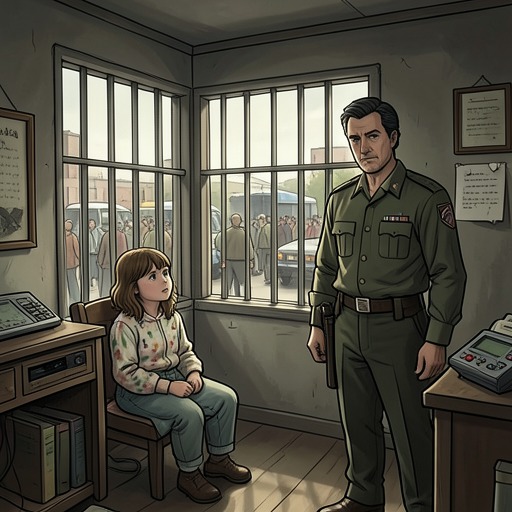
Rainbird Persuades Charlie to Agree to the Shop’s Tests
FirestarterJohn Rainbird persuades Charlie McGee to agree to the Shop’s tests by turning her hopes for freedom and reunion with her father into leverage. The decision appears to be Charlie’s, and she insists it is for herself as well as Andy McGee; its crucial condition, however, is concealed from her. Rainbird has no intention of arranging the promised meeting and has not passed along her messages to Andy.
The offer and its leverage
Rainbird begins by telling Charlie that she should not do anything for free. He presents the idea as practical advice, but it is also a way to make cooperation seem like a bargain she can control. When she is puzzled, he claims that he loves her a little and that she is like the daughter he never had. He says that her confinement, separation from her father, lack of time outside, and absence from the ordinary experiences of other children make him sick. The appeal borrows the language of care while directing Charlie toward the outcome Rainbird wants: participation in the tests.
He suggests that cooperation could bring specific benefits. Charlie might be allowed into the sun, taken into Longmont to shop, moved out of the box and into a regular house, and permitted to see other children. The progression matters: Rainbird first names freedoms she might find imaginable, then lets her supply the request that matters most. Charlie asks whether she could see her father. Rainbird responds readily and says she might secure the meeting by going partway through the tests and then threatening to stop unless the Shop allows it. He leaves that possibility hanging as bait, inviting her to picture a reward without disclosing the terms that actually govern it.
The promise Rainbird conceals
Rainbird’s offer is built on a deliberate falsehood. He tells Charlie that seeing Andy is negotiable, but he knows that it is not. He has never carried a message between father and daughter. Although he sees Andy, he sees him on television monitors; Andy is cooperating with tests while weakened by medication, absorbed by television, and waiting for his next pill. He no longer asks to see Charlie. Rainbird reasons that a face-to-face meeting could reveal what has been done to Andy and stiffen Charlie’s resistance, just as she is close to being persuaded. In his assessment, every part of the bargain can be discussed except that reunion: Charlie is never going to see her father again.
The deception also depends on the role Rainbird has established for himself as the friendly orderly. He maintains the fiction that he carries Charlie’s messages, alongside other reassuring stories that are meant to make the confined child trust him. His kindness is therefore inseparable from his concealment. He understands that the promise of Andy is the strongest bait, yet withholds both the truth about his messages and the Shop’s intentions for Andy, whom he expects will soon be sent to the Maui compound. Charlie is asked to make a choice using information Rainbird has carefully falsified.
Charlie’s decision
Three days later, Charlie tells Rainbird that she has decided to let the Shop make its tests. Her face is described as thin, pinched, and pale; the physical detail gives the decision a cost without making her resolve passive. She says she will be careful and will make the researchers be careful too. Rainbird cautions her not to proceed unless she has thought it all through, and asks whether she is doing it for the Shop. She rejects that reason. Asked whether she is doing it for herself, she says yes—for herself and her father.
That answer makes the conflict inside her decision explicit. Charlie is not persuaded that the tests serve the Shop’s interests, nor does she simply surrender to Rainbird’s authority. She frames cooperation as a means of pursuing her own ends, especially the possibility of seeing Andy. The reader, however, knows that the crucial promised outcome has already been ruled out by the person encouraging her to act. Her agency is real in the immediate sense that she chooses, but the conditions shaping that choice have been manipulated.
Bargaining, not surrender
Rainbird follows Charlie’s decision with instructions about how to handle the Shop. He tells her to make the researchers play by her rules, to keep her toughness visible, and not to let them see weakness they might exploit. Charlie says she thinks she understands. When Rainbird asks when the tests will begin, she says she will see Patrick Hockstetter the next day and tell him that she has decided to cooperate a little—and tell him what she wants. Rainbird counsels her not to ask for too much at first, comparing the negotiation to a midway carny who shows some flash before taking the customer’s cash. Charlie accepts the logic and agrees that she should show the Shop who is in charge.
The exchange gives her agreement a limited, conditional form: she intends to cooperate only a little, to state demands, and to remain guarded. Rainbird reinforces that stance because a show of resistance can make the bargain more persuasive to Charlie, even as it keeps her moving toward the tests. His encouragement to show who is boss sounds like a transfer of control, but he is the one who has framed the available choices and planted the false prospect of reunion.
Significance
The episode turns on a gap between the apparent bargain and its hidden terms. Charlie’s hope of seeing Andy makes the tests seem like a route toward family and freedom; Rainbird knows that he is offering no genuine route to the meeting she wants. The gap is particularly sharp because his performance of affection is not wholly separate from his assessment of her: he admires her intelligence and intuition, while also using that intelligence to make a calculated appeal. He knows she may be perceptive, but trusts that the promise will hold her attention.
Charlie’s agreement therefore advances the Shop’s efforts without resolving the central conflict. She enters the next day’s meeting with Patrick Hockstetter intending to negotiate, not to give the Shop unlimited control. At the same time, her stated purpose—herself and her father—rests on a lie Rainbird has chosen to preserve. The event’s decisive consequence is not simply that Charlie consents to testing, but that her consent is secured through a counterfeit promise of reunion, setting her self-protective resolve against the concealed intentions of the people controlling her.