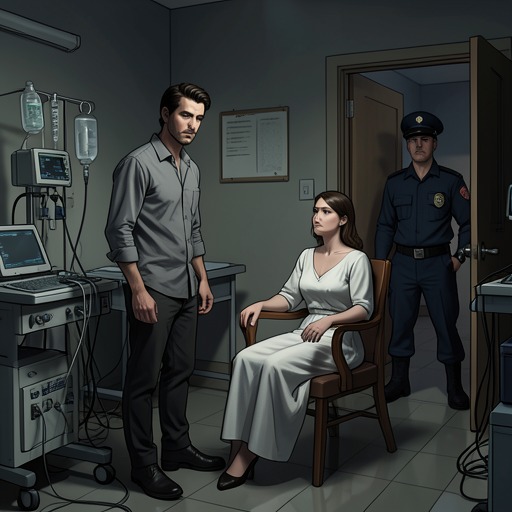
Andy’s planned push on Pynchot
FirestarterAndy McGee’s planned push on Herman Pynchot is a covert act of resistance formed under surveillance: after the blackout, Andy secretly stops taking his pills and prepares to use his mind-control ability during a routine walk. The scene’s decisive tension lies between the ordinary visit Pynchot expects and the concealed purpose Andy has brought to it. The passage brings them to the threshold of the walk, but does not show whether Andy actually uses the push.
A plan formed under pressure
Three weeks after the blackout, Andy sits before the television, outwardly calm and pleased while inwardly consumed by nervousness. A small amber Home Box Office pilot light glows on the device atop the set; on-screen, Richard Dreyfuss is trying to build the Devil’s Butte in his living room. Andy watches with an expression that conceals the urgency of the day. The contrast makes his stillness part of the plan: he must appear to be an ordinary, drugged patient while privately preparing to act.
His intention is explicit but limited in the passage: Pynchot is coming for a garden walk to discuss Andy’s progress, and Andy means to push him, or at least try. The text does not specify what command Andy hopes to give or what outcome he expects from Pynchot. It does establish why he has waited. Television monitors and listening devices have made an earlier attempt too dangerous, while the delay has allowed him to test and revise his imagined approach repeatedly. The plan is therefore not a sudden impulse; it is a purpose shaped by confinement, surveillance, and prolonged rehearsal.
Andy connects the risk to his hope of helping Charlie McGee. The secret has made him feel whole and potent again, even as it gnaws at him. He likens his position to the terror associated with the Russian KGB and to Winston Smith’s brief, furtive rebellion in George Orwell’s Nineteen Eighty-Four: fear and exhilaration coexist because keeping a secret gives him a small form of agency inside a system that watches him. He cannot know how long he can sustain the deception, or whether the attempt will succeed, but for now the preparation itself marks a change from passive captivity to resistance.
Concealing recovery
The plan depends first on Andy’s ability to hide what he is doing from those monitoring him. He has been sleeping less than ever, afraid that he might talk in his sleep and disclose his intentions. Even ordinary movement in bed worries him: he fears that restless behavior could look suspicious in a man believed to be drugged. When sleep comes, it is shallow and repeatedly broken; strange dreams include the recurring figure of Long John Silver, the one-eyed pirate with a peg leg. These details show the psychological cost of concealment: surveillance reaches beyond the room’s devices into Andy’s management of his own speech, movement, and rest.
Avoiding the medication, by contrast, has become the easiest part because the staff believe he wants the pills. They are brought to him four times a day, and no further tests have been conducted since the blackout. Andy interprets that lull as a sign that the Shop has given up testing him, and expects Pynchot’s walk may bring confirmation. That expectation remains his belief, not a fact established by the encounter shown here. The gap between what Andy thinks the staff know and what they may actually be watching keeps the plan precarious.
His methods are practical and varied. He coughs pills from his mouth into a cupped hand and hides them in food scraps before scraping them into the garbage disposal. He sends other pills down the toilet. Sometimes he pretends to take them with ginger ale, spitting them into partly empty cans so they dissolve before he pours them down the sink. The different disposal routes make the concealment concrete: Andy has turned each medication round into a small performance, with the appearance of compliance masking a repeated refusal.
He does not mistake himself for an expert. He assumes the people monitoring him may be more skilled and recognizes that closer observation would expose him. His confidence rests instead on the judgment that they are no longer watching him closely. The plan thus depends on a narrow and uncertain opening: he must recover enough ability to act while persuading the institution that the drugs are still controlling him.
The appointment becomes an opening
As Andy watches the film, the buzzer marking a break in the door circuit sounds briefly. He does not let himself jump. The controlled response matters because he is awaiting Pynchot and expects the ordinary visit to become the occasion for his attempt. His private reminder that this is the day sets the moment against the television’s fictional spectacle: while Dreyfuss climbs the Devil’s Butte, Andy is preparing for a quiet confrontation in the garden.
Pynchot enters the living room smiling. He is shorter than Andy and very slender; Andy has long found something slightly effeminate in his manner, though he cannot identify a particular feature that accounts for the impression. Pynchot wears a thin gray turtleneck sweater and a lightweight summer jacket, and greets Andy as if this were an ordinary morning. The details fix the encounter in mundane routine, not open confrontation. Pynchot’s smile and the expected discussion of progress belong to the institution’s orderly surface; Andy’s intention remains hidden beneath his own performance.
When Pynchot asks to turn off the television so they can go for their walk, Andy acts as though the appointment has slipped his mind. He then agrees, adding that he has seen the film several times and likes its ending, in which the UFOs take the central character away to the stars. Pynchot turns off the set and patiently reminds him that they are going for a walk. Andy asks where, receives the reminder, and gets up. His questions and pauses can be read as part of his display of harmless confusion, although the passage does not explicitly confirm that every hesitation is deliberate. What it does show is that he allows the expected routine to proceed without revealing his purpose.
Significance and limit of the scene
The action’s immediate accomplishment is preparation, not a demonstrated use of the push. Andy has concealed his resistance, chosen the opportunity he considers available, and reached the point where he is walking out with Pynchot. Whether the plan works, whether Pynchot is truly unsuspecting, and what Andy intends to make him do remain unresolved in this passage. Preserving that distinction matters: the scene records the risk and anticipation of an attempted action, not its result.
The television episode offers a quiet counterpoint to Andy’s situation. Its character is carried away by UFOs; Andy, by contrast, remains inside a watched facility and must try to create room for action through deception. The contrast does not remove the fear surrounding his plan. It sharpens it: his apparent leisure, his practiced compliance with medication, and his forgetful manner all serve the same hidden purpose. The walk with Pynchot is the first visible step toward that purpose, while Andy’s uncertainty about the watchers keeps even that step from feeling secure.