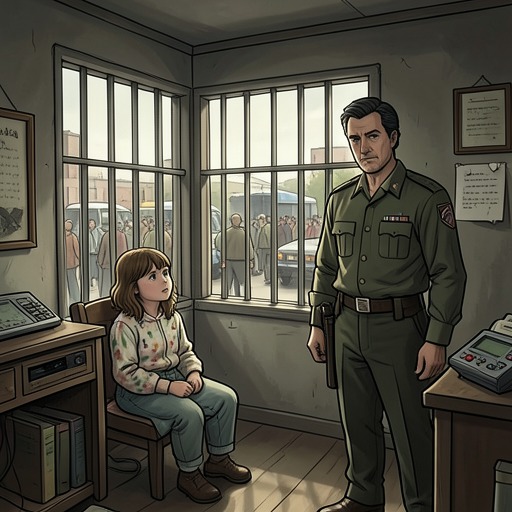
Rainbird gains Charlie’s trust
FirestarterJohn Rainbird gains Charlie McGee’s trust during a blackout by making himself seem frightened, wounded, and emotionally kin to her. The intimacy he creates is real in its effect on Charlie but inseparable from his calculated purpose: her confidence gives him influence over the firestarting ability she has refused to use, and his private thoughts reveal that his attachment carries a lethal possibility as well as tenderness.
The Blackout as an Opening
Rainbird later recognizes how much the blackout has changed the terms of his approach. The psychologists had failed to move Charlie from her determination never to light fires again; their medication has been reduced to little more than a placebo, and they believe she will do nothing. In the dark, without the ordinary surveillance, Rainbird sees a chance to reach her in a way formal tests and questioning have not. He enters her quarters at three-thirty as a storm begins, pushing a housekeeping cart loaded with sheets, cleaning supplies, a bucket, a mop, and a vacuum cleaner. Its mundane appearance helps make his visit seem part of the facility’s ordinary routines.
Charlie is seated on the floor beside the couch, legs crossed, still and withdrawn. Rainbird knows that her apparent passivity is not intoxication: she remains lightly medicated, but her refusal to make fires is sincere. He therefore does not begin by demanding a demonstration or openly challenging her vow. Instead, in the darkness, he lets her hear him asking for help in a low voice. When she feels her way toward him, he conceals a grin and answers in a strained voice that he cannot stand the dark because it recalls the place where he was held after capture. The scene’s first shift is from Charlie as a guarded subject to Rainbird as a person apparently asking for care.
A Shared Story of Captivity
Rainbird describes being questioned about troop movements and supplies, denied morphine and medical care, and confined in a hole in the ground. In his account, the captors cover the opening with boards and dirt; he is left in a small underground room with roots in its walls and only an occasional glimpse of sunlight far above. The details make darkness feel not like a temporary inconvenience but like a form of imprisonment. The narrative shows him shaping his voice and timing his disclosures, while also showing Charlie responding to the suffering he describes.
His story resonates with Charlie’s own experience of coercion. She thinks of Patrick Hockstetter’s demand that she light kindling in exchange for seeing her father, and her sympathy for Rainbird becomes entangled with memories of being pressured to use her ability. She cries for the pain and rage she has kept inside—for Rainbird, for herself, and for her parents. Rainbird hears the tears and understands that his approach has found its mark. His private image of a chisel working into armor makes explicit the strategic side of the scene: empathy is the means by which he is opening a defense that the Shop’s other methods have not breached.
When Rainbird says that captivity turned him into an animal and likens them both to rats in a trap, Charlie finally answers that they are together. He asks her not to reveal what he has said, claiming he could lose his job and needs it, particularly because of how he looks. She promises to keep his confidence. The secret makes their relationship seem reciprocal: Charlie is no longer only listening to an employee but protecting someone who has entrusted her with something dangerous. Rainbird recognizes the new bond as leverage. He thinks of her as being in his hands, even as he acknowledges that he likes her and may be falling in love with her. That tenderness does not erase the violence in his private contemplation: he imagines putting his hands around her neck and considers the possibility that he might eventually follow her into death.
Charlie’s Confession and Rainbird’s Influence
Afterward, Charlie cannot remember the full conversation, only its high points. She recalls telling Rainbird how she came to be at the facility, how intensely she misses her father, and how frightened she is that the Shop will find a way to make her use her pyrokinetic ability again. The blackout matters partly because she believes no one is listening; Rainbird matters because he seems to have suffered and to understand. She says she began talking to distract him from his memories, but her account comes tumbling out, sometimes through tears. He holds her clumsily, and she finds him sweet and, in some ways, reminiscent of her father.
Charlie has disclosed even what she had meant to keep back, including what happened at the Manders farm. She knows that Patrick Hockstetter and others already have information about her, but Rainbird’s opinion matters to her in a different way. She has received no cross-examination from him, only acceptance and calm sympathy. That contrast helps explain why the disclosure feels like intimacy rather than another interrogation. When she worries that he may be punished for knowing so much, Rainbird says he would rather the others not find out and thanks God she was there. Charlie is moved again; she fetches water by feel, and the two remain together in the dark.
Their closeness is also presented as emotionally complicated rather than simply false. Charlie embraces and kisses Rainbird, and he returns an affectionate hug. The narration describes him as loving her in his own way, while his possessive sense that she is now his sits beside the danger in his earlier thoughts. The relationship offers Charlie comfort, but the reader sees a gap between the trust she experiences and the control Rainbird believes he has acquired.
From Confidence to Persuasion
Rainbird eventually tells Charlie that she ought to light the Shop’s fires if she can. She recoils, describing her power as something like a wild animal released from a cage and remembering that the soldier at the airport and the men at the farm died in flames. Rainbird answers that, as she described those incidents, they sounded like self-defense. His response reframes the acts she regards with guilt without denying that people died. The exchange marks a change in his method: having established sympathy, he can now argue directly for the ability she has renounced.
He does not press the subject again for almost ten days. When they discuss it, they do so in the kitchen, where Rainbird says there are no listening devices, and they speak quietly. Charlie asks him to call her by her preferred name, Charlie, rather than kid. The small change in address accompanies their growing private familiarity, while the location and lowered voices show how consciously their conversations are kept apart from the facility’s scrutiny.
Charlie’s fear does not disappear. Thinking about making fires leaves her cold, tense, and trembling, a reaction described in Patrick Hockstetter’s reports as mild phobia. Yet Rainbird’s influence has altered what she is willing to consider. When she raises the question again several days later, she identifies what she sees as the deeper danger: if she starts, the Shop will demand larger and larger fires and will never stop pursuing her. Rainbird admires the acuity of that objection and privately recognizes that she has understood the Shop’s likely appetite. Her confidence in him has not removed her judgment or fear; instead, their bond has brought her into a conversation about whether to use the very power she had vowed to withhold. The episode thus establishes both Rainbird’s access to Charlie and the moral ambiguity of that access: sympathy becomes a channel for persuasion, while the trust it produces is genuine enough to make his manipulation effective.