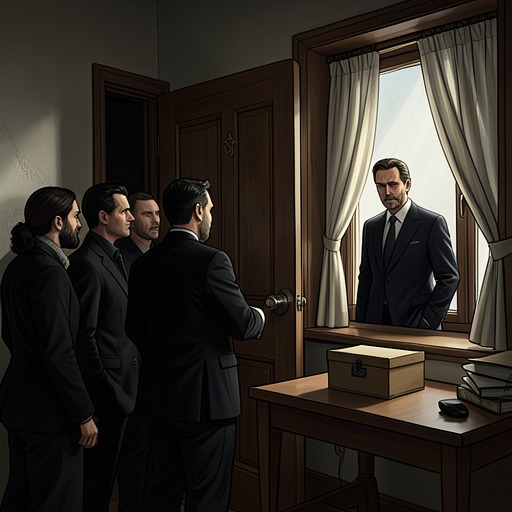
Lot Six Experiment Accident
FirestarterThe Lot Six Experiment Accident was a college drug trial that became a lasting institutional disaster: a compound intended to produce psychic effects yielded striking abilities in some participants, but amid hallucination and loss of control, it also left students dead, permanently impaired, or psychologically devastated. Its consequences extended beyond the experiment room, shaping the Shop’s secrecy, the surviving subjects’ lives, and the later pursuit of people such as Andy McGee.
Design and Setting
The experiment was led by Dr. Wanless, who explained that twelve young volunteers would receive injections in a double-blind trial. Six injections contained water; the other six contained water mixed with a small amount of Lot Six, described to the students as a hypnotic and mild hallucinogenic compound. Neither the participants nor the researchers would know who had received which substance until later, and the volunteers would be supervised for forty-eight hours after the injections.
The trial took place in Room 70 of Jason Gearneigh Hall at Harrison State College. A dozen cots had been brought in, and the volunteers were paid for taking part. Dr. Wanless moved among them while graduate assistants administered the injections. Andy McGee was one of the students; Victoria Tomlinson was on a neighboring cot. The formal assurances of scientific supervision did not prepare the participants for what followed.
The Trial’s Breakdown
Under the drug’s influence, Andy experienced the room as strange and temporally disordered. His recollections included objects seeming to move through the air without an apparent cause, and a participant suffering a medical emergency while staff attempted to revive him. The scene’s order remained uncertain to Andy even years later: he could not reliably determine which episodes had occurred first, or how much of what he remembered had been real and how much had been hallucination.
The trial was not simply a case of unusual perceptions. Participants displayed extraordinary abilities, including telekinesis, thought transference, and mental domination. Yet those effects appeared at the same time as severe intoxication, hallucinations, and behavior that the researchers could not control. The experiment thus joined apparent success to catastrophic failure: the powers the Shop wanted to study emerged under conditions that made safe observation or management impossible.
Casualties and Long-Term Harm
Two of the twelve participants died: one during the experiment after cardiac arrest, and another six days later in her dormitory, apparently from a brain embolism. Two others were left with severe, lasting disabilities. One had blinded himself during the drug-induced crisis; another later developed paralysis from the neck down. Dr. Wanless attributed the paralysis to psychological causes, but the people overseeing the project did not know whether that explanation was correct. Both disabled survivors were confined at the Maui compound.
The consequences continued after the immediate trial. A later account of the participants’ histories records multiple suicides among the surviving group. The Shop attributed some of these deaths to a lingering effect of Lot Six, including the suicide of a participant who left a note saying he could no longer endure the images in his mind. That diagnosis was the Shop’s conclusion, not a certainty established by the surviving evidence; the record also emphasizes how little could be known about what the subjects experienced. The original experiment therefore left a long aftermath that could not be contained within its forty-eight-hour observation period.
Cover-Up and Significance
Dr. Wanless had warned in a September 1968 memorandum that testing Lot Six on college students carried serious risks if the compound proved as powerful as suspected. He nevertheless recommended controlled student groups rather than animal testing or experiments on prisoners. The trial’s outcome gave that earlier warning a grim force: the researchers had chosen a human cohort despite recognizing the possibility of failure, and the people who suffered were left to bear consequences the project could neither predict nor repair.
The Shop responded with a comprehensive and expensive cover-up. Its officials faced deaths, the disappearance of participants, and continuing signs of distress among people connected to the experiment. Concealment involved nearly seven hundred thousand dollars in hush money and, in at least one case, the killing of a determined relative of a victim. The institution eventually imposed an indefinite moratorium on further testing. Though some results were considered promising, officials judged Lot Six a blind alley: the drug’s effects were too powerful, its subjects too impaired, and the risks of exposure too great.
The accident also became the starting point for the Shop’s later interest in the surviving subjects and their families. Andy’s participation linked his abilities to the trial, while the possible consequences of his marriage prompted concern about any child they might have. The experiment’s defining contradiction persisted: it demonstrated extraordinary potential, but only through an uncontrolled ordeal whose human cost the Shop then concealed. Its legacy is not a clean scientific discovery but a chain of injury, institutional secrecy, and continued surveillance.