Charlie Refuses Further Tests and Demands to See Her Father
FirestarterCharlie McGee’s demand to see her father turns the aftermath of the fourth test into a confrontation over who controls the testing room. Patrick Hockstetter tries to bargain for more demonstrations and distract her with an amusement park, but she refuses both offers: she wants Andy McGee, and she makes clear that the Shop cannot assume her cooperation will continue. The scene’s decisive reversal is that the tests meant to measure and manage Charlie have helped make her more capable of resisting the people conducting them.
The Demand and Its Conditions
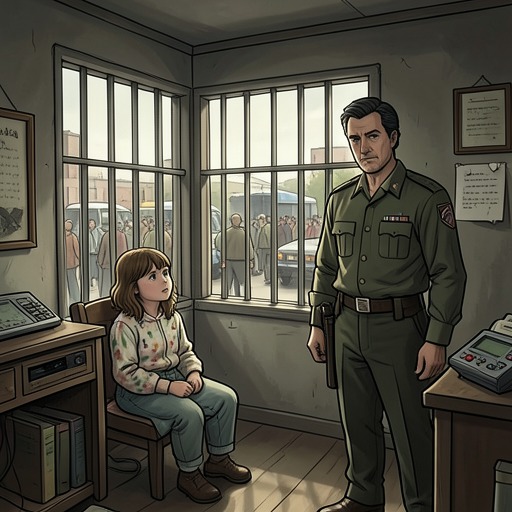
When Patrick Hockstetter enters, Charlie is pale and wan, wearing an old nightgown instead of her jumper, her hair loose over her shoulders. Her first request is direct: “I want to see my father.” Hockstetter starts to answer, then loses whatever he had meant to say. Brad Hyuck’s memo and its supporting telemetry readouts have troubled him; the final paragraphs Brad entrusted to print seem to carry implications he cannot set aside. The scene thus begins with Charlie’s simple request against the background of information that has already unsettled the scientist responsible for dealing with her.
Hockstetter answers cautiously that a visit might be arranged if she shows them a little more. Charlie rejects the implied bargain. She says she has shown enough, repeats that she wants her daddy, and becomes tearful. Her insistence is not a refusal of every further test: later she says that if she can see her father, the Shop can test her more if it wants. What she refuses is the arrangement in which the Shop demands further demonstrations while withholding the person she most wants to see. She makes access to Andy the condition for her continued cooperation.
Hockstetter attempts to redirect her by mentioning the orderly’s report that she declined a morning ride on her horse after the test. Charlie corrects the premise behind the offer: “It’s not my horse,” she says, adding that nothing there is hers except her daddy. The remark exposes the emptiness of the institution’s gestures of comfort. A horse may have been made available to her, but it does not belong to her; the things and activities offered inside the facility cannot substitute for the relationship she is asking for. Her voice rises into an angry, tearful shout as she repeats that she wants to see him.
Hockstetter’s Fear
Hockstetter tries to calm Charlie, but he is frightened by the possibility that her anger is already affecting the room. He wonders whether it is getting hotter and tells her not to become excited. His fear is not simply that she might hurt herself. Since the fourth test, he has come to believe that she may be able to destroy the entire Shop installation, perhaps even eastern Virginia, if she chooses. The prospect of danger has expanded from Charlie’s own safety to the survival of the institution holding her.
The facility’s preparations make that fear concrete. When Cap Hollister authorized the conversion of the chapel into a testing room, he also approved more Kelvinator air conditioners around Charlie’s apartment: twenty rather than eight. Only six have been installed. After the fourth test, Hockstetter doubts that even two hundred would impede her power. The equipment intended to contain or manage the situation has become, in his view, plainly inadequate. He also sees no effective check on Charlie other than John Rainbird, whom he regards as unstable. Hockstetter’s inward frustration that this should have been Rainbird’s job registers his belief that the person best placed to handle her has left him to face the crisis.
The Failed Bargain
Hockstetter smiles and offers to rent Six Flags over Georgia for Charlie for a day, describing rides and attractions and comparing it with Disney World. The offer is expansive, but it misses the point: Charlie does not want an amusement park. She answers that she is going to see her father, and says she hopes Hockstetter understands because she is going to do it. The insistence changes the exchange from a request that might be granted at the institution’s discretion into a warning that its refusal may have consequences.
When Hockstetter tries to tell her that being angry will accomplish nothing, Charlie answers, “Yes,” and says she is really mad at him. She then gives him a specific message to carry: she wants to see Andy now; afterward, the Shop can test her again if it wants, but if she does not see him, she will make something happen. She does not describe what that will be. The threat’s force lies in that omission, especially because Hockstetter already fears that her power can reach far beyond the test room. As he leaves, the heat persists, and Charlie tells him, “You’re sweating.” His fear, visible to her, undermines the reassuring authority he has been trying to perform.
What the Tests Have Changed
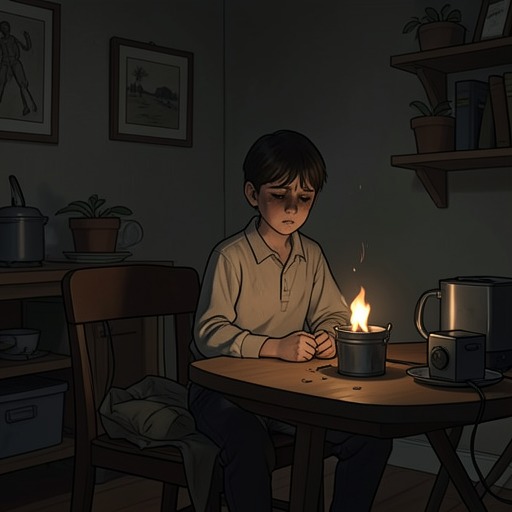
After Hockstetter leaves, Charlie collapses onto the couch and covers her face, sobbing. Her reaction gathers together guilt, horror, indignation, angry pleasure, and, above all, fear. The threats she has just made do not amount to effortless confidence: she is frightened by what the tests have changed in her and fears that the change may be permanent. She wants her father not only because she misses him but because she needs him to tell her what to do next.
The narration explains why her demand now carries such weight. The tests have weakened her complex about starting fires, like an earthen dam leaking in many places, while giving her the practice to refine a crude, forceful power into something precise and deadly. They have also taught her who is in charge. The answer is Charlie herself. That conclusion does not erase her distress or make the Shop safe from her; it marks the contradiction at the center of the scene. The institution’s tests have made her more capable of acting, while her dependence on Andy remains acute. She has asserted control over the terms of cooperation, but the passage ends not with a reunion or a settled arrangement, but with her crying and needing her father.