Angola
FirewallAngola, and especially its capital, Luanda, is the setting where Carter’s political disillusionment hardens into a conspiracy against the global financial system. The country is more than a distant backdrop: its unreliable electricity and stark inequality shape his view of the world, while Luanda becomes the base from which he watches a plan assembled with Tynnes Falk begin to unravel.
Luanda as a lived setting
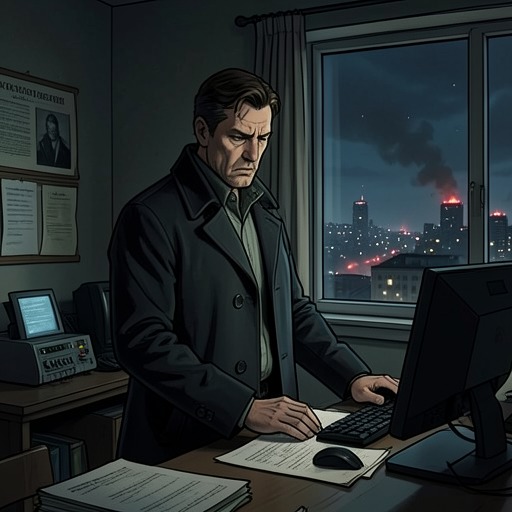
Luanda is introduced through an ordinary interruption that exposes how precarious daily infrastructure has become. Carter wakes at dawn when the air conditioning stops during a power cut. He initially suspects sabotage, since the city’s electricity is often cut by bandits, but the supply soon returns. The lines are old, remnants of Portuguese colonial rule, and outages occur so frequently that a failure every other night is familiar. For Carter, the episode is both a practical discomfort and a reminder that the systems sustaining modern life can falter without warning.
His home is guarded by fences, armed protection, and a gun beneath his pillow. Carter understands the threat of burglary in a poor country and recognizes that his wealth sets him apart from people who might rob him. Yet the security surrounding his own life does not soften his judgment of the city. On walks along the ocean, with his chauffeur and bodyguard following at a distance, he looks back toward Luanda’s decay and sees garbage, poverty, and misery. He takes that contrast as confirmation that the world he intends to disrupt has already failed its most vulnerable people.
The city also provides a private, sheltered routine for a man haunted by the past. Carter prefers the evening, keeps the strong sun from his sensitive eyes, and listens to Beethoven’s string quartets in his living room. His guarded house and harbour view place him physically apart from the suffering he observes; that separation matters, because his response to inequality is not renewed service but a destructive plan carried out from a position of privilege.
Carter’s posting and disillusionment
Carter’s connection to Angola began after his earlier work at the World Bank in Washington. He had believed that the institution could provide resources to poor countries and help shift economic justice in their favour. Although some of his friends doubted that the bank could address global inequality, he thought change had to come from within existing structures and that influence required proximity to power.
After learning Portuguese, Carter secured a senior opportunity in Angola and rose quickly within the bank. At first, he listened and observed, impressed by the dignity and joy he encountered amid hardship. Nearly two years later, he concluded that the bank’s policies were not enabling genuine independence or rebuilding a war-damaged country; in his view, they protected the rich instead. The deference shown to his rank and the corruption and greed he saw behind official rhetoric sharpened that conviction.
Carter tried to change policy through the channels available to him. He repeatedly travelled to head office, wrote memos, and attempted to persuade his superiors, but received only well-meaning indifference. A conversation with his longtime mentor, the finance analyst Whitfield, gave the failure a blunt form: the question was not whether Carter was right, but what the bank’s policy was. Returning to Luanda, Carter began to choose a different means of acting on his beliefs. Angola was thus the place where his reformist ambition turned into opposition to the institution itself.
Falk, the plan, and Jacob’s Marsh
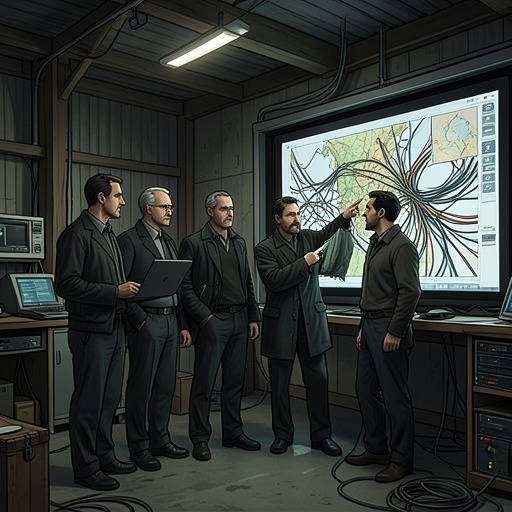
In the middle of the 1970s, Carter met Tynnes Falk at Metropol, a restaurant in Luanda’s harbour. Falk, a technical consultant, had come for a limited project; Carter offered him further work partly to keep their conversations going. They found that their political and moral views aligned, and their exchanges over many evenings became the foundation of a lasting partnership. Carter brought knowledge of finance and institutional networks; Falk explained the possibilities of electronic communication and translated broad ideas into technical plans. They remained in regular contact for about twenty years.
From their discussions emerged a scheme built around the vulnerability of interconnected systems. Carter came to believe that control of electronic communication meant control of everything, and Falk described how computer attacks might disable markets, telecommunications, or other essential networks. The two agreed to wait rather than act hastily. The project acquired the name Jacob’s Marsh from Falk’s childhood memory of a marsh beside a strip of forest, a place he associated with the chaos of life and the possibility of drowning. For Carter, the name also became a private tribute to his friend and an emblem for an operation intended to plunge others into disorder.
Falk’s death in Sweden overturns their assumptions at a critical moment. Carter had allowed for events outside their control, but not for the death of one of the planners. From Luanda, he grieves for his friend while resolving to continue alone. The loss makes the city’s distance from the investigation consequential: Carter remains far from the Swedish police, yet his plan is connected to Falk’s computer in Ystad.
A remote command post
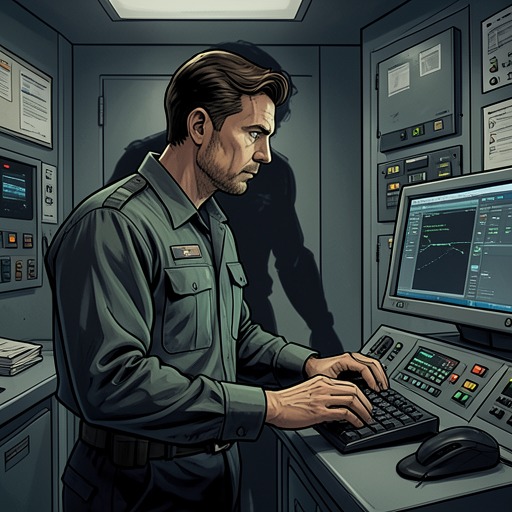
By October 12, Carter is checking the operation’s progress from his study in Luanda. An invisible clock created by Falk is counting down to D-Day, eight days away. During his routine computer checks, an icon flashes a pattern that Carter recognizes from Falk’s manual: someone has penetrated the first layer of security on the computer in Ystad. He cannot identify the intruder, but understands that the breach could expose the plan and must be dealt with quickly.
The episode turns Luanda into the operation’s remote command post. Carter is surrounded by the ordinary rhythms of his household and city, yet his attention is fixed on a network reaching across continents. The power failures of his daily life and the fragile electronic systems at the heart of the conspiracy echo one another: both reveal dependence on infrastructure, but only the latter is deliberately being turned into a weapon. Angola gives Carter his history, his justification, and his place of concealment, while the signal from Sweden shows that distance cannot keep the plan beyond the reach of those investigating it.