Ystad
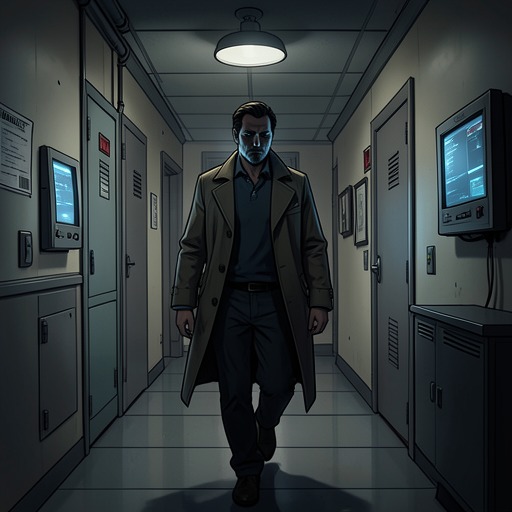
FirewallYstad is both the everyday setting of Kurt Wallander’s life and the local ground from which a far-reaching conspiracy comes into view. A death beside a cash machine, an attack on a taxi driver, a body at the power substation outside town, and a corpse arriving by ferry first seem like separate problems. As Wallander connects them, Ystad’s ordinary streets and working institutions prove to be linked to dangers reaching across southern Sweden and into the global financial system.
Town, home, and police work
The town is established through Wallander’s daily movements as much as through crime scenes. On the morning of October 6, 1997, he leaves his home on Mariagatan to attend a funeral in Malmö. With time to spare, he takes the coast road by way of Svarte and Trelleborg rather than driving directly. His return to Ystad brings him back to the police station and to a demanding investigation. The route makes the town a point of departure and return, set within a wider coastal landscape and connected to movement beyond the immediate area.
Ystad is also the working environment of a small police team handling several urgent matters at once. Wallander’s colleagues bring him the report of an assault on taxi driver Johan Lundberg, while Martinsson also reports a man found dead beside a cash machine near a department store. Wallander knows the case facts before opening Martinsson’s file, and the investigation unfolds through discussion and reconstruction at the station. The town is not merely a backdrop to individual detective work: its local police force must interpret a cluster of events whose connections are initially obscure.
That local workload includes concerns beyond the principal crimes. One motorcycle gang has bought a farm outside Ystad, prompting Chief Lisa Holgersson to insist that Wallander attend a national conference on policing violence associated with motorcycle gangs. The detail places the investigation within a community where police must anticipate threats as well as respond to incidents already underway. Ystad’s cases compete for the same officers, time, and attention.
The cash machine and the first death
The cash machine becomes one of the town’s most consequential locations. Tynnes Falk uses it shortly after midnight on October 6 to check his account balance. He takes no money; his balance is 9,765 kronor, and he keeps the printed slip in his hand. Moments later he collapses and dies. When the police find him, his wallet and money remain with him, and the slip offers a precise record of his last ordinary transaction rather than an obvious explanation for his death.
Wallander later visits the site himself. The pavement is rough and uneven, and he sees no residential buildings nearby. He imagines how, in the middle of the night, the square could be deserted: even beneath powerful street lamps, someone could cry out and fall without being heard or seen. The setting gives the death a specific, unsettling circumstance. A public place designed for routine access to money can also leave a person isolated, exposed, and apparently unwitnessed.
At first, Falk’s death is treated as a separate case. The police conduct a preliminary investigation, and an autopsy leads them to eliminate suspicion of a crime and consider the matter closed. The later removal of his body from the morgue, the theft of material from his flat, and the relay left in place of his corpse transform the meaning of the original scene. In Wallander’s reconstruction, the cash machine ceases to be only where Falk died: it becomes a point in a chain of concealment and a clue to why the death matters.
Connected scenes across the town and its outskirts
The attack on Johan Lundberg begins in a different local setting. Two girls order a taxi from a restaurant, ask to be driven to Rydsgård, and attack the driver as they reach the outskirts of Ystad. One strikes him with a hammer; the other stabs him with a knife. Their stated explanation is that they needed money, but Wallander doubts that robbery alone accounts for the violence. The town’s roads and the journey outward become part of a case whose apparent simplicity he resists accepting.
The investigation’s other major location lies outside Ystad: the power substation where Sonja Hökberg’s charred body is found. Wallander’s timeline brings together her escape from police custody, her death, and the loss of power across a large area of southern Sweden. A relay recovered from the substation is later placed in the morgue in the space where Falk’s body had been. Once technicians identify the relay as belonging to the substation, the physical link between Hökberg and Falk is confirmed. A local site is thus tied to consequences on a regional scale.
Wallander’s notes give the separate strands a provisional structure. The taxi attack, Hökberg’s death, the blackout, Falk’s death, the stolen body, and the break-in at Falk’s flat are initially distinct entries in a confusing sequence. He considers whether Hökberg was killed to prevent her from speaking and whether Falk’s body was removed to conceal something. He also recognizes that placing the substation at the center makes the blackout look like sabotage. Ystad and its outskirts provide the concrete places through which the case’s larger pattern can be traced, but the connections remain questions until further evidence emerges.
The ferry terminal and the wider world
Ystad’s connection to travel becomes decisive when a ferry approaching the town reports trouble with an axle for its propellers and discovers a dead body in the engine room. Wallander is told that a suspected murderer is returning from Poland, but is returning dead. He summons Martinsson, Hansson, and Nyberg and meets them at the ferry terminal as the ship comes in.
The discovery is made in the ferry’s lower decks, beneath an oily propeller shaft. The body has been so badly mutilated that identification is difficult; a photograph of Jonas Landahl and a few remaining tufts of fair hair help Wallander assess who it may be. The arrival turns the terminal into the meeting point of a local investigation and an international route. The ferry has carried the consequences of events elsewhere back to Ystad, where the police must establish the dead man’s identity and place his death within the case.
This transit connection echoes the investigation’s financial and technological reach. Falk’s computer work, the forged card used by an Asian customer at the restaurant, and the eventual threat to the global financial system exceed the scale of a town investigation. Yet the plan is understood through a mundane local object: Modin later recognizes the cash machine as the intended starting point for a virus attack. The local machine and the ferry terminal occupy opposite ends of the plot’s geography—one rooted in everyday transactions, the other opening onto international movement—while both connect Ystad to events far beyond its streets.
Narrative significance
The town’s importance lies in how familiar functions acquire a second, more dangerous meaning. A cash machine dispenses money and prints a balance; it is also where Falk dies and where the planned attack on financial systems is to begin. A power substation distributes electricity; it is also the site of Hökberg’s death and the focus of sabotage that darkens a wide region. A ferry brings passengers and freight into port; it also delivers the body that redirects the investigation.
The novel’s movement between these places mirrors Wallander’s effort to move from isolated facts to a coherent explanation. He first sees the deaths and attacks as sharply separated events. His lists and timelines begin to reveal how the sites might connect, though he repeatedly cautions himself against deciding too soon. Ystad therefore functions not simply as a setting for police work but as the scale at which an invisible system becomes legible: the threat is global, but its clues appear in a balance slip, a relay, a body, and the routines of a town.