Missunnavägen cash machine site
FirewallThe Missunnavägen cash machine site is the place where the apparently closed case of Tynnes Falk’s death becomes an unsettling crime scene again. Falk was first found dead beside the machine; after his body disappeared from the morgue, it was returned to the same spot with two fingers missing. The location’s ordinary function—as a place where people stop to obtain cash—makes it both a practical landmark in the investigation and a powerful point of connection to the novel’s wider concern with hidden systems and routine transactions.
Setting and First Discovery
The site is a car park on Missunnavägen, beside a cash machine in Ystad. Its precise character is initially conveyed through a confused emergency call: Nils Jönsson has tripped over a naked dead man while stopping during a drive, and struggles to distinguish the car park from a street. What he can establish is the essential fact: the body is on the pavement by a cash machine. Wallander recognizes the location from the earlier investigation and suspects that the dead man is Tynnes Falk, whose body had vanished after being taken from the morgue.
When Wallander arrives, Falk is lying face down, his hands beneath his chest and his head turned to the left. The position appears at first to make the site a scene of return, as if the body has simply been put back where it was found. But Martinsson remembers that the original body lay farther from the machine and had one leg bent. The discrepancy makes the placement an intentional reconstruction rather than a faithful restoration. The site holds a repetition with a difference: Falk is returned to the setting of his death, but not in the same position.
The Returned Body and Its Evidence
Wallander has the area sealed off and asks for Jönsson’s statement, though he expects little useful information from a witness who found the body only after its return. The investigators estimate that it was left there within roughly an hour of its discovery. A security guard’s account places a car passing the site around 11 p.m.; Jönsson reports finding Falk at about 11:45, and the police are working at the scene at 12:30 a.m. The timing suggests that whoever brought the body knew how the guards’ rounds worked. With few nearby homes, a conventional search for witnesses seems unlikely to succeed, so Wallander proposes asking dog walkers and joggers whether they noticed a vehicle or other unusual activity.
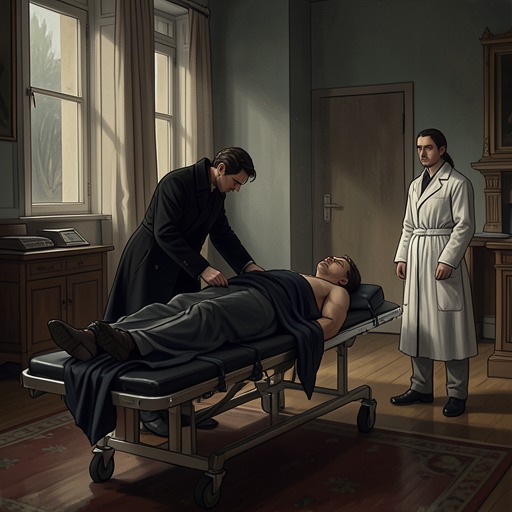
The most disturbing alteration becomes clear when Wallander and Martinsson turn the body over after Nyberg has photographed it. The index finger of Falk’s right hand and the ring finger of his left are missing. Nyberg observes that both appear to have been cleanly cut; Susann Bexell later judges that pliers were probably used. The fingers were not removed at the cash machine site. A police dog searches the area but finds nothing, and its handler considers it unlikely that the missing fingers are lying nearby. The body’s return has therefore brought fresh evidence, but has not explained either the mutilation or where it occurred.
Investigation at the Location
The cash machine gives the scene an unusual practical timetable. Wallander and Martinsson use the guard’s patrol schedule and Jönsson’s account to narrow the period in which the body could have been deposited. The investigators also consider the habits of people who pass through the car park at night: dog walkers may be especially useful witnesses because familiar routines could make an unfamiliar car or disturbance stand out. Wallander orders a further search the next day, reasoning from an earlier clue—the placement of Sonja Hökberg’s handbag at the power substation—that evidence may have been left beyond the immediate area.
The site’s importance is thus not limited to the discovery of a corpse. Falk’s original death beside the cash machine had been provisionally treated as non-criminal after the initial investigation and autopsy. His later removal from the morgue, followed by the substitution of an electrical relay, had already overturned that apparent conclusion. Returning him to the place where he died compounds the violation and makes the location part of a deliberate sequence of messages. Wallander cannot yet determine what the body’s placement is meant to communicate, but the effort involved in stealing and returning it makes clear that the site has been chosen, not merely reused by chance.
Place, Routine, and the Wider Plot
The cash machine is an everyday object, but the novel repeatedly makes such ordinary financial routines feel consequential. Falk had been found with a receipt after checking his account balance, and the investigators had wondered whether the figure on the printout mattered. Later, while the police are trying to understand the threat surrounding Robert Modin, Wallander recognizes that an ordinary withdrawal could be a workable trigger for a larger operation. That later realization occurs at another cash machine, and the evidence does not establish that it is the Missunnavägen machine. The connection is thematic and investigative rather than proof that both events use the same device.
That distinction sharpens the role of the Missunnavägen site. Here, the cashpoint first marks the unexplained death of a computer consultant; then it becomes the destination for a stolen corpse whose altered condition raises new questions. Elsewhere, the routine act of inserting a card and receiving cash helps Wallander imagine how a larger event might be activated without attracting attention. Across these scenes, the machine remains recognizably mundane, while the consequences attached to its use become increasingly ominous. Missunnavägen is therefore both a concrete crime scene and an early, local expression of the novel’s broader anxiety about the vulnerabilities concealed inside everyday infrastructure.