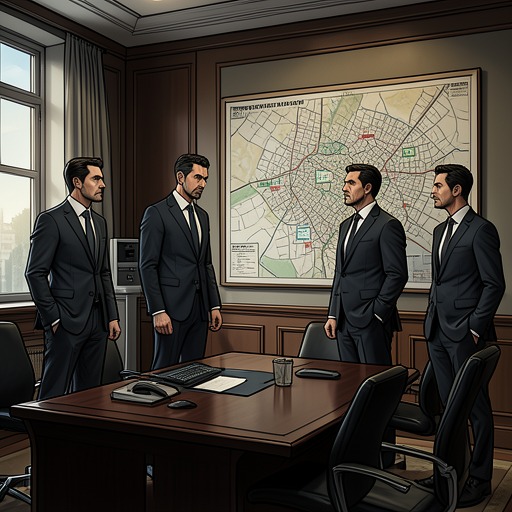
Landahl’s house on Snappehanegatan
FirewallLandahl’s house on Snappehanegatan is both a seemingly empty family home and the place where the investigation finds its first concrete connection between Jonas Landahl and Sonja Hökberg. Its orderliness initially conceals more than it explains: a saved message in Hökberg’s voice, a car that may have carried her, and a diskette hidden in Landahl’s room transform the house into a map of absences and concealed affiliations.
Setting and the Empty House
Ann-Britt Höglund locates the house after learning from Kalle Ryss that Hökberg had been involved with Jonas Landahl. Ryss knows little about Landahl beyond his name and that he lives alone in a large house on Snappehanegatan, near the corner of Friskyttegatan. Höglund drives there immediately. She sees a beautiful modern house on the left side of the street, enters through its gate, rings repeatedly, and gets no answer. After trying the back door and looking through the windows, she encounters Yngve, a neighbour across the street, standing outside the gate in a dressing gown and boots.
Yngve’s account makes the house’s apparent emptiness part of a longer pattern. The Landahls, he says, arrived about ten years earlier with their possessions and a boy, then shut themselves away. The parents disappeared on long trips and returned unpredictably; neither seemed to have a regular job, although there was always money. The boy, who was no more than twelve or thirteen when the family arrived, was often left alone for long stretches. By the time Höglund visits, he is an adult living there by himself. Yngve last saw the parents in September and says the young man left a few days earlier in a taxi. His observations are useful but partial: he has watched the house closely, yet saw no one on October 9 and cannot identify the taxi company.
Departure and Police Search
The taxi driver, Östensson, supplies a more precise account. He picked up a friendly young man shortly before 2 p.m. and drove him from Snappehanegatan to the Ystad ferry terminal. The passenger carried only a small wheeled case, sat looking out of the window, and left a tip. He appeared neither anxious nor talkative. Höglund understands that the destination was Poland, but the details do not establish why Jonas Landahl left or what he intended to do there.
Höglund obtains a warrant to search the house, but a call from her day-care centre interrupts her plans: her youngest child is vomiting, and she takes the child home. When she returns to the station, Kurt Wallander proposes opening the locks himself rather than bringing a locksmith. Höglund warns him that Yngve will be watching from his kitchen window. Wallander asks her to keep the neighbour occupied and turn his attentiveness into an informal source of observations, without telling him that the police are looking for Landahl in connection with Hökberg. The house is thus approached under the gaze of another watcher, whose curiosity the investigators try to use without revealing their purpose.
Inside, the rooms are clean and orderly, with nothing suggesting a hurried departure. Wallander finds the arrangement almost impersonal: the furniture seems to have been bought together, as if its purpose were simply to make the rooms look occupied. A photograph of a young couple with a newborn sits on the mantelpiece, but otherwise there are few personal effects. The contrast between this carefully maintained interior and the family’s history of coming and going sharpens the question of what the home actually records—and what it leaves out.
Hökberg’s Message and the Car
An answering machine provides the search’s most direct evidence. Among a computer company’s notice that a new modem has arrived and a blank wrong-number message is a recording Wallander recognizes as Hökberg’s voice: “I’ll call you again. It’s important. I’ll call you.” He saves and replays it. Hökberg did not even give her name, but the message establishes that she had been in contact with the young man who lived in the house. Wallander suspects it may be the call made after her escape, while acknowledging that this is not certain. The recording supplies a connection; its date and precise circumstances remain unresolved.
In the garage, Wallander finds a dark blue VW Golf and asks Nyberg to examine it carefully for fingerprints. He cannot rule out that it was the car that delivered Hökberg to her death. The suspicion is explicitly provisional, not a conclusion drawn from the vehicle alone. The search also reveals four bedrooms, of which two appear to have been lived in: one for the parents and one for the boy. In the parents’ room, neat rows of clothes and their apparent quality suggest money. At the back of the wardrobe, Wallander finds a dog collar and a short leather whip. Höglund comments on their possible sexual use; the objects remain an unsettling detail, not an established explanation of the family’s conduct.
The Boy’s Room and the Hidden Diskette
The boy’s room is unexpectedly bare: there is nothing on its walls or bed, only a computer on a large desk. Wallander decides not to start it yet and later returns to the room alone. From the bed he notices that a bookcase beside the wardrobe seems to lean toward the wall. The angle disappears when he sits up, but he discovers small washers beneath the bookcase’s sides, leaving a narrow gap underneath. Using a pencil, he draws out a diskette concealed there. Its hiding place is a small but deliberate alteration to an otherwise spare room, visible from the bed yet easy to miss during an ordinary search.
Wallander calls Martinsson, who arrives within fifteen minutes and inserts the diskette into the computer. Labelled “Jacob’s Marsh,” it contains one file, last opened on September 29. The file’s entire displayed instruction is “Release the minks.” Wallander connects the message to Tynnes Falk, who had been involved in an animal-rights operation, and wonders whether Landahl was one of the people who escaped detection. The diskette does not explain the full purpose of the file, but it changes the house from a place where investigators have found evidence of contact into a point of connection with Falk’s past. That discovery makes finding Landahl urgent: the apparently deserted home has preserved traces of a relationship and a concealed activity that its occupants’ sparse surroundings do not openly disclose.