Luanda
FirewallLuanda is where Carter and Tynnes Falk meet, become confidants and begin shaping the plot that threatens the global financial system. The city is more than the setting for their shared past: its harbour restaurants and consulting work bring them together, while its social misery becomes part of Carter’s justification for destruction. Years later, Luanda also proves crucial to the investigation, linking a hidden computer server to the history of the conspiracy.
The city and its contrasting landscapes
The narrative presents Luanda through distinct settings rather than a broad portrait of its geography. Carter’s connection to the city runs from the restaurants of its harbour to a house with a garden and a view over the water. The harbour is both an everyday backdrop and the place where his alliance with Falk begins. The city also appears in Carter’s later walks along the ocean, when he looks back at its deteriorating condition.
That view exposes the gulf between Carter’s earlier faith in a better future and his later contempt. He recalls having believed that Angola’s people would create a new world, but comes to see poverty, heaps of garbage and social disintegration as evidence that the existing order has failed. He imagines that what rises from the ashes of the fire he intends to start will be better. The city’s hardship thus becomes part of his rationale for a plan that would endanger people far beyond Luanda.
The meeting at Metropol
In March, sometime in the middle of the 1970s, Carter goes to Metropol, a harbour restaurant where he expects to avoid colleagues from the bank and Angola’s elite. A Swedish consultant at the next table speaks little Portuguese, and the waiter cannot speak English; Carter steps in to translate. The man is Falk, in Luanda on a consulting project for the neglected, underdeveloped state-owned telecommunications sector.
Their conversation continues after the translation is no longer needed. Carter finds Falk unusually intelligent: an able engineer and technician who has also studied Angola’s colonial history and political circumstances. Falk’s reserve and Carter’s habitual suspicion give way to an uncommon ease between them. They are the last to leave the restaurant, and, before parting, arrange to meet again the following evening. In the retrospective account of the investigation, the first meeting is described as probably accidental; what was said then cannot be reconstructed. Its consequences, however, become clear: the encounter gives two men who feel isolated a person in whom each can confide.
A home and a partnership
Falk had expected to stay for the three months his consulting project was to take. Carter offered him another project when it ended, largely as a way to keep him in Luanda and continue their conversations. On his return, Falk told Carter that he was unmarried. Carter, also unmarried, had children he rarely saw and relationships he kept apart from his work at the bank. He arranged for the lonely Falk to meet Rosa, the daughter of a Portuguese businessman and his Angolan housekeeper.
Carter helped Falk settle in: he found him a pleasant house with a garden and a harbour view, and wrote a contract that paid him lavishly for comparatively modest work. The material comforts did not themselves create the conspiracy, but they sustained the closeness in which it developed. Over long evenings, the two found that their political and moral views seemed to coincide. Carter brought knowledge of financial institutions and their vulnerabilities; Falk brought technical understanding of electronic communications and the means to turn ideas into working systems.
Their discussions became a plan. Falk described a future in which conflict could be waged through computer viruses, electronic signals and attacks on stock markets and telecommunications networks, rather than through conventional weapons alone. Carter was fascinated by the possibility that control of electronic communication could mean control of everything. Their roles complemented one another: Carter understood how the financial world functioned and how delicate its balance was, while Falk could make the technological scheme practical. They refined their plans over many evenings and remained in regular contact for about twenty years.
The name and the countdown
Carter gives the operation the name Jacob’s Marsh, a name rooted in a memory Falk shared during a rare occasion when he drank heavily. Falk described a marsh near the estate where he had grown up, beside a strip of forest and wild-flower meadows. He had played there as a child; he also told Carter that the place took its name from a man who had drowned himself over unrequited love. For Falk, the marsh later came to represent life’s chaos and the possibility of drowning oneself—or ensuring that everyone else did.
Carter treats the name as a private tribute to Falk, not a label the operation requires. The memory connects the conspiracy’s vast, impersonal ambition to the intimate history of the two men who conceived it. But Falk’s death, reported to Carter from Sweden, overturns their careful expectations: they had prepared for interference with their plans, not for one of the partners to die. Carter is left alone as the intended moment approaches.
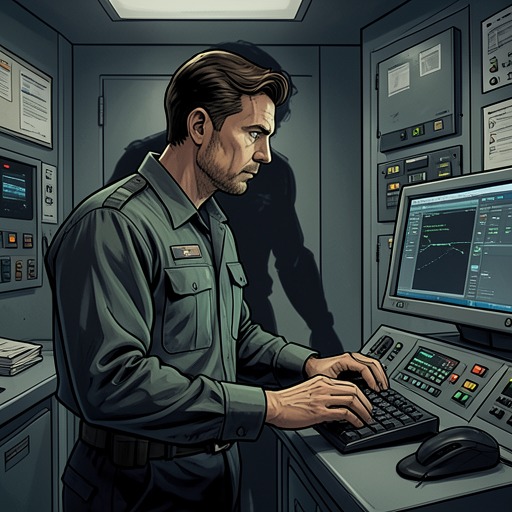
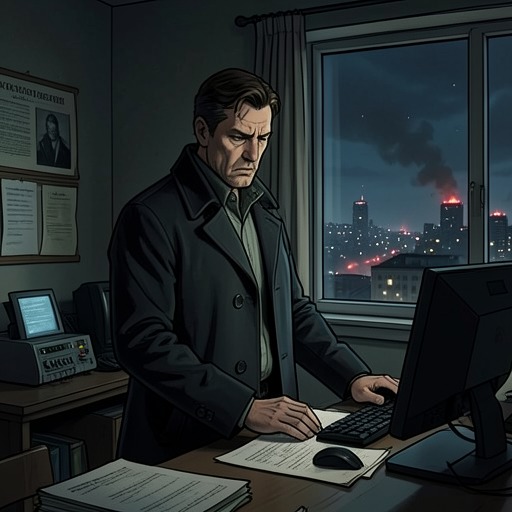
On October 12, in Luanda, Carter follows his regular routine at a computer in his study. The operation’s countdown is running toward D-Day, then eight days away. A flashing signal tells him that someone has breached the first layer of security on Falk’s computer in Ystad. The alert makes Luanda part of the immediate present of the investigation: from Carter’s study, the threat is detected, assessed and treated as a problem to be contained.
Luanda as an investigative link
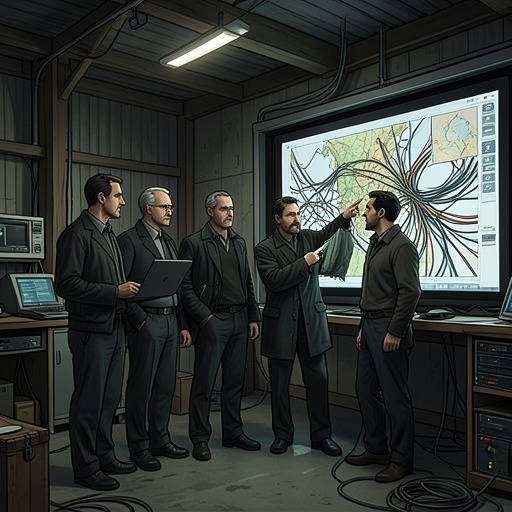
The connection between Luanda and the Swedish investigation emerges in stages. When Wallander and Martinsson examine Falk’s computer in his secret room, they find advanced programs and barriers, and learn that someone had accessed the material recently. Later, a message sent to Robert Modin appears to come through a server called Vesuvius. Wallander suspects that Falk met someone in Luanda years earlier and that the encounter changed his life; checking the server’s location turns that intuition into a concrete lead.
Martinsson learns that Vesuvius is registered in Luanda and that Brazilian entrepreneurs were responsible for its installation and maintenance. Elvira Lindfeldt also calls Carter in Luanda after identifying Modin as the person disrupting the system. These links show how the city operates in the novel’s plot as a remote but active node in a network of people, computers and financial institutions. At the final review of the case, the investigators identify the dead Carter as coming from Luanda and reconstruct the meeting there as the beginning of his partnership with Falk. The city’s significance therefore rests on a double movement: it is where the conspiracy takes shape, and where the investigation finds a route back to its origins.