The Twins’ Shared Identity and Taking Each Other’s Place
HamnetThe Twins’ Shared Identity and Taking Each Other’s Place is both a childhood game and a desperate act of devotion: Hamnet and Judith’s likeness lets them pass for one another, and, as Judith lies gravely ill, Hamnet tries to turn that familiar trick against death itself. Their resemblance makes identity seem briefly transferable, but the scene gives the exchange its deepest force through Hamnet’s belief that he and Judith are inseparable—and his decision that, if only one can live, it must be her.
A Shared Sense of Self
Hamnet experiences Judith not simply as a beloved sister but as the other side of himself. The two fit together like halves of a nut; without her, he imagines himself incomplete and lost, marked by an open wound where she has been separated from him. His comparisons make the bond bodily and elemental: living without Judith seems as impossible as asking a heart to live without lungs or expecting barley to grow without rain. The language does not describe ordinary affection alone. It gives Hamnet’s sense of his own identity a twin-shaped boundary: Judith’s survival is inseparable from his idea of wholeness.
That intimacy surfaces in small physical signs as well as grand comparisons. Judith struggles to open her eyes and move them toward Hamnet; she manages a smile and presses his fingers. When she tells him not to cry, tears appear on her cheeks. Hamnet knows they have fallen from his eyes, yet they might as well be hers. The image makes their closeness visible without erasing their separate bodies: one twin cries, the other bears the tears, and the distinction between what belongs to each becomes momentarily uncertain.
The Childhood Practice of Exchange
The possibility of exchanging places is rooted in a trick Hamnet and Judith have performed since they were small. Their faces are so alike that people remark on it every day, and changing clothes can make the resemblance convincing. Hamnet can put on Judith’s shawl, sit with his head lowered, and hide his smile; Judith can wear his hat. Their parents have mistaken one child for the other under these conditions. Their mother has addressed Judith as Hamnet and asked her to fetch wood, while their father, seeing a child in a boy’s doublet, has asked for a Latin verb to be conjugated before discovering that the apparent son is actually Judith.
The prank depends on more than matching faces. Clothing, posture, and a concealed smile help sustain the confusion, while the hidden twin waits to reveal the mistake. The children understand the routine well enough to arrange its stages: one takes the other’s visible place, an adult makes an assumption, and the concealed child emerges to expose it. What begins as play gives them a shared practical knowledge of how other people recognize them—and how easily those recognitions can be unsettled.
Hamnet’s Attempt to Take Judith’s Place
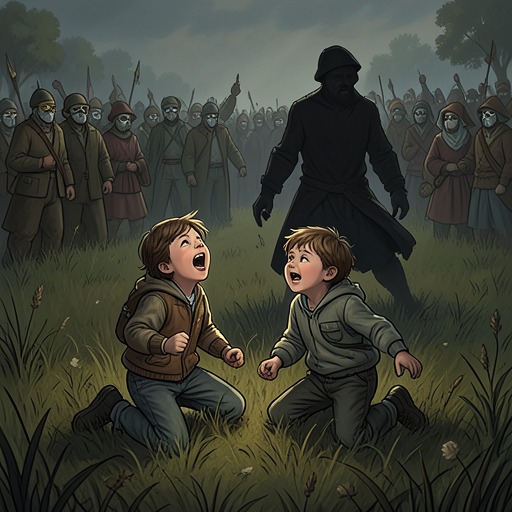
In the sickroom, Hamnet applies that old knowledge to a new and terrible purpose. He senses death waiting in the shadows and fears that it will carry Judith away, beyond anything he can do to stop it. Since their childhood substitutions have fooled other people, he wonders whether the twins can perform the trick once more and confuse death in the same way. He looks toward the darkness beside the door and imagines death turning away, closing its eyes for just a moment.
Hamnet acts carefully and physically. He slides one arm beneath Judith’s shoulders and the other beneath her hips, moves her toward the hearth, and takes the hollow she has left on the bed. She weighs less than he expected. As she turns and half-opens her eyes, he smooths his hair to either side of his face and pulls the sheet over them both, tucking it beneath their chins. The repositioning recreates the children’s exchange in the most intimate possible form: no costume change is needed when the twins lie together, covered by the same sheet, their likeness offered as a means of deception.
Judith understands what he is doing. Though too weak to rise, she tries to sit up and refuses the substitution. Hamnet holds the sheet tightly, breathes into her ear, and imagines giving her his strength, health, and life. His decision is not presented as a bargain between equals. He believes there is not enough life, air, or blood for both of them, and chooses that Judith should have what remains. The childhood trick has become a proposed sacrifice: he will occupy her place not to make an adult laugh at being fooled, but to make death take him instead.
Meaning and Limits of the Exchange
The scene makes the children’s likeness an instrument of love, but it does not establish that death can actually be deceived. Hamnet believes the resemblance might make the substitution possible; the narrative shows his actions and conviction, not proof that death accepts the exchange. That distinction preserves the scene’s tension. The familiar game offers him a form for action when he cannot command the illness or rescue Judith by ordinary means, yet the power of the act lies in what he gives rather than in any confirmed success at fooling death.
The twins’ identity is therefore both shared and unequal. Hamnet imagines them as one, but it is Hamnet who moves Judith, takes the vacated place, and decides that she should keep his life. Judith remains a person who recognizes his intention and resists it, even while she is too weak to get up. Their resemblance enables the attempted substitution; their difference—one sibling choosing, the other refusing—keeps it from becoming a simple merging of selves. The exchange gathers the childhood game, the siblings’ bodily closeness, and Hamnet’s willingness to die for Judith into a single scene, where the old question of who is who becomes a question of who should live.