Agnes’s Foresight and Premonitions
HamnetAgnes’s Foresight and Premonitions are a form of knowledge that comes to her without an evident chain of reasoning, often through touch, smell, or an abrupt certainty. They let her perceive hidden family relations and anticipate what may come, but they do not give her mastery over events. The narrative makes that tension central: her intuitions can disclose a life’s shape, while the arrival of danger exposes how little foresight can protect her from the unexpected.
Form and Range of Her Perception
Agnes’s insights arrive as discoveries rather than deductions. She does not explain how she knows what she knows; she receives the information suddenly and accepts it with the gratitude and surprise of an unexpected gift. That openness is part of the experience: her intuition is not presented as a method she can apply at will, but as a capacity whose results she recognizes when they appear.
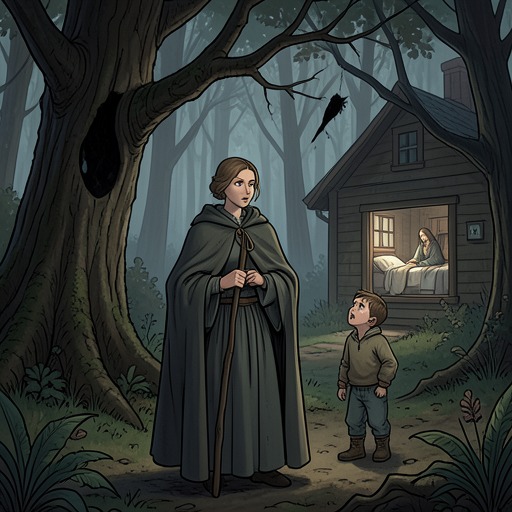
Her perception can extend beyond immediate appearances into the likely emotional and family life of others. In John’s household, she sees that his favorite son is Gilbert, whose strength and enjoyment of setting people against one another distinguish him. Mary’s preference is for Richard: she lifts her head when he speaks and silences the others to hear him. Agnes also perceives the different forms of attachment around Edmond. Mary loves him but has resigned herself to Eliza being the one who cares for him, while Edmond continually watches his elder brother and reaches out to him as he passes.
These observations become a vision of Edmond’s future. Agnes foresees that he will be cheerful and happy, willingly imitate his elder brother, and live a short but good life. She sees that women will love him, that he will have many children despite his short life, and that Eliza will be the last person he remembers before he dies. She also foresees that her husband will pay for Edmond’s burial and weep at his grave. Agnes sees these things but says nothing, leaving the knowledge private rather than turning it into a warning or a public claim.
Her perception also registers fear within the household. When John suddenly stands, all six children shrink as if sensing a predator nearby; Mary blinks slowly, seeming to close her eyes against what might happen. These are not predictions of a particular incident, but they show Agnes reading the family’s unspoken responses as readily as she reads individual affections. Foresight here includes attention to what people do not say.
Pregnancy, Omen, and the Household
When Agnes discovers that she is pregnant again, the knowledge comes alongside another, troubling perception. A smell of wilted flowers, stagnant water, and damp lichen seems to fill the room. She searches under the table and chest for something physically decaying, but realizes that the odor is not a material source: it signifies that something is wrong in the house. The two impressions pull in opposite directions. The pregnancy is good news, a sign that another child will arrive toward the end of winter; the smell is bad, a discordant warning that grows like mould beneath plaster.
Agnes has believed she knows how many children she will have and imagines that two will be beside her at the end of her life. She understands this pregnancy as the arrival of the second and as the true beginning of what she has foreseen. The certainty is familial and long-ranging, but it does not make every detail accessible. Her foreknowledge can offer a broad outline without identifying exactly what the next moment will bring.
The omen becomes more pointed when her husband comes downstairs. As he sits opposite Agnes and Susanna, the bitter, damp smell returns stronger, seeming to come from him and gather above his head like a grey-green cloud. He looks much as usual at first, but Agnes sees that he is pale and wasted, with swollen eyelids and purple shadows beneath his eyes. His gaze appears fixed on the window without truly seeing it, and his hand rests between them as if empty. The sensory impression gives form to a condition she has not understood in advance.
She tries to reconstruct the signs she might have missed: he has been sleeping more, staying out later at taverns with friends, and no longer reading to her at night as he once did. Their routines have carried them along together, she had thought, even as she has attended to Susanna, the house, the garden, and people at the window, while he continued his lessons and his father’s errands. The recognition is therefore not just a supernatural disclosure; it arrives with the painful awareness that ordinary changes were visible but had not added up for her before the odor made them legible.
Where Foresight Fails
As childbirth approaches, Agnes expects some sign that will tell her whether the child is a boy or a girl. Instead, every supposed indication contradicts another. A knife pointing toward the fire suggests a girl, while the best piece of a crisp apple suggests a boy. Her dry, crackling hair seems to point one way, her soft skin and strong nails another; a male lapwing crosses her path, but later a female pheasant emerges from the bushes. She cannot settle the question. This uncertainty is a striking limit for someone who has often sensed what lies ahead: the signs are not merely absent but mutually confusing.
The limits become more severe when labor begins earlier than Agnes expects. She had believed she had more time and had not foreseen this turn. Suddenly she is unsure of the familiar room, its table, chairs, shelves of pots and jars, and hazel branches set in a jug. Her former sense of living in a transparent world, where events could be anticipated, gives way to confusion and lowered guard. She touches her belly as if to communicate with the child and resolves to pay attention and prepare, but that resolve cannot restore the time she thought she had.
In the room, the timing feels wrong: events are moving too quickly, Agnes is not where she should be, and neither is her husband. She wonders whether she might die, imagining her dead mother calling her to the place from which no one returns. When the midwife and Mary try to put her on the dark, oil-smeared three-legged birthing stool, Agnes recoils from its hole in the seat and refuses to sit. Her resistance is immediate and physical; at the point when she most needs to act, perception has not supplied a calm, usable forecast.
The Body as Instrument and Boundary
Agnes’s intuition works through the body as much as through thought. She reads the odor in a room, notices her own breath moving like a tree in wind, and experiences the approach of childbirth as a rupture in her sense of what is knowable. The pregnancy itself is first recognized as sudden certainty, but labor brings pain and disorientation rather than advance warning. The same sensitivity that detects a hidden discord in the household cannot guarantee that she will understand its cause in time.
Her dream of falling among the agitated birds at Hewlands also places this uncertainty beside the intimacy of family life. She wakes in her own bed, pregnant, with her husband beside her, reaching for her in his sleep. She smooths and twists a lock of his hair, imagining his thoughts moving through it toward her fingers. From this closeness she senses his worry about whether she and the child will survive. She would like to reassure him that they will have two children who live for many years, but keeps the assurance to herself because people do not like hearing such things. The moment joins a far-reaching intuition to a practical silence: even when Agnes believes she knows, she does not assume that knowledge should be spoken.
Significance
Agnes’s foresight is neither an all-purpose gift nor a simple device for predicting plot. It gives her access to emotional truths others leave unspoken, and it lets the narrative place glimpses of future lives beside present gestures: a mother’s attention turning toward Richard, Edmond’s eyes following his brother, or children shrinking when John rises. Yet its authority is repeatedly qualified. Agnes can envision the broad course of a life and recognize pregnancy, but cannot identify the child’s sex or anticipate the early onset of labor.
That contrast keeps intuition from becoming control. Agnes may sense what is coming, but a warning can remain difficult to interpret, private, or too late to prevent bewilderment. Her most consequential moments of knowing arrive alongside uncertainty: good news beside a bad odor, perceived signs beside contradictory signs, and a confidence in the future beside a birth that comes before she is ready. The concept therefore joins perception to vulnerability. To know more than others does not mean knowing everything, and the capacity to sense danger does not place Agnes outside the danger itself.