The Absent Mother
HamnetThe Absent Mother is both a concrete interruption in a child’s day and a lasting condition carried through Agnes’s life. Hamnet finds the house and courtyard empty when Judith is unwell and he has been sent to seek help; Agnes, meanwhile, is living with the older and more profound absence of the mother she remembers from childhood but cannot recover. Across these situations, maternal absence is not simple disappearance. It is measured against habits of care, recalled through the body and landscape, and, at moments, transformed into a presence the bereaved person can still sense.
A Child Calling into an Empty Home
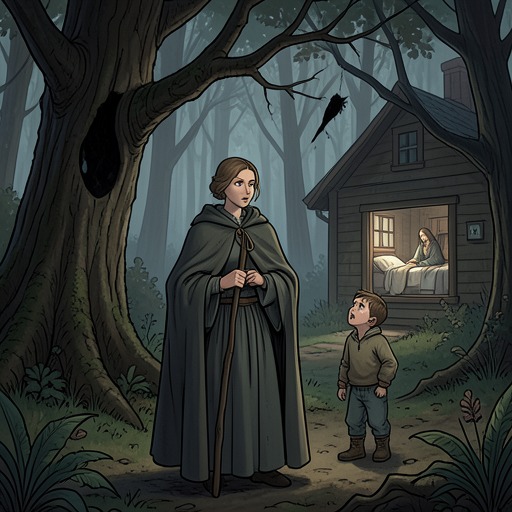
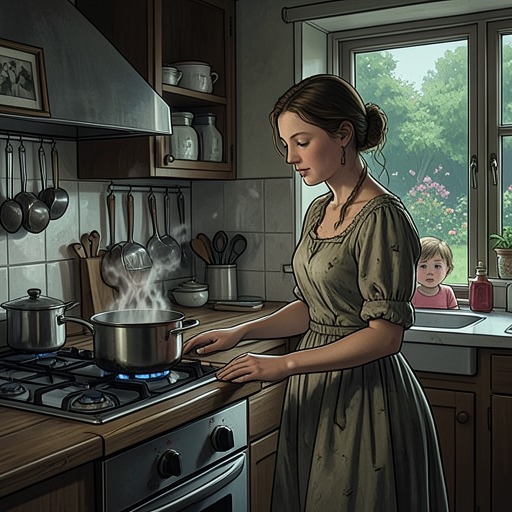
Hamnet’s encounter with absence begins in urgent confusion. He runs through the passage toward the courtyard, remembers that Judith needs help, and searches the household for someone who can assist. He opens the kitchen, the room where beer is fermenting, and the washhouse, calling until his throat is rough. The rooms are cool and dark; his mother and grandmother, whom he expects to find at home, are nowhere there. Alone in the courtyard, he wonders where everyone has gone and whom he can ask for help. The crisis is sharpened by the ordinary familiarity of the place: there should always be someone present.
The narration sets that solitude against the work of care that has made Hamnet’s home feel inhabited. The people he calls have fed and wrapped him, soothed him, held his hand as he learned to walk, and taught him small practices of safety and daily life. Their absence is therefore felt not as an abstract fear but as the sudden withdrawal of the routines on which a child depends. Even the courtyard holds traces of the life continuing around him: the pinecones he and Judith used as toys for the kittens, and the kittens themselves, which Judith keeps close. The remembered play makes the empty household more poignant without making it unfamiliar.
Hamnet repeats that his mother is coming and that she is near. The assurance is not entirely mistaken: Agnes is about two kilometres away, on the land at Hewlands, where she tends bees and works among herbs, flowers, and other plants. The distance explains how she can be absent from the house without being beyond reach. The scene’s tension rests on the difference between the child’s immediate need and the mother’s actual, limited separation; the narration holds his frightened experience beside the fact of where she is.
Agnes’s Remembered Mother
Agnes’s own relation to absence reaches back to a mother whose presence survives in vivid childhood memories. She remembers strong bare feet crossing the house and entering the forest, and a warm, firm hand preventing her from falling. When her mother carried her on her back, Agnes could shelter beneath her hair and watch the trees appear like a festival of lights. Her mother pointed out a squirrel and a kingfisher, and climbed to shake hazelnuts from branches. These recollections make the lost mother specific: she is remembered through touch, movement, attention, and shared passage through the natural world.
Agnes’s memories include Bartholomew, too. Their mother carried him against her chest, where the children could look at and touch one another over her shoulders. She made two identical dolls from green reeds and laid them together in a box. The image of the paired dolls belongs to a childhood organized around closeness, while the mother who made them is no longer there. The past is not merely a story Agnes has been told; it is a world she insists she remembers, including the plants her mother cultivated and the hole-pierced stone she filled with herbs.
That insistence meets denial from the people around her. Agnes is told that she never had another mother and that remembering her real mother is impossible. She protests with anger, stamping and striking the table, but the question she cannot answer is not whether the mother existed. It is where she went and why she left. Agnes tells the apothecary’s widow, who acknowledges the goodness of the woman Agnes remembers. The recognition does not resolve the mystery of her absence, but it confirms that Agnes’s recollection is not simply dismissed by everyone she confides in.
Absence, Death, and Inherited Memory
A later memory gives Agnes’s mother’s disappearance a terrible material form. Seeing her father kill a lamb brings back the image of a blood-soaked bed and a narrow box. Agnes recalls her mother cold and still, with a small, doll-like figure held in her arms, and a priest summoned at night to perform a secret rite. The recollection explains why the mother is absent from Agnes’s life, while preserving the child’s limited understanding of what she witnessed. Agnes remembers nearly everything, but memory cannot tell her why her mother had to go; the fact of death and the unanswered question remain side by side.
The novel links this childhood loss to another maternal absence through the contrast between Agnes’s past and Hamnet’s present. Agnes’s mother once guided her through the forest; Hamnet, in turn, searches for Agnes when he cannot find her at home. The situations are not equivalent: Hamnet’s mother is close by, while Agnes’s mother is irretrievably lost. Yet both scenes make care visible by briefly withholding it. The empty rooms expose the network of daily attention around Hamnet, just as Agnes’s memories preserve the particular acts by which her mother made the world intelligible to her.
Imagined Presence and the Wedding Day
Agnes’s mother is absent even from the wedding day on which Agnes imagines how she should have been there. She pictures her mother walking beside her to the altar, their steps and heartbeats keeping pace. Her mother would have made and placed the flower crown, brushed Agnes’s hair, and tied the blue ribbons that held up her stockings. These are imagined actions, not events that occur; their precise domestic detail gives shape to what Agnes has lost and to the care she wishes could accompany her into marriage.
Agnes does not need to turn around to sense her mother beside her. She fears that looking might frighten the presence away, and instead holds to the knowledge that her mother is there in some incorporeal way. The moment does not undo death or answer the old question of departure. It shows absence changing form: what cannot return as a living mother can still be carried as memory and felt presence. Across the scenes of Hamnet’s anxious search, Agnes’s remembered forest, and the imagined walk to the altar, the absent mother remains a force in the lives of those she leaves behind.