The play brings Hamnet back as “Hamlet”
HamnetThe play brings Hamnet back as Hamlet by making his name and remembered presence part of a tragedy. For Agnes, this transformation first appears as an injury: the name of her dead child has been printed and spoken as though it belonged to a work of entertainment. At the performance, however, she recognizes her son in both the young Hamlet and the ghost. The play does not undo his death; it gives grief a theatrical form in which the child can appear again, and in which Agnes can understand her husband’s act as an exchange of places with their son.
The name on the poster
Joan tells Agnes that her husband’s new work is a tragedy, then presses her with assumptions about what a wife must have known: that he would have shared the title in his letters, sought her consent, and sent her a poster. Joan’s talk treats the play as public news, already circulating in the town; her cousin has arrived from London with a copy, and she has brought one herself. The poster becomes the physical object through which this public story enters Agnes’s private grief.
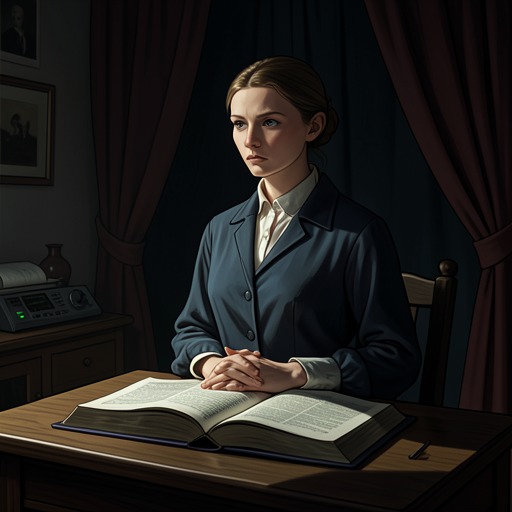
Joan unrolls the paper and leaves it on Agnes’s lap. Agnes handles it with two fingers and smooths it across her mud-stained apron. She first has to make sense of the printed page: the rows of letters, the words, her husband’s name at the top, and the word tragedy. At the center, in the largest letters, is the name of her son. The detail of its placement makes the discovery impossible to treat as incidental. The name is visible, enlarged, and exposed to the world, while Agnes associates it with the child she named after the twins were born and whose name was spoken at baptism and cut into a gravestone.
Agnes’s resistance
Agnes cannot reconcile the poster with what she knows: her son died nearly four years earlier. To her, Hamnet remains a particular child, not a set of letters that can be detached from him and used in a play. She thinks of him as the boy who might have grown into a man, but did not. The printed name seems to collapse that distinction, turning the life and death she holds sacred into something that can be discussed, performed, and displayed. Her inability to understand is not a failure to read the paper; it is a refusal of the apparent meaning it imposes.
Judith looks over Agnes’s shoulder and asks what the paper is, but cannot read its letters or recognize the name of her own twin. Susanna holds one corner while Agnes’s fingers tremble. When Susanna tries to take the poster, Agnes will not release it. Her grip makes her resistance visible: she cannot accept the name being taken from her, even as its appearance on the page wounds her. Joan, who expected the poster to impress or inform, is startled by the family’s response. Agnes’s daughters lead her away, telling Joan that their mother is unwell; Agnes hears the false concern in Joan’s farewell. The scene leaves the poster’s public announcement in direct conflict with the family’s private knowledge of the dead child.
The ghost and the name
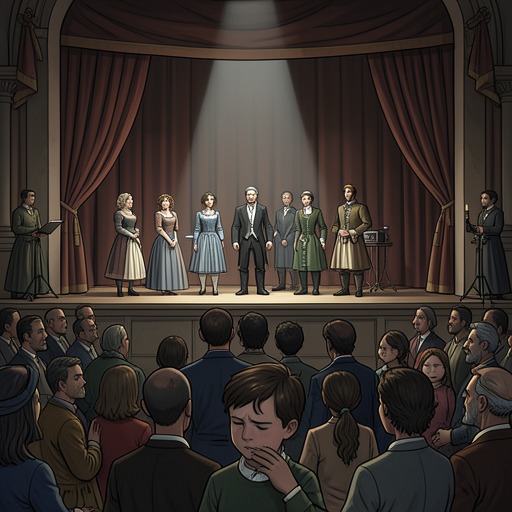
At the performance in London, Agnes watches the ghost enter in full armor, its visor closed and its body partly wrapped in a shroud. While the audience holds its breath, she studies the figure rather than the other men’s boasts and cries. She attends to height, movement, a raised hand, the particular bend of the fingers, and the motion of the shoulder. When the visor is lifted, the painted face and gray beard do not make her mistake the figure for someone else. She knows who is beneath the costume, although the recognition does not yet explain what she is seeing.
The ghost leaves, and Agnes strains to keep it in view and to know when it will return. Then an actor says Hamlet. The name rings out, is repeated, and passes among the men onstage. Agnes hears it attached to a dead king and cannot understand why her husband has taken her son’s name and placed it in the play. She regards this use as a stripping away of the life the name once held, a separation of the name from the child and from the relationship it signifies. Her first response is to leave, return to Stratford, and tell her husband not to come home. The name onstage seems to confirm the very fear raised by the poster: that the play has made Hamnet’s identity into material that can be used without regard for his death.
The living boy onstage
Agnes is stopped from leaving by the entrance of a figure who seems at once a boy and a man. His blond hair rises at the forehead; his step is springing, and he impatiently throws his head back. The sight strikes Agnes bodily. When the king addresses the boy as his son, she understands him as Hamnet, though she knows that Hamnet is dead and buried in the churchyard. The stage figure is at once not her child and unmistakably like him: nearly grown to the age he might have reached, walking with his gait and speaking with his voice.
As the young Hamlet listens to the ghost describe his death by poison, Agnes recognizes small, particular gestures: the tilt of the head and the knuckles brought to the mouth when something is not immediately understood. The actor has never known Hamnet, yet seems to reproduce him. Agnes’s attention moves from resemblance to the process that could have made it possible. She understands that her husband found the boy, taught and rehearsed him, and prepared his speech and movements. The performance’s likeness is therefore neither a literal return nor a coincidence in Agnes’s understanding; it has been made through deliberate instruction, with the father shaping another boy into an image of his own.
Exchange, return, and remembrance
Agnes’s recognition changes how she interprets the tragedy. The stage Hamlet is two people at once: a living young actor and the dead father represented by the ghost. The theatrical doubling makes it possible for the son to appear as both living and dead. Agnes understands her husband’s writing as an exchange of places: he has taken the child’s death upon himself and made it his own, putting himself in death’s grasp so that the boy might live in the play. This is not a reversal of what happened in life, but a dramatic form for the parental wish to suffer in a child’s place.
The recognition does not erase Agnes’s earlier anger or make the performance painless. She remains at the front of the crowd, close to the stage, with Hamlet a short distance away and the ghost speaking in her husband’s voice. She reaches toward the space between the three figures, as if trying to cross the boundary between audience and actors, life and theater. When the ghost turns toward her and asks to be remembered, the play’s use of the name acquires a different force. What Agnes had experienced as the theft and emptying of Hamnet’s name becomes, through the performance, a means by which the lost child is present to her again—not restored to life, but held in a form that joins the father’s grief, the mother’s recognition, and the actor’s living body.