The Legend of the Girl at the Forest’s Edge
HamnetThe Legend of the Girl at the Forest’s Edge is a communal tale about Agnes’s childhood, turning a girl who lives beside a forbidding wood into a figure of mystery. The story gives her an uncanny inheritance, a falcon, and the power to perceive what others cannot; the narrative also makes clear that this is the version told by local people, not necessarily Agnes’s own account. Its force lies in that tension: folklore makes her exceptional, while the practical demands of family life continue just beyond the legend’s frame.
A story passed from mouth to mouth
The tale begins as local gossip and fireside entertainment. People ask one another whether they have heard of the girl at the forest’s edge, repeating the story while kneading bread or carding wool. Such tales make a long night seem shorter, quiet an unsettled child, and distract listeners from their worries. But the opening also carries a promise: once the girl is introduced, those nearby turn to listen and imagine her entering the trees or standing beside their green wall. The legend is thus presented not simply as information about Agnes, but as a story made and circulated by a community, inviting its audience to expect something extraordinary.
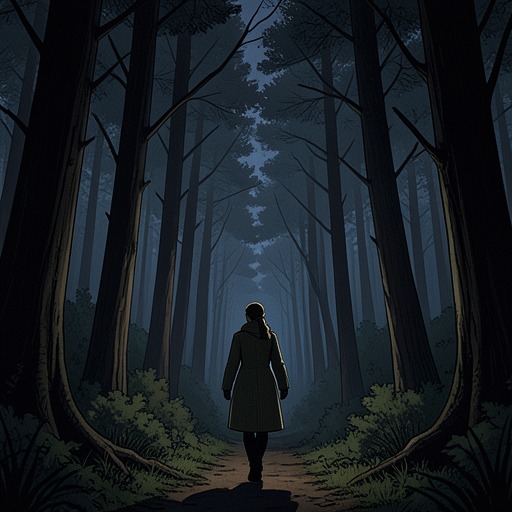
That invitation is sharpened by the forest itself. The trees grow so closely together that, in places, light is said never to enter; brambles and ivy tangle across the ground, and paths turn travelers back toward where they began. Breezes seem to come from nowhere. In clearings, people hear music, whispers, or a voice calling a passerby by name and beckoning them farther in. These details make the wood more than a backdrop: it is a place that unsettles direction and judgment, drawing people away from their intended paths and seeming to answer their presence.
The community’s warnings and customs give that unease practical form. Children are taught never to enter the forest alone, and young women are advised to keep away from whatever may be hidden in its greenery. Travelers who must cross it stop to pray at an altar or cross, asking for protection from the forest’s inhabitants, spirits, and leaf-beings. The cross is eventually swallowed by vegetation and ivy. Others turn to offerings: strips of clothing tied to branches, jugs of ale, bread, pieces of bark, and strings of bright beads left in hopes of appeasing the spirits and securing passage. The forest is feared, approached with ritual care, and never fully mastered.
The girl and her imagined inheritance
At a house on the forest’s edge, the girl lives with her little brother. From the rear windows they can see the treetops moving in the wind, and in winter the bare branches seem to lift twisted fists toward the sky. The siblings have known the forest’s strength and its call for as long as they can remember. The legend places them close to its threshold, not deep inside it: their home looks out on the trees, while the woods remain a neighboring power that can summon, threaten, or confound.
The tale extends that closeness to the girl’s mother. The oldest people in the area suppose that she came out of the forest, though nobody knows where she was from. She might have been one of the forest’s people, separated from her own kind, or something else altogether. In the story, she appears by parting the brambles. A farmer tending his sheep happens upon her and cannot stop looking at her. He removes leaves from her hair, snails from her skirts, twigs and moss from her sleeves, and mud from her feet; he takes her home, feeds and clothes her, marries her, and soon the girl is born. The tale turns a lack of known origins into a possible supernatural one, but preserves uncertainty rather than resolving it.
The legend also associates Agnes with abilities beyond ordinary perception. As she grows older, people come to her under cover of darkness, seeking help for things said to be unusual. She finds ways to meet those who need her. At dusk she walks by the forest’s edge with a falcon: the bird circles above the branches before returning to the leather lure on her gloved hand. Those who want to consult her can arrange to be walking there at the same time. The ritual of a meeting—twilight, the border of the wood, the circling bird—makes the community’s account of her power inseparable from the place where she lives.
Touch, rumor, and the story’s limits
When asked, Agnes removes her glove and holds a person’s hand, pressing the flesh between thumb and forefinger, the point described as containing all the body’s strength. She then tells the person what she perceives. Those who seek her do not agree on the sensation: some feel dizzy and drained, as though their strength has been taken; others find the experience invigorating, like a sudden shower. Above them, the falcon wheels with its wings spread and cries out as if warning them. The account gives her gift a physical procedure and sharply divided effects, even as it keeps the source of her knowledge unexplained.
Rumor, however, does not remain the only account available. Joan, after her marriage, abruptly stops complaining about the girl in public and dismisses the claims that the girl can see people’s souls from within. She insists that there is nothing unusual and treats the talk as foolish gossip. That denial does not settle whether the legend is true; it shows how the same family and community can frame Agnes in opposing ways, as a source of mystery or as an ordinary girl surrounded by exaggeration.
The narrative explicitly distinguishes this myth of Agnes’s childhood from the way Agnes herself would tell it. Immediately afterward, the account turns to sheep that must be fed, watered, watched, moved between pastures, and fetched whatever happens. Indoors, the fire must never go out: it has to be fed, tended, and stirred, sometimes with her mother bending to blow on it. These duties do not disprove the folklore, but they change its scale. Against the forest’s unknowable call and the community’s extraordinary claims stands the repeated labor of keeping animals and a household alive. The legend makes Agnes memorable as a boundary figure; the contrast with her own telling keeps that image from becoming the whole of her life.