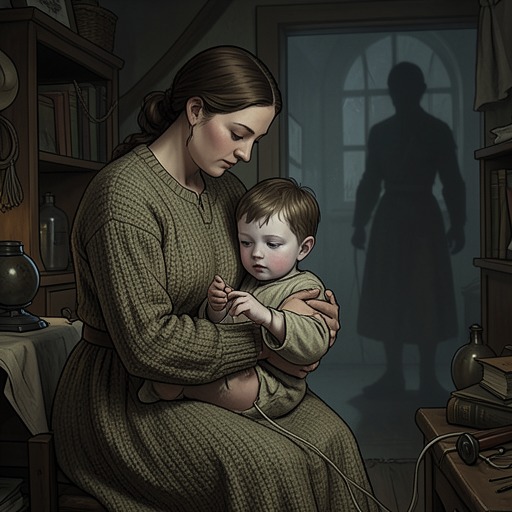
Grief for a lost child and the search for the dead
HamnetGrief for a lost child and the search for the dead shape the aftermath of Hamnet’s death. Agnes, William Shakespeare, and Judith each keep looking for him, but their searches take different forms: a mother’s instinctive count of her children, a father’s gaze sweeping crowds, and a twin sister’s secret night watch. The repeated search does not undo the loss. It gives grief its language and its pattern, returning the question of where Hamnet is even when the family knows he is dead.
The Shock of Loss
Before Hamnet dies, Agnes’s care is fixed on Judith, whose fever has not broken. Agnes remains beside her through the night, without eating or resting, wetting a cloth to wash her daughter’s forehead, arms, and throat. Mary can persuade her only to drink a little. The vigil makes the later shock especially bitter: Agnes has been watching one child’s danger so closely that, after Hamnet’s death, she reproaches herself for not recognizing that he was the one at risk.
At Hamnet’s deathbed, practical preparations begin around Agnes, but she cannot respond. She sits with one hand on his cold, contracted fingers and the other on his hair, while the basins and folded shroud wait nearby. Her thoughts surge through questions about how the family will live, what she should have done, and how she could have saved him, before contracting to the bare fact of his death. Her mind cannot make those words mean what they mean: the child she remembers as the strongest and healthiest has fallen ill and died within days.
The loss also breaks the ordinary mental habit by which Agnes keeps her children present. At the fire, she is accustomed to tracing each one’s whereabouts: Judith upstairs, Susanna beside her. Her attention continues to reach for Hamnet as if he might be at school, playing, or by the river. The question recurs despite the answer she can see before her: his body lies cold and lifeless on a board. This gap between knowledge and instinct turns the question of where he is into the central form of her grief.
The Family at the Threshold
At the burial, Agnes watches William Shakespeare lower their son into the earth, helped by Bartholomew and Edmond. She cannot bear to look, and loses the moment when Hamnet disappears into the grave. Leaving the churchyard is another ordeal: the family entered with three children and leaves with two. At the gate, William takes Agnes by the arm. His face seems unfamiliar to her, yet she recognizes Hamnet’s cheekbones and forehead in it. The resemblance joins father and dead son in her sight, while William’s living body, tears, and beating heart mark the distance between them.
Agnes cannot cross the gate. She grips its wooden post with both hands, imagining that if she could remain there, with her daughters on one side and Hamnet on the other, she might contain the loss. The image gives physical form to a grief that has made her feel insubstantial, as if she might come apart. Susanna is silent and grave; Judith weeps continuously. Agnes thinks of Hamnet as the pin that had held the family together, and his absence as the force that threatens to scatter them.
Grief also separates the parents even while it binds them. During the first two nights, William walks ceaselessly in the room below while Agnes hears his footsteps from upstairs. The silence between them is not an absence of feeling but a sign of how difficult it is to speak from inside the loss. Later, when they sit together, Agnes expects William to explain himself or speak of another woman. Instead, he asks how much she thinks about Hamnet. Her answer—that he is always with her and at the same time not there—opens a conversation in which each recognizes the other’s bereavement.
Searching in the House and Beyond
Agnes searches for Hamnet night after night, for weeks and months. She waits by the place where his bed stood, sits in the chair where he died, and goes into the frost-covered yard to call for him beneath the leafless plum tree. She keeps a blanket around her shoulders and a lantern burning. These repeated visits make familiar domestic places into sites of expectation: the room and yard still hold the traces of his life, but offer no answer to her calling.
The search is sharpened by Agnes’s confidence in her own perception. She can hear the dead and what remains unspoken; by touch, she can sense illness advancing through a body, and she reads people’s eyes and hearts. Yet she cannot locate her own son’s spirit. She listens for him among what she can hear, but finds only silence. The failure is not presented as proof that Hamnet is nowhere; rather, it exposes the limit of the knowledge that once seemed to make her unusually attuned to hidden things.
Judith’s experience differs. She finds Hamnet in ordinary movements and sounds: a broom brushing the floor, a bird’s slanted flight, a pony’s mane moving, hail against a window, wind in the chimney, or the rustle of willow in the roof of her shelter. She tells no one, keeping these perceptions to herself and silently addressing her twin. The contrast is profound: Agnes searches in chosen places and waits for a distinct presence, while Judith encounters him in passing details of the world. Their different responses do not cancel each other; they show how grief makes separate forms of attention.
The Search Repeated
William, too, looks for Hamnet. In the theater, he searches the audience night after night for his son’s crooked smile and perpetually astonished expression, scanning faces carefully because he cannot accept that the boy has simply vanished. The crowd becomes both the place where he might be found and the evidence of his absence: William looks through many faces for one particular child, or for a version of him.
The work itself offers William uneven shelter. Historical plays and comedies let him attend to distant kings, old battles, and safer subjects, away from memories that might seize him. Yet even within that apparent refuge, his eyes return to the audience. His private search continues beneath the public performance, unknown to the other actors. The stage does not resolve his bereavement; the act of looking is carried into it.
Judith’s search becomes a nightly vigil after the midwife tells her that Hamnet appears only at night, never during the day. Judith slips out without telling Agnes or Susanna. The secret is both a private bond with her twin and a fear of making the hope vulnerable to disclosure: she does not want to tell anyone in case Hamnet never appears to her. She waits in the house where he died, facing the door, and longs to see him once more. Her vigil makes explicit what the other searches leave open: after losing her twin, she feels that without him she is only half a person.
Across these distinct searches, the novel renders bereavement as repetition rather than progress toward a simple resolution. Agnes’s habitual count of her children, William’s sweep across the audience, and Judith’s watch at the door all return to the same absence. The dead child remains present in memory, resemblance, sound, and expectation, but cannot be recovered by any of them. Their searching is therefore at once an act of love and an encounter with its limit.