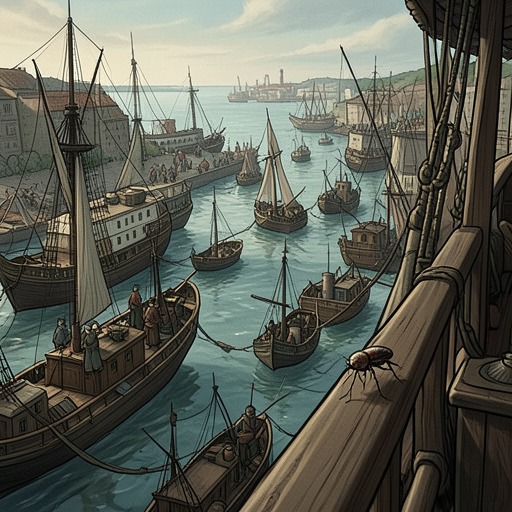
The plague’s chain of transmission and chance
HamnetThe plague’s chain of transmission and chance is the novel’s account of how a disease travels from distant ports to Warwickshire in the summer of 1596, not a confirmed historical explanation for Hamnet’s death. Its force lies in the connections it makes between ordinary acts and catastrophe: a moment of distraction in a glassworks, a sailor sent ashore for provisions, and fleas moving unseen among animals and people. The chain gives a vast epidemic a material, intimate scale, while the author’s note acknowledges that the historical cause of Hamnet’s death is unknown.
Background and the First Links
The chain begins with two people whose separate circumstances must converge for the plague to reach Warwickshire: a master glassmaker on Murano, in the principality of Venice, and a ship’s boy aboard a merchant vessel arriving from Alexandria. The novel presents this convergence as a sequence of contingencies rather than as an inevitable march. Events that seem remote from one another become consequential only through contact, movement, and the passage of time.
In late 1595, the glassmaker is making millefiori beads, small glass pieces patterned in five or six colors and shaped like stars or flowers. Distracted by a fight among the stokers, he lets his hand slip into the white-hot flame used to soften a bubble of glass. The pain is so intense that at first he does not understand what has happened; those around him rush to help, and the accident ends with two fingers amputated. His injury matters to the chain not as an isolated misfortune but because it changes who packs the beads for shipment.
The next day, while the glassmaker is at home, bandaged and drowsy from poppy syrup, a fellow worker packs the tiny red, yellow, blue, green, and purple beads. Unaware of the glassmaker’s usual method, he wraps them in rags from the factory floor instead of cushioning them with wood shavings and sand. Those scraps of cloth become an overlooked vehicle: later, fleas hidden among them will travel with the cargo. The small substitution joins a workplace accident to a journey across the sea.
At the same time, the ship’s boy is ordered ashore in Alexandria to fetch food for his hungry, exhausted shipmates. His errand places him in the setting where the next transfer can occur. The boy does not know what will pass between him and a monkey he encounters, but during their brief contact three fleas leave the animal. One falls to the ground and is crushed without his noticing; another moves through his fair hair and later jumps to a tavern keeper. The third remains in a fold of the red handkerchief around his neck, a gift from his beloved in his homeland. In this way, the chain branches: one flea disappears, another changes host, and the last travels with the boy.
The Flea Aboard the Ship
After returning to the ship, the boy brings his nearly white cat, whose tail is striped, close to his neck. The flea that has remained in a fold of the Red Handkerchief jumps into the cat’s thick, white fur. The animal soon falls ill and settles in the ensign’s hammock, as if seeking refuge from the person who dislikes it. When the ensign finds the cat dead there, he curses it, removes it without care, and kicks it across the cabin. The gesture, casual and brutal, relocates the flea again: several fleas remain where the cat had lain, and the one descended from the monkey makes its way to the sleeping ensign’s damp armpit to feed on his blood.
The chain keeps moving through ordinary shipboard routines, largely unnoticed. The vessel sails past Damascus toward Aleppo; the ensign is reported sick and confined below, then delirious, foaming at the mouth, and suffering from a swelling on his neck. The captain’s response is belated and practical: he orders the ship’s doctor to visit. Only afterward does the steward add that several cats aboard have died. The novel gives no single observer the whole pattern. Illness, animal deaths, and the flea’s successive changes of host become connected for the reader through details scattered across the ship’s journey.
By the time the flea’s route is described again, it has lived in a rat and, before that, in a cook who died near Aleppo. The flea that began on the monkey is thus carried onward through a succession of creatures and people, while the ship continues to lose crew members. The episode makes transmission neither a deliberate act nor a clean passage from one human body to another: it depends on a cat’s closeness to the boy, the ensign’s treatment of the dead animal, and the hidden movement of fleas among the ship’s inhabitants.
From Ship’s Hold to Warwickshire
The same flea later passes from the boy to the glassmaker’s sleeve and climbs to the man’s left ear, biting behind it while he is chilled by canal air and fog. He does not notice. His attention is fixed on getting the boxes aboard and earning enough to return to Murano, where orders await and the stokers may be fighting again. The bodily link between the two men is as slight as the bite, but it joins the Alexandria episode to the shipment of beads whose packing had already been altered by the glassmaker’s injury.
During the voyage, the Venetian cats sleep in the hold on top of the boxes of Murano beads. Few people go below, so when the cats die one after another, their bodies remain undiscovered on the cargo. Flies move from dying rats to the cats’ striped fur, then across the boxes and into the packing rags surrounding hundreds of tiny, multicolored millefiori beads. The glassmaker, back in Murano, is meanwhile among workers struck by a mysterious virulent fever. The hold becomes a concealed transfer point: animals die above the cargo, while insects settle among the cloth that will travel onward.
The ship’s progress is marked by loss and exhaustion. After rounding Sicily, the second officer falls ill with African fever; with two Polish sailors, he is buried at sea off the coast of Naples. In Barcelona, the few remaining Polish sailors go ashore and disappear into the confusion of the port, but the captain presses the rest of the crew onward with their cargo of cloves, cloth, and coffee. The vessel calls at Cádiz, Oporto, and La Rochelle before turning north toward Cornwall. By the time it reaches London, only five crew members remain. The route is not a straight line from one infected person to another: the voyage carries sick sailors, dead cats, rats, flies, beads, and rags through successive ports, while the links among them remain unseen.
The beads then continue inland by horse. Fleas hidden in the rags emerge hungry after their stay in a warehouse without a host, and recover by leaping between the horse, its rider, and people encountered along the road: a woman who gives the rider a quart of milk, a child who approaches to stroke the horse, and a young man at an inn. By the time the rider reaches Stratford, the fleas have laid eggs in the seams of his doublet, the horse’s mane, the saddle stitching, the lace, and the rags protecting the beads. The eggs are described as descendants of the flea that left the monkey in Alexandria. A chain that began in separate ports has thus arrived in Warwickshire embedded in ordinary clothing, tack, and packing material; in the summer of 1596, the plague reaches the place where Judith will fall ill.
Historical Record and Narrative Meaning
The novel’s epidemic plot is built around a gap in the historical record rather than a documented diagnosis. The author’s note identifies the work as fiction inspired by the short life of a boy who died in Stratford, Warwickshire, in the summer of 1596, and says that the surviving record confirms Hamnet Shakespeare’s burial but not its cause. The elaborate route traced through fleas, animals, cargo, and ports is therefore the novel’s imaginative answer to an unanswered question, not evidence that the historical Hamnet died of plague.
The note makes that distinction especially pointed: William Shakespeare mentions neither the plague nor the period’s term “pestilence” in his plays or poetry. The novel takes that silence as a source of speculation, while preserving the difference between what can be known and what it invents. Its imagined transmission chain supplies no certainty about Hamnet’s death; instead, it gives narrative form to the possibility that a catastrophe affecting one family could begin in remote, unremarkable incidents beyond its knowledge.
The documented family setting is spare by comparison. In the 1580s, a couple living on Henley Street in Stratford had three children: Susanna and the twins Hamnet and Judith. Hamnet died at eleven in 1596, and four years later his father wrote a play titled Hamlet. The names Hamnet and Hamlet were interchangeable forms in records from Stratford in the late sixteenth and early seventeenth centuries. That historical proximity gives the novel’s imagined epidemic a second kind of passage: alongside the movement of disease from one host to another, a child’s name travels into a play, where Agnes encounters it printed on a London playbill and struggles to reconcile the name with the son she has lost.
The two transmissions are not equivalent: one is a fictional reconstruction of an unknown cause of death, the other is grounded in the recorded relationship between the family and the play’s title. Together, however, they shape the novel’s treatment of chance and loss. The chain makes catastrophe legible through minute material contacts, while the uncertain historical record keeps its central cause beyond recovery. What can be followed is the route the fiction constructs; what Hamnet actually died of remains unknown.