Agnes’s intuitive perception through touch
HamnetAgnes’s intuitive perception through touch is a form of knowledge grounded in the body: a hand on another person can disclose what ordinary sight and speech cannot. It guides her attention to bees and illness, allows her to search for a message from Hamnet after his death, and finally brings her to the simple, living fact of her husband’s heart. The gift is powerful but not sovereign. Its silence when Agnes most needs it makes touch both an instrument of perception and a measure of what cannot be recovered.
A Bodily Way of Knowing
Agnes’s perception is described as immediate and physical rather than as a conclusion reached by reasoning. She presses the muscle between a person’s thumb and index finger, listens, and concentrates. In the case of her children, this contact ordinarily opens onto a rush of images, sounds, secrets, and information. Susanna knows the method well enough to hide her hands behind her back when Agnes is near. The gesture suggests that the gift is intimate, but not necessarily welcome: closeness gives Agnes access that others may prefer to keep to themselves.
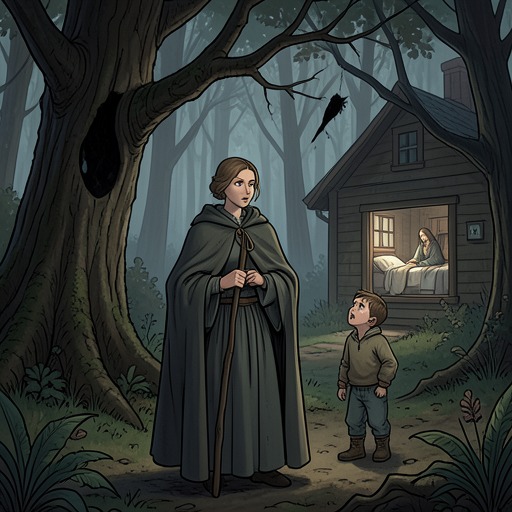
The novel connects this unusual perception with a wider attentiveness to bodies and living things. When Agnes examines the bees in a troubled hive, she passes her hand above and below it and among the remaining insects. She works without a beekeeper’s veil, while bees fly around her head and settle on her sleeve and face. She murmurs to them and studies a comb covered with clustered bodies. This scene does not present the bees as a secret Agnes translates through touch; rather, it shows the patient physical proximity and careful observation that also characterize her knowledge of people. Her way of attending begins with contact and presence, not distance.
Reading Illness in Judith
That attention becomes urgent when Judith falls ill. Agnes takes her pulse and feels it shift between force and weakness, at moments disappearing before racing again. She touches the swelling at Judith’s neck with her fingertips, noting its damp, yielding texture, then loosens her daughter’s shirt and discovers more swellings in her armpits. The examination makes the disease visible and tactile at once: the lumps push outward from beneath Judith’s skin, turning a feared possibility into something unmistakably present.
Agnes’s touch here has practical stakes. The pulse and swellings are not vague impressions but bodily signs that reveal the seriousness of Judith’s condition. Her attention moves from one detail to another—the irregular beat, the large swelling at the neck, the smaller and larger growths beneath the arms—until the evidence can no longer be mistaken for imagined danger. Touch does not make her invulnerable to illness, but it lets her recognize what is happening in the body before comfort or hope can soften the facts.
The novel’s account of this faculty also places it within the ordinary labor of care. After Hamnet’s death, Agnes stops tending to people who approach her about wounds, gum inflammation, deafness, rashes, heart pain, or coughs. Her medicinal herbs dry out, and the jars gather dust. Susanna wipes them clean, removes useless dried herbs from the beams, and tends the medicinal plants with Judith. The change is concrete: the hands that once examined and helped others no longer perform that work, while her daughters begin to carry its tasks. The passage marks a withdrawal from healing rather than an explicit explanation of its cause.
Hamnet’s Silence
Agnes’s gift reaches its most painful limit after Hamnet dies. She presses the muscle between his thumb and index finger, using the familiar method and waiting for a sign. In the past, even the most private or mysterious people have given her something to perceive; her children have offered a clamor of images and information. Hamnet’s hand, however, gives her nothing. She listens for a murmur, a message, or an indication of where she might seek him, but the silence remains absolute.
The failure is more than an absence of information. Agnes has understood touch as a means of finding what lies beneath the surface; now the hand she knows so intimately cannot lead her beyond death. In the weeks and months that follow, she searches for Hamnet in the places associated with him: at the site of his bed, in her father’s chair where he died, and beneath the leafless plum tree. She waits with a candle burning or calls his name into the frost, yet cannot locate his spirit. Her ability to sense hidden things makes the failure sharper, not easier. The one person she most wants to hear remains beyond the reach of her perception.
Judith’s experience offers a contrast, though not a resolution. She finds Hamnet in ordinary sounds and movements: a broom against the floor, a bird settling on a wall, a pony’s mane shifting, hail at a window, wind in the chimney, and the wicker of her shelter. Judith keeps these perceptions to herself. Where Agnes searches directly and receives silence, Judith recognizes her twin through the world around her. The difference does not restore Agnes’s lost access; it shows that the surviving family members encounter Hamnet’s absence in distinct ways.
The Heart That Remains
Much later, Agnes tests her perception on her husband. He holds her hand and does not pull away as she turns his palm upward and presses the familiar place between finger and thumb. At first she encounters a jumble of voices and impressions, along with fear of a journey and something connected with water or the sea. Beneath that tumult, she senses an empty, dark expanse. Then, for the first time, her attention settles on something she has not experienced in this way before: the heart, beating steadily in his chest.
When he asks what she found, Agnes answers that she found nothing, then identifies his heart. The apparent contradiction gives the scene its force. Against the hidden voices, fears, and emptiness she has just encountered, the heart is not a revelation about the past or a route to the dead. It is the immediate presence of another living body. Her husband brings her hand to his chest, making the perception bodily in both directions: she discovers his heartbeat through touch, and he answers by holding her hand there.
The episodes define Agnes’s gift through both its reach and its limits. It can sharpen attention to a diseased pulse, draw her close to bees without a veil, and open another person’s inward life to her. It cannot make Hamnet answer. Its final significance therefore lies not in mastery over hidden knowledge, but in the contrast between the unreachable dead and the living heart that can still be felt.