The Threshold Between the Living and the Dead
HamnetThe Threshold Between the Living and the Dead names a boundary that is never simply secure in Agnes’s experience: the dead press close, the living perceive them, and grief makes separation feel almost impossible. The novel gives this threshold a vivid image in Agnes’s vision of a lit room surrounded by a cold wasteland, then tests that image against plague, birth, bodily care, and burial. It offers no power to reverse death; instead, it shows how the desire to guard the living and remain connected to the dead persists even when the boundary cannot be crossed at will.
A Boundary Made Permeable
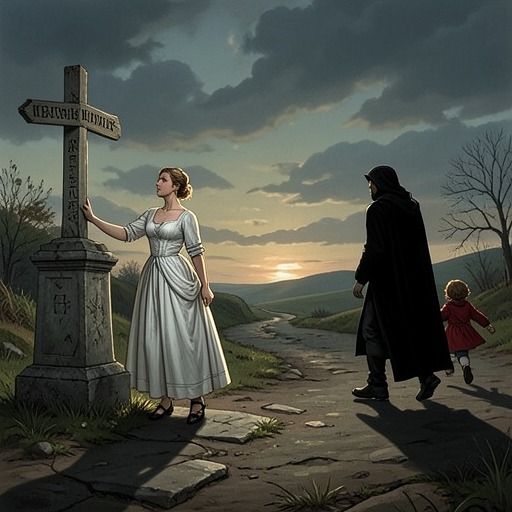
Agnes’s sense of the threshold is not abstract. When Mary confirms that Judith has pustules and fever, Agnes sees Anne, Mary’s daughter who died of plague at eight, beside the door. Anne appears in the room with a shroud over one shoulder, loose hair, blackened fingers and a swollen throat. Agnes knows the story of Anne’s death because Eliza told her, yet she also experiences the dead girl’s presence as something immediate. The scene makes the boundary porous: Agnes does not turn away from Mary, but knows Anne is there with them, and understands the veil between the two worlds as fragile. The living and dead seem distinct, yet close enough to touch and to permit passage between them. Her certainty that Judith must not cross to the other side turns perception into a fierce resolve.
Mary’s response connects that vision to practical care. She draws Agnes into a forceful embrace, then returns to work: she clears space by the hearth, calls for Hamnet to bring wood, and prepares to make a bed there for Judith. The threatened passage into death is answered not by a claim that it can be undone, but by an urgent arrangement of warmth, clean sheets, and bodies gathered around the sick child. The threshold is therefore both a supernatural-seeming divide and a pressure on ordinary acts of tending.
The Room of the Living
The image that organizes Agnes’s understanding is a room illuminated from within, perhaps set in the middle of a great wasteland. The living inhabit the room; the dead circle outside, pressing hands, faces, and fingertips against its windows in desperation to return to those they love. Some inside can hear or see the dead, and some can speak through the walls, while most cannot. The image makes the boundary a structure with uneven access rather than a simple line: the dead are near, but nearness does not mean that reunion is possible.
Agnes’s fear for the newborn Judith gives this vision its most immediate stakes. She nurses the twins repeatedly, holding one and then the other, and attends especially to Judith, whose mouth must be coaxed to feed. She imagines the smaller twin as the one who will be lost, and senses that the door from the room of the living stands ajar for the child; she can almost feel its cold draft. Her response is to imagine herself blocking that way out, filling the children with life and refusing to let death take one of them. Her conviction that she will have only two children collides with her insistence on defending all three. The threshold is feared precisely because it cannot be managed by maternal vigilance, even as vigilance becomes her answer to it.
The Twins and the Wish to Exchange Places
When Judith lies gravely ill, Hamnet sees death waiting in the room, near the door and watching for its chance. He wonders whether he must insist that it take him too, so that he and Judith can go together as they have always done. His imagined solution grows from the twins’ familiar childhood trick: because they have the same face, they exchange clothes and places to fool their family. The game has worked at the table and in the presence of their father, when a mistaken identity is revealed by a concealed smile or a demand to conjugate a Latin verb. Hamnet now considers whether the same substitution might deceive death.
That thought gives the threshold a painful relation to identity. The twins can imitate one another closely enough to confuse other people, and Hamnet’s wish to take Judith’s place extends that intimacy into a desperate attempt to bargain with mortality. But the scene does not establish that death can actually be tricked. It shows the limits of the twins’ shared identity: the imaginative exchange of clothes and roles offers a language for sacrifice, not control over who crosses the boundary.
The Dead Body and the Work of Separation
After Hamnet’s death, the threshold becomes inseparable from the body left behind. Agnes recognizes his hair and fingers as familiar while the rest of his face has been altered by illness and death. She recalls closing his eyes with her own hands and placing a penny on each eyelid to hold them shut. The task makes the passage irreversible in material terms: the child she knew is present before her, yet his body no longer answers as it did in life.
The women prepare the room and the body for burial. They burn the bedding, air and clean the room, move the still-weak Judith upstairs, and bring warm water, cloths, a white sheet, strong thread, and needles. A decree requires those who die of plague to be buried the same day. Agnes initially does not respond to the women’s offer to begin, while the basins of water cool beside her. The demand to prepare Hamnet for burial makes communal and public time press against her private inability to move forward.
When Agnes does begin, care takes the form of exact, remembered touch. She washes Hamnet and passes her fingers over the scar from his fall at Hewlands, the knot left by a dog bite, the writer’s callus on his right ring finger, and the marks of a childhood rash. She chooses rue, comfrey, chamomile, lavender, thyme, and rosemary to place in the folds of the shroud, rejecting plants whose smell Hamnet disliked or that had failed to save him. Then she threads thick thread and sews the sheet from the feet upward. The careful work does not erase the divide; it gives her a way to accompany his body toward burial without pretending it remains unchanged.
Burial, Departure, and the Unclosed Threshold
William Shakespeare carries Hamnet’s body to burial, wrapped in the white shroud and surrounded by flowers and sprigs. Agnes follows with Susanna and Judith; Bartholomew carries Judith, who hides her face against his neck and wets his shirt with tears. The procession passes along Henley Street, and Edmond joins William Shakespeare to help carry the board. These acts assemble the family around the passage from household to grave, even as each person bears the loss differently.
At the graveside Agnes imagines how Hamnet would have chosen a place near the river, because he loved water. She cannot bear to watch William Shakespeare lower him into the earth. In a moment she looks down toward Judith; when she looks back, Hamnet and the shroud have disappeared into the clay. The physical act of burial completes what her perception cannot accept: he is no longer there to be seen, and she understands that she will never see him again.
Leaving the churchyard proves harder than entering it. Agnes feels the dead there tugging at her skirts and touching her with cold fingers, as though they ask her not to leave them behind. She hides her hands and gathers her skirt, while struggling with the fact that she entered with three children and leaves with two. At the gate, William Shakespeare takes her arm; his face seems strange to her, though she can see in it the cheekbones and brow of their dead son, alongside the signs of living blood, tears, and a beating heart. Agnes feels emptied and cannot bring herself to cross the gate. The ending keeps the threshold open as an experience of grief: burial separates the dead from the living, but memory, perception, and the body’s resistance to leaving make that separation anything but clean.