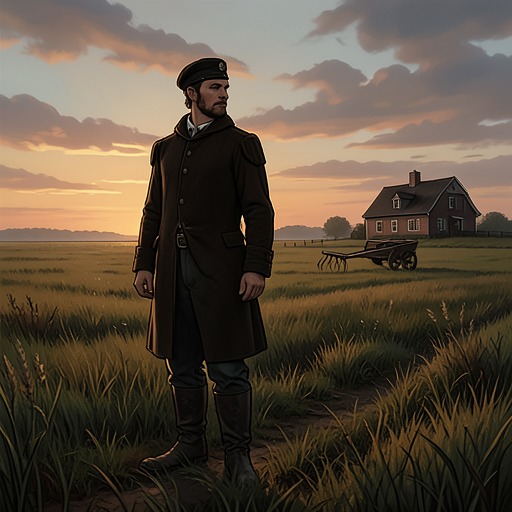
Walter Thirsk and Cecily: marriage
HarvestWalter Thirsk and Cecily: marriage is both a formative partnership in Walter’s life and a bond that continues through his widowhood. Cecily helps make the land and its demanding work his own; after her death, he remembers her as a source of love and encouragement, and understands that leaving the village will not end his attachment to her.
Marriage and a Shared Life
Walter recalls that he was once an outsider to the rhythms of village work. In his early days, he admired the countryside’s flowers and trees as objects of beauty, while his neighbors valued plants for their practical uses. His outlook changed after he found Cecily and began working the land himself. He came to understand that husbandry left little time for contemplation: the soil demanded unrelenting effort, and each year’s work was a defense against hunger. His marriage thus belongs to a larger change in his life, from a newcomer’s wonder at the landscape to an intimate, labor-shaped knowledge of it.
That change took place within a community dependent on shared agricultural work. At harvest, the reduced number of villagers made everyone’s labor necessary: children weeded, stronger workers cut the grain, women bound sheaves, and older people set the stooks. Walter describes this work as collective and sociable, its demands joined to common hopes and the need to secure food for the year. The account establishes the demanding world in which his life with Cecily took shape, though it does not specify her particular tasks in the harvest.
Love, Memory, and Loss
Cecily’s death leaves Walter a widower, and his grief returns in brief episodes rather than reaching a clear conclusion. He describes himself as an empty pod without her love and finds comfort in the prospect that he will never entirely stop missing her. The certainty of that continuing absence does not lessen his attachment; it becomes part of what he carries with him.
In a later private reverie, Walter imagines Cecily among the people whose judgment matters to him. She appears in his mind as alive and full of voice, encouraging him to make her proud. This imagined presence accompanies his attempt to prove his defiance through a furrow plowed into the field. The scene makes his memory of their marriage more than a recollection of past happiness: even in her absence, Cecily remains an audience for his choices and a measure of his courage.
The Village and the Land They Shared
Walter’s memory of Cecily is inseparable from his understanding of the land. Before joining village life, he could treat a flower or a dawn as a reason to pause; after beginning husbandry, he learned that the land’s beauty did not suspend the work required to survive. The change gives his marriage a practical as well as emotional dimension: loving Cecily coincides with taking up the labor and obligations through which he becomes part of the community.
As enclosure and a shift toward sheep farming threaten the agricultural life of the village, Walter imagines a different future based on wool, shepherding, and household weaving. The promised ease of that future sits uneasily beside his knowledge of the risks and effort involved in cultivation, and the proposed change threatens the shared way of life in which he and Cecily made their home. His memories therefore connect private loss to a broader loss of place: the marriage is over, but the land and village remain bound to it in his mind.
Widowhood and Departure
Walter’s grief does not resolve into a decision to remain. As he leaves Clover Hill, he acknowledges both that he cannot stay and that he will never finish missing the place. The two attachments—Cecily and the country associated with their life together—are distinct but intertwined. His departure changes his relation to that home without erasing it; memory makes continued absence, rather than reunion or closure, the final condition of the marriage’s presence in his life.