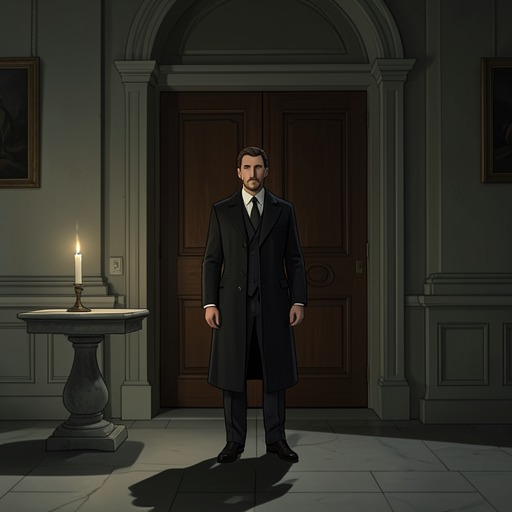
Charles Kent—Lucy Kent
HarvestCharles Kent—Lucy Kent is a marriage shaped in the story by both private loss and public inheritance: Lucy’s death leaves Charles Kent grieving, while the terms governing her estate make her kinship more legally powerful than his position as her husband. Her absence persists through objects she made and ceremonies held in her memory, even as a cousin’s claim threatens the household and land they shared.
Marriage and Family Background
Lucy was the daughter of the former landowner, who had no son. After Lucy married Charles Kent, her father died and the manor and property passed to her as her sole inheritance. This placed Charles Kent within the estate’s ruling household through marriage, but did not make him a blood heir. The distinction becomes decisive after Lucy’s death: a legal document provided that the property should be divided equally among her male blood heirs when she died.
The couple had no surviving son. Lucy died in childbirth in the spring, and the child was a girl. Charles Kent describes himself as Lucy’s sole heir, but the succession arrangement excludes him because a husband is not a blood relation. A cousin, Edmund Jordan, therefore asserts a claim. Their marriage had connected Charles Kent to the estate in daily life and responsibility; the inheritance terms nevertheless leave his authority vulnerable to a relative whose claim rests on blood descent.
Bereavement and Material Remembrance
Lucy’s death is marked not only by the loss of her and the newborn child but by the objects that remain. During the stable fire, Charles Kent comes down wearing a sleeveless mandilion Lucy had woven for him in the winter of her death. He stands beside his rescued mare, Willowjack, as the stable burns. The garment carries a domestic trace of Lucy into a public crisis: the surviving husband appears in something made by the wife who is no longer there, while his home and peace of mind are scorched by the fire.
The velvet shawl associated with Lucy becomes another consequential remnant. When Edmund Jordan asks about it, Charles Kent identifies it as his late wife’s. He does not identify the woman Walter Thirsk recognizes as its wearer, though he understands the connection between her and Willowjack’s killing. Instead, he offers a story in which an unknown nighttime intruder entered the manor and stole the shawl. This response places his bereavement alongside his choice to withhold a name from the new claimant. The evidence establishes the concealment, but does not reduce Charles Kent’s reasons to a single motive: he is also prepared to blame himself for Willowjack’s death, and the woman’s kin had been punished at his command.
Lucy’s Place in Village Memory
Lucy’s memory belongs to the village’s shared rites as well as to Charles Kent’s household. At the wooden cross and pillory by the unbuilt gateway of the unbuilt church, Charles Kent conducts marriages and baptisms, delivers eulogies for the dead, comforts bereaved people, and blesses seed corn and the plow. Lucy’s funeral was held there, as was that of Walter Thirsk’s wife. The same structure therefore serves as a place of communal observance and a device of punishment; its meaning changes according to the occasion.
This public setting gives Lucy’s death a communal register. Her marriage to Charles Kent belongs to the village’s ordinary continuities, while her death places her among those whose passing is acknowledged at the shared cross. The structure’s role in the novel is not limited to commemorating her: the account of Lucy’s funeral sits beside the later sight of newcomers confined there. A place that holds eulogies and offers comfort can also become an instrument of sentence, linking private bereavement to the village’s precarious customs of care and authority.
Inheritance and the Marriage’s Aftermath
The arrival of Edmund Jordan turns Lucy’s death into an immediate political and material crisis. Charles Kent’s proposed changes to the estate, including plans for sheep and the maps prepared by Philip Earle, are not presented as his own wishes. They are demanded by the cousin, who arrives to make good what he considers his entitlement. Lucy’s legal position, once the basis of her inheritance, now determines how much power her husband can retain after her death.
The marriage thus has consequences beyond the couple: through Lucy, Charles Kent became the estate’s master, but her death activates a rule that gives priority to male blood heirs. The discrepancy between domestic authority and legal claim helps explain his distress and the pressure surrounding the village’s future. Lucy remains central even when absent, not as an active participant in the estate dispute but as the person whose inheritance, death, and family line define its terms.
Significance of the Relationship
The relationship is rendered through a set of contrasts: a husband who governs village ceremonies but is not a blood heir; a wife whose woven garment survives her, while her legal inheritance passes into dispute; and a funeral remembered at the very structure later used to confine others. These details make marriage both intimate and institutional. Charles Kent’s attachment to Lucy is visible in the objects and memories attached to her, while the consequences of their union are measured by inheritance law and the uncertain future of the estate.
The narrative does not supply a detailed account of their courtship or married life. Instead, it gives the relationship weight through its aftermath: Lucy’s death in childbirth, the daughter who does not secure a male line, the husband’s contested status, and the wife’s belongings that continue to affect events. Her absence is therefore not a pause in the story. It is the condition that exposes Charles Kent’s legal vulnerability and shapes the choices he makes amid loss and change.