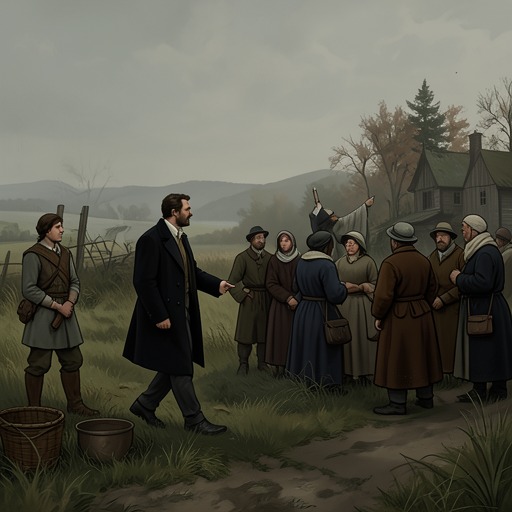
Walter Thirsk—Philip Earle
HarvestWalter Thirsk and Philip Earle develop a companionship that begins in practical collaboration and grows into mutual recognition. Earle arrives to chart the land, while Thirsk knows its demands from a lifetime of labor; their conversations bring those different kinds of knowledge together. As Earle’s maps turn the village into lines and colors, Thirsk becomes his guide to the lived landscape—and begins to imagine a life beyond the fields.
First Impressions and Shared Work
Thirsk initially regards Earle with a mixture of curiosity and apprehension. Earle is a young, cheerful visitor dressed for the open air rather than field labor, but his stiff left arm and shoulder make him visibly ungainly on rough ground. The villagers wonder whether the marks he makes on his board might somehow mark them in turn. Thirsk’s first response is therefore shaped by both Earle’s evident difference and the uncertainty of being measured by a stranger.
Their working relationship changes when Earle asks Thirsk to walk the village bounds, name what he sees, and help carry his charting tools. Earle also needs Thirsk’s assistance preparing paint and the calfskin that will become vellum for a land chart. The request offers Thirsk a departure from gleaning, where he would ordinarily gather grain for private ale and porridge and winter feed for the pigs he shares with John Carr’s family. He accepts the different work as an opportunity, and the walk becomes more than a survey: Thirsk supplies the knowledge that makes the mapped places intelligible.
That exchange is not effortless. Earle delights in scenery that Thirsk recognizes as inseparable from hardship, including The Bottom, whose beauty Earle praises without noticing its stench and the bones among the flies. The contrast makes Thirsk conscious of something he has lost. When he first arrived in the village, he too had been captivated by its plants and morning light, imagining that he could immerse himself in the land and contribute to the fields. Experience taught him instead that farming permits little time for reverie: the soil is stern and urgent, and work from dawn to dusk is a defense against hunger. Earle’s fresh wonder briefly restores Thirsk’s memory of that younger self, without erasing the labor that changed him.
Companionship in Art and Conversation
Earle’s artistry offers another point of connection. At the harvest gathering, he joins the village piper, Thomas Rogers, with his fiddle. His playing first echoes the pipe, then embellishes and takes over its tune; the music draws villagers into a dance that moves from children to young people and married couples. Thirsk watches with Charles Kent, unable to join because his palms and fingertips are sore. The episode shows Earle entering communal life through a talent that is not cartography, even as his accomplished playing unsettles the piper’s confidence.
Later, in the scullery, Thirsk and Earle work together on the calfskin and speak quietly. Thirsk tells him that, since the death of Cecily, he wants a change and an adventure—one that does not involve shepherding. Making vellum appeals to him as a craft. Earle listens closely, giving Thirsk reason to hope that he might discuss employment with his host. Their conversation is reciprocal rather than merely practical: Thirsk asks whether Earle has adventures of his own to pursue.
Earle answers by disclosing the limits that have shaped his life. His parents are dead, and his eldest brother has inherited the family home, warehouse, and riverboat business. Earle describes himself as neither wealthy nor physically suited to work: a childhood palsy left his left side wooden from shoulder to ribs. He cannot help his brother in the warehouse or on the boat, and he has been made to feel unfit for outdoor work and too burdensome for employment indoors. He has never been in love and doubts that, in his clumsy state, he could find a wife. He locates his happiness instead in paints and drawings. Sharing these circumstances makes Earle more than the smiling mapmaker Thirsk first observed; it gives their work together the character of an exchange between two men considering what use and purpose remain available to them.
A Possible Change of Life
As Thirsk prepares the vellum, Earle turns rough charts and drawings into a vivid composition. Thirsk sees patterns in them like those he has noticed in bark, lichens, moss, and the underside of leaves, but Earle’s designs are tidier and more colorful than nature’s. He recognizes the maps as rewarding objects in themselves, even as Earle explains that one depicts the land as it is before Young Edmund Jordan brings in his improvements. The work therefore joins Thirsk’s local knowledge to Earle’s craft while recording a landscape threatened by planned change.
The collaboration also gives Thirsk a possible way out. He considers the prospect of leaving within the week if Earle takes to him and Charles Kent gives permission. Parting from Charles, whose company and fellowship have been Thirsk’s for a lifetime, would be painful; becoming subject to Charles’s relentless cousin would be worse. Thirsk makes a point of appearing meticulous, though he has exaggerated his experience of preparing high-quality vellum. Earle’s expectation of a smooth but still textured surface, thin enough for candlelight to pass through, turns the task into a test of Thirsk’s ability to learn a new kind of work. His injured hand is recovering, though its tender center still prevents him from returning fully to threshing and winnowing.
Thirsk’s feelings about this prospect are mixed. After the walk and work, he likes Earle, but also feels that he has both made a conquest and been beguiled. He recognizes an opportunity in the visitor, and the attraction of it is inseparable from the chance to turn impending changes to his own advantage. The relationship is thus not simply a settled friendship: it is a growing attachment joined to a practical hope, with Thirsk’s future still dependent on Earle’s response and Charles Kent’s permission.
Mutual Attachment and the Village’s Peril
Earle’s attachment to the community becomes clear when, after fewer than four days among the villagers, he says that he fears for them. His inclusion of himself in that concern surprises even him. Thirsk recognizes the moment as a sign that Earle is putting down roots just as Thirsk imagines pulling up his own. Their positions have begun to reverse: the newcomer is becoming emotionally implicated in the village, while the longtime resident is contemplating departure.
That shared concern is focused on Mistress Beldam. Thirsk and Earle agree that she must be found and warned, since those investigating the bloodstained velvet shawl may connect it to her, whom villagers have seen wearing it both at the newcomers’ shelter and at the feasting barn. Charles Kent has claimed the shawl as his late wife’s, buying her time but risking his cousin’s contempt. Thirsk and Earle’s agreement does not erase Beldam’s misdeeds or offenses; instead, the narrative presents their attachment to her as persisting despite them, and possibly because of them. Their companionship is revealed not only in craft and conversation but in a shared willingness to care for someone endangered by the village’s unfolding conflict.
The bond remains open-ended. Thirsk may seek employment with Earle, but the evidence does not establish that they leave together or that the prospect becomes a settled arrangement. What has changed is the range of futures Thirsk can imagine, and the extent to which Earle, initially an outsider with a board of mysterious marks, has become someone whose work, vulnerability, and loyalties matter to him. Their companionship brings artistic mapping into contact with practical knowledge, and personal possibility into contact with responsibility for the people among whom they have met.