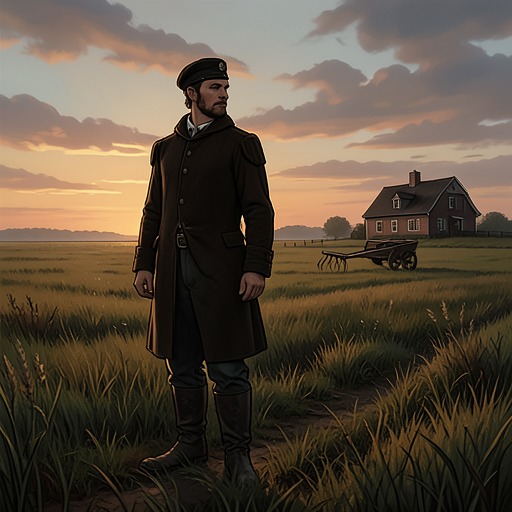
Walter Thirsk and Kitty Gosse: affair
HarvestWalter Thirsk and Kitty Gosse’s affair is a private bond with public consequences: it gives the widowed Walter a place of intimacy and refuge, yet deepens his precarious position between the village and the manor. The relationship is presented less as idealized romance than as a complicated attachment shaped by bereavement, habit, gossip, and the villagers’ rival claims on loyalty.
Formation and Circumstances
By the time Walter’s relationship with Kitty is known to the village, she is a widow. Walter recalls that he has spent the previous evening in her bed, while his own recent bereavement has narrowed his capacity for wider attachments. He does not describe himself and Kitty as great lovers; instead, he understands their connection as something simpler and less exalted. That qualification does not make it insignificant: the affair offers closeness at a point when Walter is still living with the loss of Cecily.
Kitty’s home is a familiar refuge for him. Walter remembers that she has welcomed him there before, and that he has spent nights with her while she drank her greenish barley ale. Kitty describes the drink as a way of dampening the sorrows of widowhood, though Walter recalls that she drank it even when Fowler Gosse was alive. The detail places their intimacy within an established domestic routine rather than presenting it as a sudden or purely romantic attachment.
Intimacy and Village Judgment
The village’s harvest customs make private conduct unusually exposed to communal talk. During the collective reaping, people work together within earshot and treat gossip as part of the day’s shared labor. Their jokes range across sexual and marital conduct, including widowers suspected of seeking intimacy elsewhere. In that setting, Walter and Kitty’s relationship is not simply a private matter; it becomes legible to neighbors who watch, speculate, and measure one another’s behavior.
When the villagers begin closing ranks amid suspicion and danger, Walter recognizes that the affair counts against him in two different ways. Those connected to Kitty and Fowler Gosse may regard him as someone who has trespassed on another man’s domestic place; Saxton family members may see the relationship as disloyal to the memory of Cecily. He also acknowledges that jealousy may sharpen some men’s anger, since others had hoped for Kitty’s favor. These judgments compound his existing reputation as the master’s man, making the relationship one more reason for neighbors to keep him at a distance.
Separation and Emotional Consequences
When Kitty is taken away to the manor, Walter experiences her absence as a powerful distress. He is surprised by the intensity of his response because he had thought his capacity for attachment diminished by Cecily’s death. His feeling is not framed as proof of a grand romance: he continues to distinguish their bond from idealized lovers’ devotion. Rather, the loss of access to Kitty makes clear how much the ordinary intimacy between them had come to matter.
After the villagers have left, Walter stays in Kitty’s home instead of taking an empty neighbor’s bed. He has been accustomed to being welcomed there, and that history makes the room feel more available to him than other abandoned homes. The choice also reflects his continuing attachment to local custom: even when the village is absent, he is reluctant to enter a neighbor’s house without invitation. In Kitty’s cottage, familiarity offers a limited shelter, but not the companionship he wants.
Habit, Loneliness, and the Affair’s Afterlife
On another night, Walter leaves Kitty’s home hoping to find the Beldam couple and share their company. Finding no sign of them, he returns to the ale Kitty kept in the cottage and drinks far more than he usually would. His account of her ale recalls her habitual thirst and the nights he had spent with her, so the drink functions as a reminder of their shared domestic life even when Kitty herself is absent. It does not replace her presence: Walter describes the drinking as a way to quiet his sorrows and anxieties, while his imagined visitors and conversations with shadows reveal the extent of his isolation.
The affair therefore persists in the narrative not only as a sexual relationship but as a measure of Walter’s fragile belonging. Kitty’s home has admitted him where other village homes now feel closed, and her absence leaves him without the intimacy on which he had come to rely. At the same time, the relationship cannot secure his place among the villagers: it supplies companionship, but also gives suspicious and jealous neighbors another reason to treat him as separate from them.