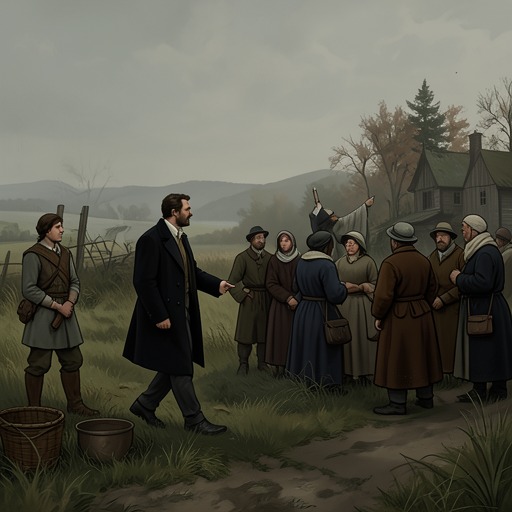
Walter Thirsk and Philip Earle: friendship
HarvestWalter Thirsk and Philip Earle’s friendship grows through divided loyalties, acts of kindness, and work shared at the plow. Walter does not simply admire Philip from a distance: he considers joining his employ, feels responsible for warning him of danger, and searches for him when he disappears. Philip, meanwhile, offers an example of courage and compassion that Walter sees the village failing to provide. Their friendship is chiefly witnessed from Walter’s side, and its final measure is his discovery of Philip’s murdered body.
A Friendship Across Divided Loyalties
Walter’s attachment to Philip takes shape while Walter is unsure where he belongs. He has kept secrets from his neighbors, including what he overheard in the manor house gallery and what Philip disclosed about the older Edmund Jordan’s will and its entitlements. Walter acknowledges that his silence makes him difficult to trust, but also that he cannot serve every master and friend equally. In that unsettled position, he considers working for Philip, whose colored charts and elevated view of the world both attract and unsettle him. Walter wonders whether Philip is too vulnerable for him, yet the possibility of entering his employ remains real enough that he imagines returning to the manor house as Philip’s ally.
The attraction is not only practical. Walter recognizes in Philip a man whose physical vulnerability is visible, and whose manner does not conceal it. Philip has described himself as an awkward, ill-fitting presence; Walter recalls the remark while weighing whether he can depend on him. Their connection therefore begins without an easy assurance of comfort or strength. Walter’s sense of kinship with Charles Kent complicates his choices, but his uncertainty about where he will finally belong leaves room for a different allegiance to form around Philip.
Courage and Kindness in the Church Ground
Walter witnesses Philip’s compassion at the unbuilt church gateway, where the remaining pillory captive is spending his third night in the stocks. The villagers pass without greeting either man, though they are disturbed to see Philip with his arm across the young prisoner’s shoulder, speaking close to his ear. The gesture makes the two outsiders appear joined, and it risks making Philip unpopular. Walter understands why the village has failed the captive: the community is ashamed of its treatment of both him and the older man who died, but shame has not yet become practical kindness. Philip supplies what the villagers withhold, offering intimate comfort where they have not even offered a greeting or a crust.
Walter’s judgment of Philip is consequently moral as well as personal. He sees him as valiant and kind, and recognizes that Philip’s conduct exposes the village’s own failure to follow its customary obligations. The contrast matters to their friendship: Philip is not merely an employer Walter might choose, but a person whose actions give Walter a reason to respect and defend him. Walter sees that this generosity may cost Philip standing among the villagers, yet it strengthens Walter’s regard for him.
Intimacy Through Shared Work
The friendship becomes most tangible during a day of plowing. Walter and Philip—his silent helpmate at the oxen—cut a narrow strip through a field that would ordinarily take twelve days to plow with four oxen and twenty men. They mean to complete only a single day’s work, but Walter wants the furrow to be straight and sound. As they move across the ground, Philip whistles; Walter talks. The physical labor gives them a form of companionship that does not depend on a reply. Walter describes the troubles of the week, remembers Cecily and his boyhood friend Charles Kent, and praises Philip’s bravery and decency. Philip continues whistling, leaving Walter unsure how much he is hearing, but the two remain close through the work itself.
The conversation also reveals the pressures surrounding their bond. Walter contrasts the laboring oxen with the sheep that may replace them, imagining a future in which people wait upon helpless animals. The warning is part of a conversation with Philip, but also an expression of Walter’s unease about the estate’s transformation. The plow joins them to a threatened form of life and labor: reins, mud, furrows, and the oxen’s steady movement. Afterward Walter sends Philip away before sowing winter wheat himself, so the shared work is substantial but bounded. Walter takes responsibility for the sowing and for the field’s future; the day’s intimacy lies in what they have done side by side, not in a promise that they will always act together.
Searching for Philip
When the village becomes tense after the women and several sons go missing, Walter resolves to find Philip and warn him about the reception he may face. Walter knows that he is unpopular and suspects Philip does not understand how exposed he is among the villagers. Yet Walter is not simply protecting Philip from other people: he fears Philip may be injured, and fears as well that Philip has become intimate with Mistress Beldam. The concern is complicated by Walter’s suspicion of Beldam, but it does not cancel his sense of duty to Philip. He leaves his ordinary work undone and makes himself available in the lanes, anxious for the Chart-Maker’s whereabouts.
Later, Walter searches near the place where the Beldams first made their den, following the edge of Turd and Turf. He does not want to find Willowjack, the remains of the pillory captive, or Philip’s body. For a time he chooses the likelier hope that Philip was warned and escaped. At Blossom Marsh, Walter sees a stone memorial raised by Beldam’s daughter for her father, but no sign of Philip’s body above the bog. He calls out both Philip’s familiar title and his surname, listening for an answer that never comes. The scene makes Walter’s search an act of attachment as well as investigation: he cannot move on safely himself until he has made some effort to learn whether Philip is alive.
Discovery and Loss
Walter eventually finds Philip in the manor’s attic, facedown beneath the loose lining of a travel chest. He recognizes him without turning his face: Philip’s gentlemanly boots, decorated jerkin, townsman’s breeches, plain cap, paint-stained fingers, and carefully shaped beard identify the man Walter has been seeking. Even the creases at the back of Philip’s neck seem to preserve the trace of his familiar smile. Walter recognizes the body as Philip’s, not merely as the missing Chart-Maker’s, and sees how death has fixed his already lopsided form into a harsher stillness.
The body bears repeated sword wounds through the chest and back. Walter cannot determine when the killing occurred; he considers both the previous night and the night of the women’s torture. He does infer that it probably happened in the upper rooms, near the poorly maintained attic stairs. The uncertainty leaves the murder unresolved at the moment of discovery, but not the relationship’s ending: Walter’s earlier fear that Philip might be hurt gives way to the fact of his death. The friendship that had been expressed through warning, witness, and shared labor concludes in Walter’s recognition of Philip’s body and his hurried flight from the attic, carrying the loss into the danger that surrounds him.