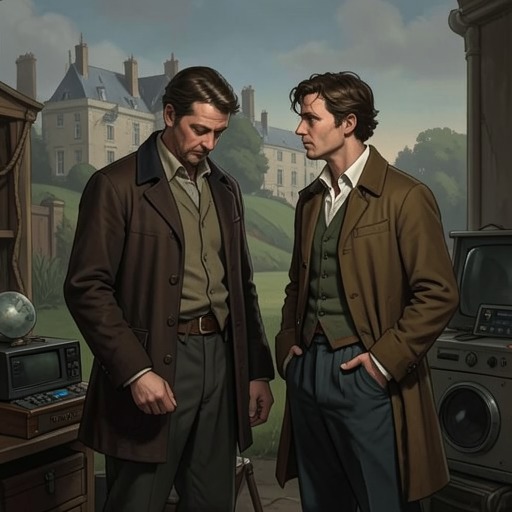
Walter Thirsk and Charles Kent: friendship and service
HarvestWalter Thirsk and Charles Kent: friendship and service is a relationship in which work and affection are inseparable. Walter is Charles’s man, but he also regards Charles as a kind of brother; their bond is tested when Walter’s loyalties fracture amid the village’s collapse, then reappears in a quiet reunion between two aging men who recognize what has been lost. Their closeness is measured not by declarations but by shared labor, familiar gestures, and the painful question of whether service can still mean belonging when the land and community that gave it meaning are disappearing.
Service and a Shared Working World
Walter’s connection to Charles takes shape within the demands of the fields. Harvest is collective necessity: with the village’s numbers reduced, everyone able to work is expected to reap, bind sheaves, clear weeds, or stack grain. Walter describes this labor as both physically exacting and socially binding. The workers gather within common ditches and shared hopes, and the work’s rhythm makes conversation public. Charles’s household and Walter’s labor belong to this same seasonal world, where the prospect of enough grain for the year depends on sweat, weather, and the coordinated effort of neighbors.
That world also gives their relationship its practical intimacy. Charles is not a distant authority in Walter’s account but a master encountered amid work and village custom. At the village’s unbuilt church ground, the neglected pillory serves as a cross and a communal gathering place. Charles conducts marriages and baptisms there, delivers eulogies, and comforts the bereaved. Walter’s wife, Cecily, and Charles’s wife were both commemorated at that spot. The shared setting binds personal grief to public ritual: they have each lost a wife, and the place where the community gathers to remember the dead is also where Charles performs the duties that hold their scattered village together.
Affection Beyond Rank
Walter’s feeling for Charles exceeds the language of employment. When he is estranged from the villagers, he considers asking Charles to take him back as his man and let him return to the manor house and its attic rooms. He imagines standing beside Charles when Charles’s cousin asserts control and sheep begin to replace the village’s fields. Walter calls Charles his only brother in a way, while immediately admitting that he cannot quite think of him as family. The hesitation matters: their bond crosses the boundary between master and servant, but does not erase it.
Walter’s loyalty is not simple or constant. He has kept secrets from the villagers, including what he overheard in the manor house and what Philip Earle disclosed about the older Edmund Jordan’s will and its entitlements. He acknowledges that this silence has made him difficult to trust, even as he understands it as a way of avoiding divided service to masters and friends. His uncertainty extends to Charles: he may return to him, but does not know whom he most wants to please or where he wants to settle. The relationship thus becomes a choice under pressure, not an unquestioned inheritance.
The Crisis of Loyalty
The threatened transformation of the estate sharpens the conflict between service and friendship. Charles’s cousin, Edmund Jordan, intends to enclose the land and turn it into sheep country. Walter understands that Charles may need an ally as his authority is challenged, and he associates returning to Charles’s service with the possibility of remaining at the manor. But he also knows that the village’s customary life is imperiled. The choice is not merely between two employers: it is between different claims on Walter, and between attachment to Charles and the land that has sustained the community.
When Walter is isolated from the villagers, Charles becomes the person toward whom he can turn. Later, while in Edmund Jordan’s employ, Walter risks a carefully chosen question about whether Charles has been deposed altogether. To show that his concern is more than political calculation, he reaches across the bench and lays a hand on Charles’s elbow. The gesture is a reminder of their former closeness and an attempt to step back into Charles’s world. Walter describes the appeal as a return to Charles’s yard, suggesting that service offers him a possible place when the village no longer trusts him.
Reunion and Shared Loss
The relationship is renewed in the orchard, where Charles accompanies Walter as they go to prepare five horses for a journey. With the groom unable to do the work, the horses have been left untethered overnight. The two men walk shoulder to shoulder down the lane, graying and weathered by life on the land; for a moment, they could be mistaken for equals. Charles takes Walter’s hand and thanks him, telling him how glad he is to see him and admitting that he feared Walter had fled with everyone else. Walter has returned despite his bruises, and Charles acknowledges that he would not have blamed him for leaving.
Their conversation turns from relief at finding one another to the speed of the village’s disappearance. Charles has considered fleeing himself, even setting a light to his home rather than witnessing the changes ahead. In five or six days, he says, the village has been lost to him and to everyone. The reunion does not repair that loss; it makes it intimate. Their old friendship is briefly restored within a landscape emptied of the people and routines that once gave their relationship its daily setting.
Charles’s response to the crisis also shows the practical care that persists between them. Once the villagers have dispersed, Edmund Jordan’s interest in the captives and accusations of sorcery diminishes. Charles uses that shift to intercede for the captive women and Lizzie Carr, arguing that their punishments should end. Walter is present to hear of this effort, even though the earlier political turmoil had left him uncertain about where his loyalties belonged. The bond between them therefore survives not as a return to an unchanged hierarchy, but as a renewed recognition between old companions confronting a common dispossession.