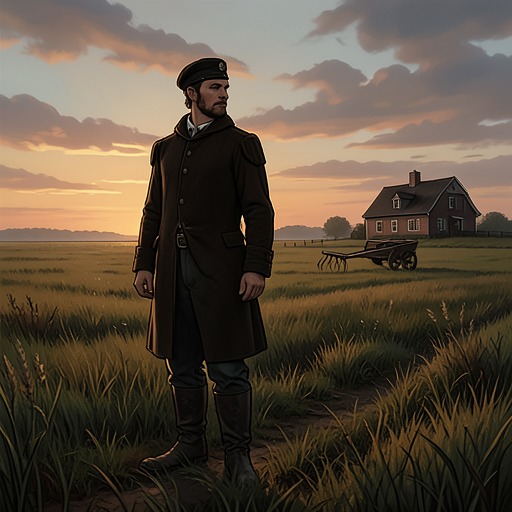
Walter Thirsk—Cecily
HarvestWalter Thirsk and Cecily’s marriage is the emotional bond through which Walter comes to belong to village life: he courts her by working beside her, makes a home through shared labor, and, after her death from fever, finds that neither his work nor his place in the community feels wholly his own. Their relationship is remembered less through domestic scenes than through the land they cultivated together and the bodily traces grief leaves behind.
Meeting and Courtship
When Walter first came to the area, he was still in Charles Kent’s service and regarded the surrounding land as a treasury of possibility. He walked through the commons to the forest edge, touching what he encountered, and saw in the fertile countryside a chance for an expansive life unlike the one he had known in town. His attention to the place soon became bound up with his attention to Cecily: he saw a future there with her and courted her by working at her elbow in her fields.
That labor was not merely a way to win Cecily. Walter describes it as an act of love, giving his strength to the needs of her soil and putting his shoulder to the plow for her. The physical demands of country life changed him: his muscles grew through work, and he became tough through the effort of adapting to the land. In this account, courtship takes the form of participation. Walter’s affection is expressed not at a distance from Cecily’s life, but by entering its daily work.
Marriage in the Working Landscape
The marriage gave Walter more than companionship; it helped turn a promising landscape into a home. Before Cecily, he had been struck by the countryside’s beauty and abundance. Living and working with her taught him its less forgiving character. The land was stern and impatient, exposing those who depended on it to scars, bruises, roughened hands, and the constant necessity of labor. Walter came to value the village not as an untouched pastoral refuge but as a place where people pressed themselves against a living, changeable world.
Harvest gives a sense of the communal setting in which their life unfolded. Everyone able to work was expected to take part: children weeded among the crop, stronger workers swung sickles and scythes, women bound sheaves, and older villagers arranged the stooks. The work was strenuous, but its shared rhythm also brought neighbors together in one field, where conversation, teasing, and gossip accompanied the cutting of grain. Cecily’s own tasks are not individually described in this harvest account, but Walter’s courtship memory establishes that fieldwork was central to their shared life. His remembered act of working alongside her belongs to the same material world of seasonal labor and dependence on the crop.
Loss and the Change in Walter’s Work
Cecily died of fever after more than eleven years of married life with Walter. He remembers the illness as a sudden, overpowering midnight loss. The account does not dwell on the course of her sickness; instead, it makes clear what her absence changed. Walter still has a portion and a place in the village, and he recognizes that he is fortunate, but he no longer experiences his labor as he once did. Without Cecily, work has lost its loving purpose and become duty.
That distinction marks the depth of the bereavement. Walter’s attachment to the countryside began partly in wonder, but it was made durable by his bond with Cecily and by the life they built through work. After her death, he feels that he has not become entirely at home, even after twelve years in the area. He contrasts himself with families long woven into the place, whose belonging seems inseparable from its customs and land. He regards himself as someone who has stayed rather than someone formed entirely by the commons. Cecily’s absence thus unsettles both his intimate life and his sense of membership in the community.
The Marriage Bed and the Continuing Bond
The marriage survives in Walter’s memory through the ordinary place where its intimacy was lived. When Kitty Gosse comes to his door at night, Walter sometimes turns away from the possibility of being with her because the bed is the one he shared with Cecily. He remembers that Cecily slept and died there, and that a woman who shared a life with him for more than eleven years leaves a mark. In the dark, his hand crosses the rough mattress and finds the hollows where her shoulders and hips had rested, which he experiences as bodily traces of her absence.
This recollection distinguishes his marriage to Cecily from his physical relationship with Kitty. Walter characterizes what he feels for Kitty as sexual rather than deeply affectionate, and he recalls Cecily’s touch as tenderly laid across his chest. The comparison does not erase his desire or make him free of contradiction; it shows how grief continues to shape his responses to intimacy. Cecily is absent, yet memory of their shared bed can interrupt a later encounter and draw Walter back toward the history of their marriage.
Significance of the Relationship
Walter and Cecily’s relationship binds love, labor, and belonging together. Its beginning is marked by Walter’s willing effort in her fields; its loss is measured by the way work continues without its former emotional meaning. The land is never simply a picturesque setting for their marriage: it asks for sustained labor and exposes those who depend on it to uncertainty. Yet it is precisely through that demanding life, shared with Cecily, that Walter once found a future and a home.
The marriage’s afterlife is therefore carried in two forms: in the agricultural habits that persist after Cecily’s death, and in the intimate memory that remains lodged in the marital bed. Walter can continue to work and can remain among his neighbors, but neither fact restores the love that once joined his labor to a shared future. Cecily’s absence leaves him working in the same landscape while feeling that the life that made it home has gone.