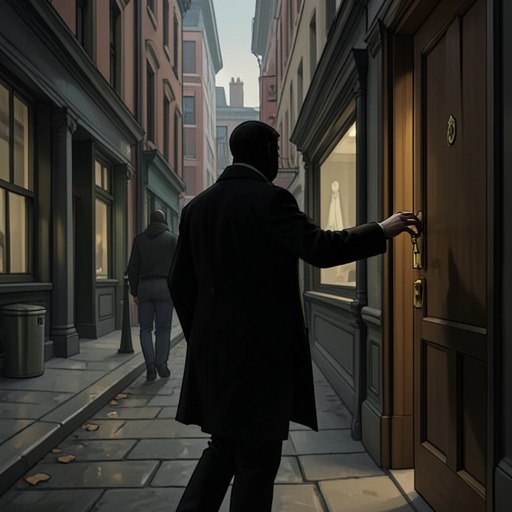
Kraken’s Ambush by Billy Deener
HomunculusBilly Deener’s ambush turns Bill Kraken’s hunger for shelter into a sudden, nearly fatal assault: drawn into a dark rented room by what appears to be a woman, Kraken finds Deener waiting with his own peapot, then faces a pistol as his head is already bleeding. The attack strips away Kraken’s livelihood and leaves him to interpret his survival through the unlikely conjunction of a bullet, a book, and what he calls a miracle.
The Ambush
A lit house advertises beds for rent, and Kraken, caught between desire and regret, is dragged up its stoop and into a room scarcely larger than two closets placed end to end. He stumbles against the bed and falls face-first, hunched over his peapot; its lid flies off and clatters against the opposite wall. In the darkness, a hand pushes him down when he tries to rise. As he reaches for help, another hand takes the peapot by the thong and pulls it away. Kraken reads the rough handling as part of an encounter he has misunderstood, and tries to make sense of the breathing and shuffling behind him.
The moonlight supplies the recognition too late. Kraken rolls over expecting to see his female companion, but the figure standing above him is a man: Billy Deener, slowly chewing his tongue beneath a battered black chimney-pot hat, with the peapot raised over it. Kraken shouts Deener’s name. Deener brings the pot down; Kraken twists aside and raises his left wrist to shield his face, but the blow glances off the wrist and smashes into his cheek. He rolls into a wall. In the tiny room, the bed is the only other feature he can make out, and there is nowhere to retreat.
Deener swings the pot by its thong, strikes Kraken’s forehead, and hauls it back for another blow. The attack is close and bodily: Deener’s mouth hangs open as he growls, and spittle flies when the force of his swing throws his head back. Through the blood blurring his vision, Kraken watches with detached astonishment as Deener slowly draws a pistol from his coat, cocks it, and aims. The peapot that had marked Kraken’s precarious trade has become the weapon used against him; the assault leaves him with a head wound and a lasting ache in his chest.
The Book and the Aftermath
Kraken wakes in an unfamiliar bed, pleasantly warm beneath a feather comforter, with a rushing in his ears that recalls an earlier cold night in a Limehouse riverside cannery. His forehead is wrapped like an Egyptian mummy, and his chest carries a dull ache as if a horse had kicked him. The disorientation gives way to recognition through a familiar object on the bedside table: William Ashbless’s Account of London Philosophers, its ocher binding worn and curled at the edge from handling.
A round hole runs through the book, page after page, ending at a conical lead slug whose nose rests against page 180. The bullet has stopped just short of damaging a treatise on poetics. Kraken reads that the book divides humanity into two opposing camps: poets, or wits, and men of action, or half wits. He doubts the philosophy, yet the bullet’s curious halt persuades him that he ought to study it further. A volume of argument has become the material proof of his reprieve.
Kraken identifies the bullet as the one that could have killed him and calls its preservation of the page a miracle, the unmistakable finger of God. The recovery also exposes the cost of the ambush in ordinary terms: his peapot is gone, and with it the livelihood he has come to despise. He decides he would rather return to hawking squids, reasoning that being struck with one would not amount to very much. The shift is characteristic of his picaresque survival: a near-fatal encounter becomes, at once, divine sign, comic lesson, and practical reassessment of the trade that brought him into danger.
The Rescue at Jermyn Street
Kraken’s recovery is framed by the quiet signs of a rescuer before he fully understands where he is. Beside the familiar volume lie clay pipes, a tobacco pouch, and matches; a moving shadow beyond the half-open door resolves into the head of Captain Powers. The darkness beyond the window is Jermyn Street. Kraken recognizes that Captain Powers has saved him, and that the book which stopped the bullet has become part of the same unlikely reprieve.
The adjoining room carries a different kind of danger. A woman sobs that she cannot, while Captain Powers remains silent for several moments. He then says, “The Indies.” Kraken catches only fragments of what follows, including that Langdon St. Ives is all right; when Captain Powers suddenly cries, “Let them try!” the woman’s shadow returns and embraces his. The scene gives no further explanation of their exchange, but sets Kraken’s private recovery against an urgent concern shared by the two figures in the next room.
Kraken listens from his bed without joining them, peeking over the spine of the book as he follows the shadows. The contrast completes the reversal of the ambush: in the rented room, he was alone, trapped between the bed and the wall; at Jermyn Street, other people have intervened, though their own trouble remains beyond his knowledge. His survival is therefore not presented as a tidy escape from danger, but as a brief shelter inside a wider conflict.
The Bullet, the Peapot, and the Book
The ambush binds Kraken’s material losses to an unsettling lesson in interpretation. Before Deener appears, the peapot is both the tool of Kraken’s trade and the object he is hunched over in the rented room; in Deener’s hands, its thong makes it a blunt weapon. Afterward, the pot is gone, but the bullet that could have ended Kraken’s life remains lodged in a book. The reversal is exact: the object that sustained his livelihood becomes an instrument of violence, while a volume he can scarcely assess becomes the explanation he carries away from it.
The bullet’s path gives that explanation its peculiar force. It makes a round cavity through the worn book and stops at page 180, its conical nose short of the treatise on poetics. Kraken reads that humanity is divided between poets, or wits, and men of action, or half wits. He is not convinced by the argument itself; what persuades him to study it is the bullet’s failure to pierce the page. The book does not simply offer a philosophy after the event: its physical damage, and the limit of that damage, become part of what the event means to him.
That response preserves the scene’s comic uncertainty without diminishing its violence. Kraken calls his survival a miracle and the unmistakable finger of God, yet immediately draws a practical conclusion from the loss of his peapot: he would rather hawk squids, whose blows, he thinks, would matter less. His reasoning moves between providential meaning and street-level calculation, neither canceling the other. The ambush leaves him alive, wounded, and without his trade; the book gives him a way to turn that arbitrary reprieve into an occasion for thought, even as his next concern remains how to make a living.