The Exhumation of Joanna Southcote
HomunculusThe exhumation of Joanna Southcote turns Shiloh’s private hope of recovering his mother into a covert operation by Willis Pule and an unnamed companion. At Hammersmith Cemetery, the coffin’s accidental collapse exposes the remains and a figure emerges from the grave, but Pule continues the task, wraps the remains in a tarpaulin, and carries them away. The recovery leads toward Ignacio Narbondo’s laboratory, where Joanna’s remains are placed amid preparations for reanimation. The episode binds religious expectation to experimental practice while making the grave itself a source of uncertainty: the person who climbs out is not identified, and Shiloh’s desired resurrection has not yet been achieved.
Motive and Stakes
Shiloh’s interest in the exhumation is not simply an appetite for the dead or for spectacle. He imagines that Narbondo might restore Joanna, whose body lies beneath the soil at Hammersmith Cemetery. The possibility overwhelms him because the goal is to recover and revitalize his mother, not merely to make a corpse move. He regards that hoped-for return as worth far more than Narbondo’s animated corpses, which Shiloh understands as useful but imperfect recruits: they can work without protest, yet cannot think. His vision therefore sets personal restoration apart from the doctor’s instrumental use of the dead.
That hope belongs to a wider religious conviction. Shiloh believes that the tiny being in the box, the homunculus, was his father, and sees himself as carrying on his father’s work. He also resents those who had condemned Joanna and denied the possibility of her divine conception, though they are beyond his reach. Recovering her remains offers a way to revisit that past and potentially prove his beliefs through an extraordinary return. The scene does not confirm that his interpretation is true; it establishes the intensity of his belief and the emotional importance he assigns to the experiment.
The Night at Hammersmith Cemetery
Willis Pule performs the digging in near-total darkness, working with an unnamed companion beneath a heavy fog. The labor is uncomfortable and risky, and Pule resents being the one wielding a spade while Ignacio Narbondo is absent. He expects that, if they are discovered, Narbondo could leave in his dogcart while Pule is left to answer to the authorities. That imbalance makes the undertaking not only clandestine but also a further expression of Pule’s subordinate and resentful position in the partnership.
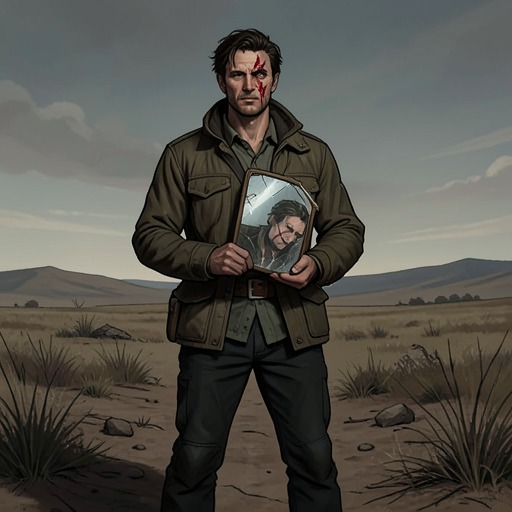
The broken headstone supplies only a fragment of Joanna’s name, while the coffin is identified as hers. Although the wood has endured underground, one corner has begun to decay. As Pule helps lever the coffin out, its bottom gives way and the remains slide onto the ground. His companion, who has been working beside him, appears to be trapped beneath them; with deliberate effort, the man frees himself, climbs out of the hole, and walks away into the fog. The text leaves his identity and condition unresolved. The moment interrupts the practical work with an unexplained escape from the grave, but it does not stop Pule from completing the recovery.
Pule climbs into the hole, takes hold of the remains, wraps them in canvas, and drags the bundle across the wet grass toward the road. He leaves the lantern behind, and the open grave disappears into the mist. The image of the abandoned light and the covered remains marks the transfer from a public burial place to secret custody: Joanna is no longer undisturbed in her grave, but her hoped-for restoration remains uncertain.
From Grave to Laboratory
The removal becomes part of a larger network of dealings around death and reanimation. Theophilus Godall later connects Narbondo’s experiments with Shiloh and Kelso Drake, speculating that Narbondo might supply Drake with an army of workers and that Drake may instead be interested in the homunculus. Godall does not claim certainty about these motives. His account places Shiloh’s attempt to recover Joanna alongside competing schemes, but the particular hope attached to her remains is Shiloh’s own.
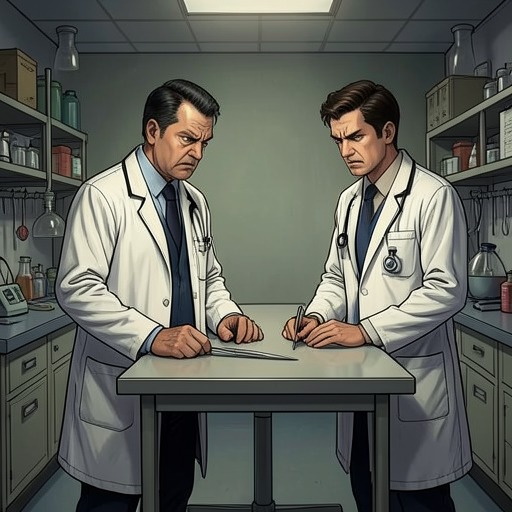
At Narbondo’s laboratory, the remains lie on a slab while the doctor prepares another body and a sluggish carp on a gurney. He has extracted a bean-shaped gland from a carp and preserved it in amber liquid; his handling of the fish makes animal matter part of the procedure, rather than treating reanimation as a purely spiritual or mechanical act. When Narbondo moves the Keeble box, the heap of bones and winding sheet appears to slump. The small movement abruptly recalls Joanna’s identity to Shiloh, whose attention shifts from the apparatus to his mother. He then notices that her hands are missing and demands an explanation. Narbondo asks Pule where they are, but the passage does not establish their location or what was done with them.
Uncertain Results and Aftermath
The laboratory scenes distinguish preparation from success. Narbondo’s work is controlled and purposeful, and the preserved carp gland suggests a method, but the exhumation itself does not restore Joanna. The remains respond only with a brief, ambiguous movement when the box is shifted. Later, Bill Kraken finds the bones shuddering, gathering themselves, and then collapsing again; the movement produces the clatter that draws his attention. Langdon St. Ives and Hasbro subsequently confront a laboratory crowded with shambling ghouls, confirming that the experiments have consequences beyond the table. These events intensify the danger surrounding Narbondo’s work without establishing that Joanna has returned as the person Shiloh longs to recover.
The exhumation’s decisive consequence is therefore a change in custody and meaning. Joanna’s remains are taken from the cemetery for an experiment whose instruments include a carp gland, a fresh cadaver, and the Keeble box. For Shiloh, the aim is a singular reunion with his mother; for Narbondo, the remains enter a broader practice of animating the dead. The episode leaves those purposes in tension, and its unexplained figure emerging from the grave anticipates the story’s repeated uncertainty over the boundary between a body that moves and a person who has truly returned.