Drake’s Threat to William Keeble
HomunculusDrake’s Threat to William Keeble marks the point at which Kelso Drake’s interest in Keeble’s perpetual-motion invention becomes an attempt at coercion rather than a negotiation. He offers money for the engine plans and patent, then responds to refusal with threats of pressure and ruin, an imposed deadline, and a pointed remark about Keeble’s daughter. Keeble does not yield; the encounter instead makes clear that Drake regards the invention as a tool for industrial use and that his pursuit of it may endanger the people around its maker.
Background and Stakes
Keeble’s invention had taken twelve years to develop, a duration that disappointed Langdon St. Ives. Keeble nevertheless judged that the work could now be done faster, though at fearsome expense. The effort had attracted Drake’s attention: Keeble told St. Ives that Drake had approached him about the device and, specifically, its patent. Drake apparently imagined using perpetual-motion engines to power entire factories. The stakes therefore exceeded the price of a curious mechanism. The patent could place control of an unusual technology in the hands of an industrialist whose ambitions were directed toward large-scale production.
A break-in at Keeble’s house had already sharpened the suspicion surrounding that interest. The intruder fled with plans for a roof-mounted sausage cooker, not the sought-after invention. Keeble believed the thief had been trying to reach plans hidden in a cache, but had been trapped by a window that closed and latched; surprised by the cook, the intruder grabbed the nearest set of papers and escaped. The bizarre, useless prize obscured the likely target. Theophilus Godall suspected that Drake had been after the perpetual-motion engine, and imagined that he might market the stolen cooker plans simply to mock Keeble and his associates. That account is suspicion, not proof of Drake’s role in the break-in, but it establishes the atmosphere in which his later visit is understood.
The Offer Becomes a Threat
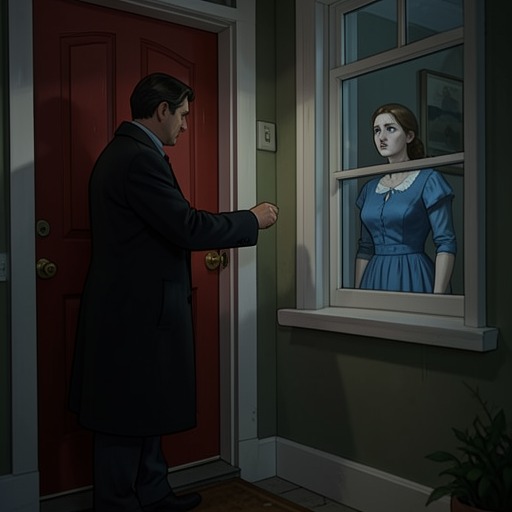
Drake confronts Keeble at home while the toymaker is in his nightshirt and cloth cap. His expensive new coat and silk hat, cigar, and moneyed manner sharpen the contrast between the visitor’s social confidence and Keeble’s unprepared state. Drake offers a substantial sum for the engine plans and patent. Keeble is uninterested; when Drake doubles the amount, the added money still does not change his answer. Keeble’s objection is not a disagreement about price. He rejects Drake’s industrial vision, including the prospect of textile mills powered by perpetual-motion engines, and recoils from the practical, utilitarian purpose Drake assigns to the invention.
When the offer fails, Drake says that he has methods and resources, can exert pressure, and could ruin Keeble. Keeble does not bargain or accept the proposed time to reconsider. The clock’s elaborate clockwork apes and iron octopus sound during the standoff, a small domestic spectacle sharply unlike Drake’s blunt declarations of power. Dorothy enters from the stairs, and Keeble tries to direct her back upstairs with a glance. Drake turns toward her, introduces himself, and comments on her appearance. The remark follows his threats and Keeble’s attempt to keep her away from the confrontation; in that context, it makes Dorothy’s presence part of the pressure, though Drake does not state an explicit plan to harm her.
Keeble tells Drake that there is no room for discussion. Drake sets Thursday as the deadline, says the business will require Keeble’s efforts regardless of the outcome, and again refers to Dorothy. As he leaves, he flips Keeble’s nightcap from his head with his walking stick. The gesture is a calculated affront within an encounter already marked by an imbalance of power: Drake departs in a waiting brougham, while Keeble remains in the hall, visibly shaken. Keeble tells himself that Drake is bluffing and will not dare return, but his shaking hand as he drinks from the walrus-tusk vessel undercuts that assurance. He goes upstairs without having changed his answer, but not without feeling the threat.
Refusal and Renewed Pressure
The home visit does not secure Drake the invention. Keeble remains unwilling to sell, and his refusal is grounded in his rejection of Drake’s intended use, not merely in distrust of the man. That distinction matters: the conflict is over who will direct the technology as well as who will possess its plans. For Drake, the engine promises industrial power; for Keeble, transferring it to that project is unacceptable.
The confrontation recurs when Drake later faces Keeble at Captain Powers’s shop. By then the sought-after object is the machine itself: Drake says it will do as well as the plans because his workmen can puzzle it out. Keeble, visibly shaking, answers that his decision has not changed. The renewed demand confirms that the original refusal and deadline have not resolved the dispute. Drake’s persistence shifts the danger from the abstract possibility of commercial appropriation toward a continuing contest over access to Keeble’s work.
Wider Implications
The later discussion among St. Ives and his associates places Drake’s pursuit beside the other schemes surrounding reanimation. Godall recalls having watched Ignacio Narbondo revive what was almost certainly a corpse at The Blood Pudding, and speculates that Drake and Narbondo may have been bargaining over an army of workers whom union bosses could not make difficult to manage. He also proposes another possibility: Drake may believe Narbondo can deliver the form of life-preserving technology that Sebastian Owlesby had wanted. Godall does not know which explanation is correct, and the account does not establish either as Drake’s confirmed plan. His conjectures nevertheless connect Drake’s industrial ambitions to the broader struggle over bodies, labor, and technological control.
This threat thus functions as an early measure of Drake’s methods. He begins with an offer, treats refusal as an obstacle to be overcome, and brings personal intimidation into a dispute over an invention. Keeble’s resistance prevents the scene from ending in a transfer of the patent, while Drake’s continued pursuit shows that refusal alone has not ended the danger. The contrast between the ingenious domestic objects around Keeble and Drake’s vision of factories powered by the engine gives the disagreement its larger shape: invention may remain a source of eccentric curiosity, or it may be commandeered for systems of production and control.