The Struggle for the Keeble Box on Hampstead Heath
HomunculusThe Struggle for the Keeble Box on Hampstead Heath turns a contest over a small, intricately made container into the convergence point for the novel’s rival schemes, mistaken identities, and experiments with life and death. As Birdlip’s dirigible arrives, several boxes change hands in a chaotic public confrontation: Bill Kraken recovers one from Kelso Drake, Jack Owlesby takes another from Shiloh the New Messiah, and Willis Pule finally breaks open the box carried by Birdlip. Its destruction frees the homunculus, making private scientific and criminal pursuits suddenly visible to a crowd gathered on the Heath.
Causes and Background
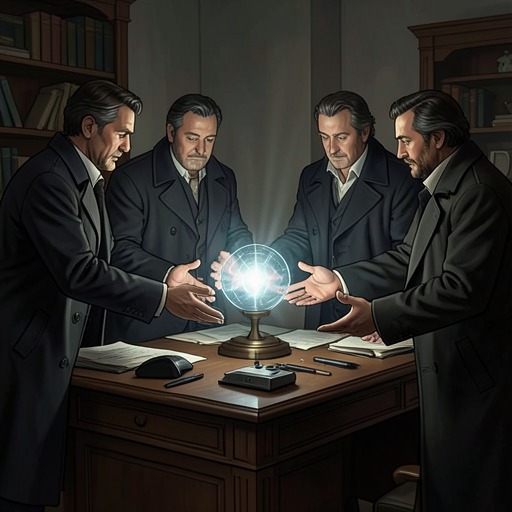
The confusion surrounding the boxes has a material history. Sebastian Owlesby had withdrawn his interest in the West African Gem Company as a great emerald intended for his son Jack’s inheritance. Because he feared lapses into madness, he had also told Nell that she must kill him if he fell into that condition again. He persuaded William Keeble to construct a container for the emerald almost identical to the lead-lined cube that held the homunculus. Their similar appearance later makes it possible for the emerald and the living prisoner to be confused, with consequences extending well beyond the value of either object.
The other box is tied to the experiments of Ignacio Narbondo. At his laboratory, he studies carp and extracts a pulsing gland from one of the fish, preserving it in amber liquid. His attention to the organ and the presence of corpses in his working space establish the connection between animal material and his attempts to animate the dead. Shiloh witnesses Narbondo’s work and has his own investment in resurrection: when a box is moved during an experiment involving his mother’s remains, his attention shifts from the container to the body before him. These earlier scenes make the boxes more than interchangeable parcels. They carry different possibilities—wealth, captivity, scientific control, and religious meaning—even when their workmanship makes them difficult to distinguish.
The convergence on the Heath is also anticipated by Theophilus Godall’s investigations. He has seen Narbondo revive what he believes was a corpse and has observed Narbondo negotiating with Drake at The Blood Pudding. Godall considers, without claiming certainty, that Drake may want Narbondo to supply workers who cannot be controlled by union leaders, or may hope to obtain the form of life Sebastian Owlesby sought. Godall therefore regards the dirigible’s arrival as potentially significant, particularly because he understands that Drake believes the homunculus is aboard.
The Boxes Change Hands
As the crowd watches for the dirigible, Godall approaches carrying the Marseilles Pinkle, a round metallic device that catches the firelight. Kraken sees him, as does Langdon St. Ives, while Drake remains unaware of Godall’s presence. Kraken has little time to react: he runs into Drake and strikes him, then takes the Keeble box from him. Holding it carefully as he flees, Kraken draws Drake after him through the tumult.
The dirigible lands on the green, close to St. Ives’s spacecraft, and the crowd surges toward it. The landing redirects public attention even as the struggle over the boxes continues. Kraken turns on Drake again by identifying him to the crowd as the man who murdered a child. The accusation provokes a rush against Drake, giving Kraken an opening to move toward the dirigible with his box. The scene makes the charge consequential without pausing to establish it through an investigation: the crowd’s response becomes an immediate force in the contest.
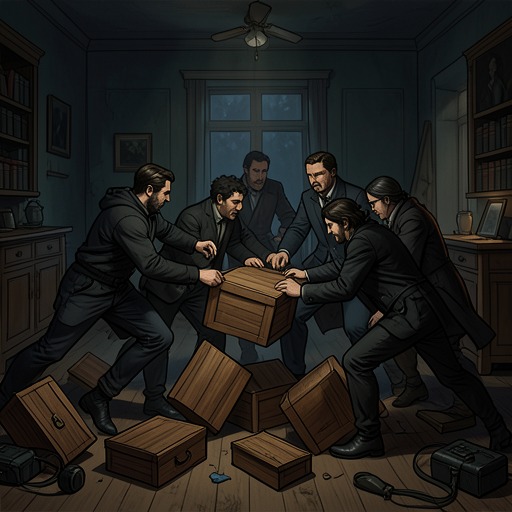
Meanwhile, Willis Pule is caught in a struggle with a group that includes Shiloh. Godall circles around the box Pule is holding, and Jack Owlesby stays close, watching for a chance to act. When the box is snatched away, Shiloh takes possession of it and heads toward open ground. He does not know which of the several unusual boxes he has acquired, but regards them all as holy and believes they properly belong to him. Jack follows. Godall points his pistol at parishioners who try to stop the young man, and Jack reaches past him to take the box from Shiloh. Godall gives Shiloh the Marseilles Pinkle, while Jack escapes toward the dirigible carrying the container.
A Public Convergence
For a brief interval, the distribution of the boxes seems to favor St. Ives and his allies. Jack has recovered a Keeble box; Kraken carries another; Godall possesses a third. St. Ives reaches to shake Jack’s hand, but the apparent resolution collapses when Drake, now free of the crowd’s attack, comes after Kraken. Kraken pitches forward, and the box he carries sails away. St. Ives leaps to deflect it from the fire, but the box travels instead toward the enigmatic ghoul seated in a stuffed chair, striking its chin and falling into its lap.
The scene places the box contest beside the novel’s other extraordinary public display. The crowd has gathered for the landing of Birdlip’s dirigible, while the Royal Academy, led by Parsons, attends to the ghoul in the chair, regarded as a skeletal sailor returned from the sea. The dirigible’s arrival, the ghoul’s presence, and the boxes’ uncertain identities occupy the same patch of ground. In this setting, private experiments and disputed possessions can no longer remain hidden from witnesses, though the crowd cannot necessarily tell what each object contains or means.
The Homunculus Freed
Birdlip steps down onto the green holding a Keeble box. Pule, who has abandoned any practical scheme of theft and is driven instead by a desire for destruction, takes it from him. He raises the container and smashes it against a stone. Its carefully made joinery breaks apart, and the lid flies into the crowd. A tiny man emerges and stands free: the homunculus, less than eight inches tall even with his hat on.
The release gives the contest its decisive reversal. The boxes have been treated as valuable property, sacred objects, or possible instruments of power, and their similar construction has repeatedly made possession uncertain. Pule’s act destroys the container rather than resolving its ownership. In doing so, it releases the being whose confinement gave the Keeble box its greatest significance. The people gathered around the green see the homunculus run away from the broken box toward Birdlip, past Parsons and through the grass. The account establishes that the small figure has a destination in mind, but leaves its purpose unstated at the close of the episode.
Consequences and Significance
The struggle links scientific ambition, inheritance, religious belief, and criminal rivalry through objects that can be carried, mistaken, seized, and broken. Drake’s interest in what Narbondo might provide, Sebastian Owlesby’s emerald and his fear of madness, Shiloh’s conviction that the boxes are holy, and Pule’s final destructive intervention all converge in the same physical contest. The Keeble box is not simply a container: its near-identity to the emerald box has made the story’s material evidence unstable, while its destruction changes the homunculus’s condition at once.
The final movements also leave several outcomes distinct rather than collapsing them into a single victory. Jack reaches the dirigible with a recovered box; Kraken moves toward it carrying another; and the account later presents Dorothy Keeble reunited with Jack, while Captain Powers holds open a Keeble box containing the great emerald. St. Ives, for his part, does not regret losing his spacecraft, believing that his voyage has already mattered and that the future may bring another. Against these signs of recovery and forward motion, the homunculus’s release remains the event’s sharpest change: the hidden being is no longer confined, and his unexplained movement toward Birdlip carries the scene beyond the crowd’s struggle for possession.