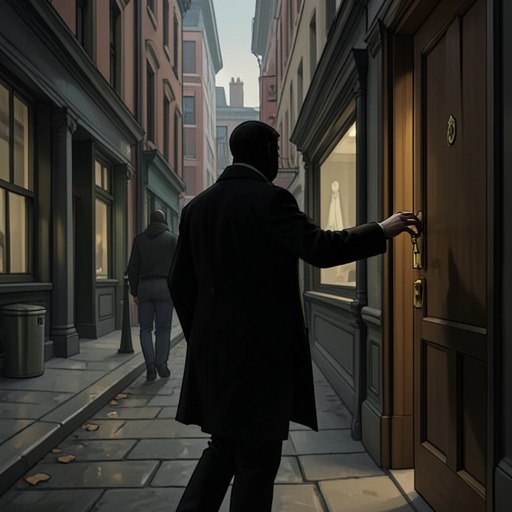
The Break-ins at Keeble’s Toyshop
HomunculusThe Break-ins at Keeble’s Toyshop turn William Keeble’s private experiments into the target of a repeated intrusion, linking a physical struggle at his home with a more calculated search for concealed plans. The thief’s apparent objective is a perpetual-motion engine, but the evidence leaves the intruder unidentified and the theft’s success uncertain. What is clear is the contrast between the invention he seems to want and the useless plans he actually carries away.
Background and First Intrusion
The first described encounter begins while Keeble and Langdon St. Ives are discussing the oxygenator. Keeble is taking apart the handle of a heavy chisel when a bang at the upper casement startles them. Liquor spills from the hollow handle across a drawing of the device, interrupting their work before they know who is outside. St. Ives initially attributes the sound to wind, but lightning reveals a shadowed face leaning over the sill, and heavy rain begins.
St. Ives climbs a tilted stepladder toward the small gable and reaches the roof just as the intruder’s head and shoulders disappear over its edge. From below, Jack Owlesby calls that he has hold of the man. St. Ives considers following across the slick roof, then judges that a fall into the road is likely and returns inside to take the stairs. The pursuit shifts rapidly from the roof to the street: cries, snapping sounds, curses, and tearing vegetation mark the struggle as it moves out of the house.
Passing a bewildered Winnifred Keeble on the landing, St. Ives runs down to find Keeble grappling the intruder from behind in an ankle-deep puddle. The man tries to escape while Keeble holds him around the chest, and stamps on the toymaker’s toe in an effort to break free. Lights flicker on and off in Captain Powers’ shop as neighbors open their windows to shout at the disturbance. St. Ives rushes into the rain to help, while Captain Powers emerges from the shop on his peg leg, waving a pistol. The account establishes a forceful confrontation, but does not establish that the intruder is captured.
The Return and the Stolen Plans
At a later discussion, Keeble identifies the assailant as the same man who had broken in before. He recounts an intrusion while he was working on an engine: the plans, notes, and a small cayman device had been hidden in a hole in the floor, a cache he believed no one else could discover. After working until noon, he had fallen asleep. A crash at the casement woke him, and he heard footsteps inside.
The thief passed valuables without taking them. Keeble’s account suggests that the intruder had seen him put plans into the floor cache and tried to reach them with a prybar. Keeble thinks the man had propped the casement open with a stick to make a quick escape; when the stick slipped and the window shut and latched, the thief panicked and seized the nearest plans instead. Those were for a roof-mounted sausage cooker, which Keeble had meant to test during an electrical storm. The cook, entering through the back door with a chicken, encountered the thief, struck him with the plucked bird, and reached for a carving knife. Keeble pursued the man into the street in his nightshirt, but abandoned the chase because of the indignity and because his foot had barely recovered from their previous encounter.
Suspected Target and Uncertain Outcome
The stolen cooker plans are a misleading measure of what the thief wanted. Keeble says they are of no practical use to anyone, and the group’s discussion distinguishes them from the engine plans hidden under the floor. The explanation that the intruder grabbed the wrong papers is Keeble’s theory rather than a confirmed account of the thief’s intentions, but it fits the disregard for valuables and the attempt to reach the concealed cache.
The possibility that Kelso Drake is behind the intrusions is raised as an inference, not a resolution. Theophilus Godall suspects Drake might publicize the absurd cooker as a prank at the group’s expense, while also asking whether the real object of the break-in was the perpetual-motion engine. Keeble begins to agree, but the discussion is interrupted by a knock at the door. The identity of the intruder and the fate of the stolen plans therefore remain open in this episode.
Narrative Significance
The repeated entry makes Keeble’s work vulnerable in two different ways: the hidden cache invites a search through the house, while the exposed casement provides a route in and out. In the nighttime encounter, weather and architecture shape the pursuit: lightning briefly reveals the watcher, rain makes the roof dangerous, and the descent by stairs carries St. Ives into the street. In the earlier account, the slipping prop defeats the thief’s planned escape and helps turn a targeted search into a hurried, mistaken theft.
The cooker plans give the episode its central irony. The intruder’s apparent interest in a consequential invention produces a theft whose actual prize is a scheme Keeble himself has not yet tested. Yet the comic mismatch does not make the intrusion harmless: Keeble is hurt during the struggle, his household is drawn into the pursuit, and the repeated appearance of the same man encourages the investigators to connect an apparently petty break-in to a broader contest over Keeble’s research.