The Oceanarium Carp Heist
HomunculusThe Oceanarium Carp Heist is Willis Pule’s nighttime theft of a live carp for Dr. Ignacio Narbondo, supplying an essential component of Narbondo’s attempt to restore Joanna Southcote. The episode turns a fish tank into part of a clandestine scientific operation: the fish is not merely stolen property, but a necessary link between Narbondo’s experiments and the promised return of the dead. Pule secures it under pressure, while Narbondo waits nearby, prepared to escape if the break-in attracts attention.
Purpose and Background
The theft takes place on a late-April night, while Langdon St. Ives reads Sebastian Owlesby’s manuscript to the horrified members of the Trismegistus Club at Captain Powers’ Pipe and Tobacco Shop. At the same time, Dr. Ignacio Narbondo and Willis Pule travel along Bayswater Road toward the oceanarium near Craven Hill. Their errand is urgent for practical as well as financial reasons. Pule believes Joanna Southcote will otherwise become only remains, and that her son, Shiloh, will be less willing to pay the half-crowns he has promised if the attempt fails. The fish is therefore both an experimental requirement and the condition on which the men’s payment depends.
The wider circumstances make the expedition part of a larger, unsettled pattern of corpse reanimation. Theophilus Godall has already seen Narbondo revive what he believes was a corpse, and has observed him meeting Kelso Drake at The Blood Pudding. Godall speculates that Narbondo might supply Drake with workers, or that Drake might seek the kind of life-preserving achievement Sebastian Owlesby desired; he does not know which, if either, is true. That uncertainty is part of the surrounding plot, not a confirmed explanation for this particular theft. The immediate purpose is clearer: Narbondo and Pule need a carp for the work involving Joanna.
Entry into the Oceanarium
The building is dark, and Narbondo keeps the dogcart some distance away in the shadows rather than approaching the windows with Pule. A groundskeeper is somewhere inside, possibly accompanied by a dog. Pule tests windows along the wall, trying to enter without drawing attention. When he pulls at a broad double casement, it opens with difficulty, but he cannot get inside on that first attempt. Narbondo remains seated by the cart, positioned to leave quickly if trouble begins. Pule understands that his companion may be unwilling to risk himself, but also knows that Narbondo needs the fish.
Pule is not unfamiliar with the room. He has visited it repeatedly during the preceding month and learned the arrangement of the aquaria, as well as the locations of nets, siphons, buckets, and the large rubber bladders that supply air to the tanks. Once inside, he uses that knowledge to work quickly. He brings a broad net and a step stool to a long, low tank, where a large carp rests among rocks and weeds. He removes the glass cover and places it on the floor, then clears weeds from the water so they will not catch in the net. He selects a mottled koi about a foot and a half long, eases the net beneath it, and lifts it out before it can move away.
Interruption and Escape
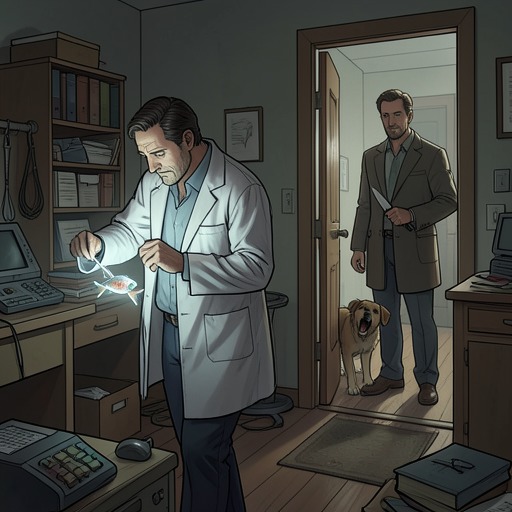
The capture does not go cleanly. The fish suddenly struggles free of Pule’s grasp, and the stool begins to tip. Behind him, a light appears and a dog starts barking. The watchman calls out and enters the room as Pule and the fish fall amid wet weeds. Pule manages to regain the fish while the dog catches at his trouser leg and the watchman tries to control it. The interruption changes the task from a careful theft into an improvised escape: Pule thrusts the carp through the open window because he cannot climb out while holding it.
The handoff leaves Pule to follow without the fish. He climbs through the window and drops farther than he expected, landing beside the dogcart. Narbondo curses as Pule grabs at the cart and struggles to get aboard; Pule curses him in return. The watchman remains at the open window with his dog, while Narbondo drives off. Pule manages to pull himself into the cart’s bed, where he ends up beside the carp. The escape succeeds, but the sequence makes clear how narrowly the operation depended on the open window, the fish being passed out first, and Narbondo’s waiting transport.
The Carp’s Place in Narbondo’s Work
The stolen carp’s importance is clarified by Narbondo’s later experiments. At the oceanarium, Narbondo is shown studying koi in large aquaria. After feeding worms to five fish, he watches a sixth that ignores the food, gulps air at the surface, and repeatedly sinks before struggling upward again. He extracts a small, pulsing gland from a carp and preserves it in a vial. This is a separate instance of his fish research, not evidence that the extracted gland came from Pule’s stolen fish; together, the scenes establish the attention Narbondo gives to carp and their organs.
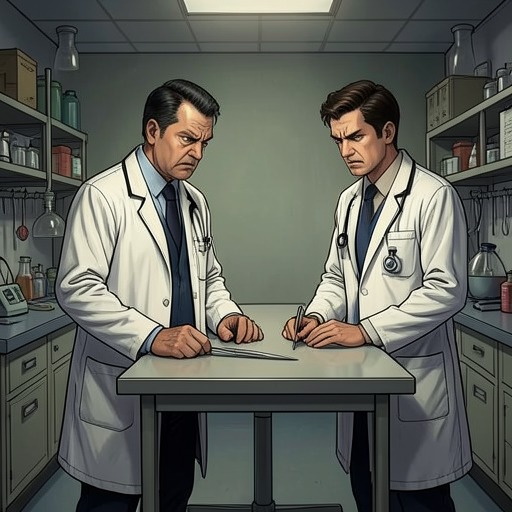
Later, during the work involving Joanna Southcote, Narbondo and Pule bring a fresh cadaver to a gurney beside her remains. Narbondo takes a live but sluggish carp from a trough beneath a jar of yellow fluid and places it beside the body. He works quickly, with visible concentration, as though aware that the procedure is complicated. The narrative thus connects the aquarium raid to the later experiment without reducing the episode to a successful piece of theft: the carp carries Narbondo’s work forward, while the fish’s presence exposes the material dependency beneath his claims of resurrection. The heist joins an urban night raid, a paid promise to Shiloh, and a secret laboratory practice in one chain of cause and consequence.