The Theft of Captain Powers’s Hidden Box
HomunculusThe Theft of Captain Powers’s Hidden Box turns a private act of pilfering into a flight from a danger that is at once real and misread. While a birthday gathering distracts the people in the shop, Bill Kraken opens a sea chest and takes the hidden emerald box. A distant voice, his intoxicated terror, and the arrival of Kelso Drake collapse into one alarming impression; Kraken escapes through a window, and Captain Powers discovers the loss too late to catch him.
Distraction and Opportunity
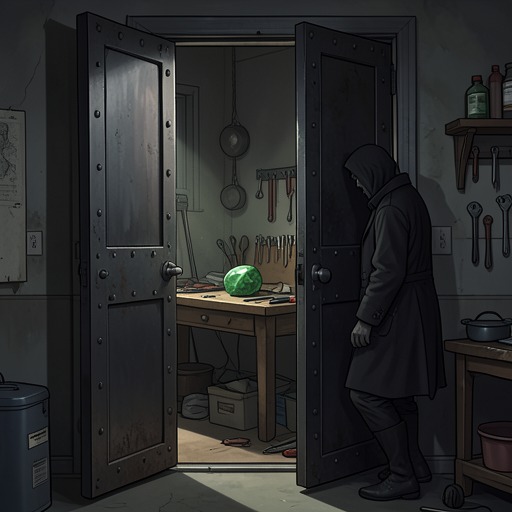
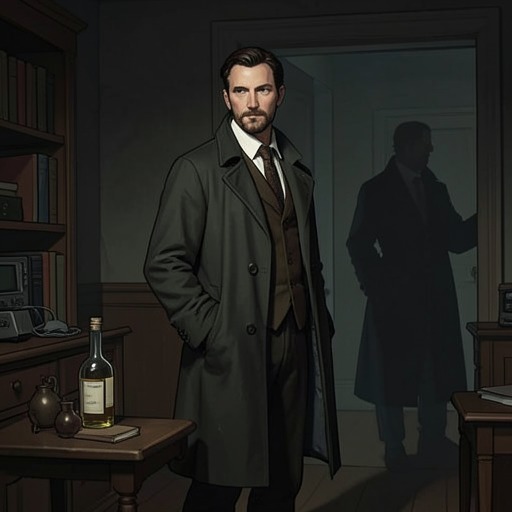
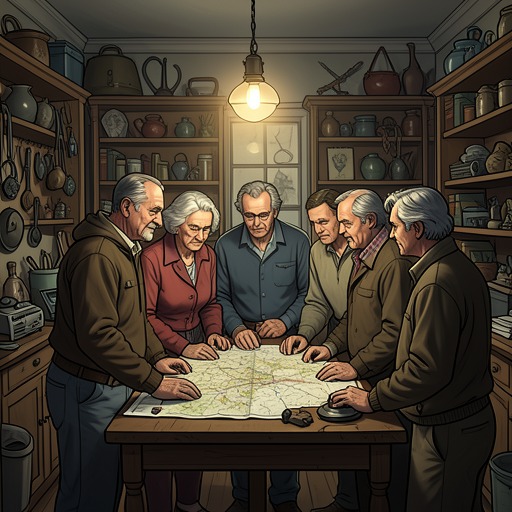
Kraken has been in a room off the gathering, drinking and brooding over Sebastian Owlesby’s memoirs. When young Jack displays a mechanical toy, Kraken watches its crocodile tear at and swallow one of its tiny birds. The spectacle perplexes him, but it also draws him toward the open doorway. In the adjoining dark room he finds the sea chest. In the outer room, everyone is gathered around Jack’s birthday present, Keeble’s miniature perpetual-motion engine, and their attention gives Kraken the chance to move unseen.
His entry into the chest is neither a planned search for a known prize nor a confident theft. He feels along the front until he locates the flat, circular iron hasp, uncertain how the mechanism works and unsure what he wants. When the hasp snaps up and strikes his knuckles, he worries that the noise will expose him. He imagines that the others will take him for a common thief, or suspect him of being allied with their enemies. The small, painful mishap makes the risk plain even before he has found anything worth taking.
The Chest and the Voice
Kraken rummages among the chest’s contents, trying to quiet the objects as they shift. The light from the other rooms is faint; a brass spyglass presses against his cheek, and nautical possessions crowd around his head. He becomes so absorbed among them that he momentarily imagines he could remain there, away from the people outside. Yet the scene’s concealment is uneasy: while he searches, he hears what seems to be a tiny, distant voice, indistinguishable from the rushing noise in his own head.
He finally withdraws with the hidden box in his hands. The discovery brings a rush of fear and excitement, not calm satisfaction. Unable to understand the voice, Kraken suspects that it comes from inside his own head and calls it a devil in his thoughts. His interpretation is shaped by drink and by what he remembers of the recent beating: he believes that a woman who lured him to the den where he was beaten was a witch, and that the bodies he had carried through London burden him with Mumia. Shaking, he tries to silence the sound by clacking his teeth. When it swells into shouting, he slams the chest lid. The scene leaves the voice unexplained; Kraken’s certainty about its supernatural source is his frightened conclusion, not a confirmed account of what he heard.
Drake’s Arrival and Kraken’s Escape
The shouting comes from the outer room. Kraken peers around the doorway and sees Kelso Drake standing at the shop entrance. Because Drake has already had him beaten and shot, Kraken reads this arrival as an attempt to finish the job. He retreats into the dark room, reaches a closed window, unhooks its latch, and climbs across the sill. He lands in the muddy alley, breathes heavily, then looks back toward Spode Street before running toward Billingsgate Market. He expects the crowds gathering there in a few hours to hide both himself and his prize from his enemies.
That escape depends on the same concealment that enabled the theft. The gathering had masked the noise Kraken feared while he opened the chest; the window now gives him an exit before anyone in the outer room can stop him. The box changes hands without a confrontation between Kraken and Drake: their danger to one another is expressed through Kraken’s decision to flee, not through a fight in the shop. The hidden object becomes his prize as soon as he gets it, but carrying it also makes it something he expects his pursuers to seek.
Discovery and Uncertainty
The theft is discovered after Kraken has gone. Captain Powers notices an open window and enters the room. Gaslamps reveal the disorder: the spyglass, sextant, and broken pieces of oak plank lie on the floor; the chest has been disturbed, and the pig and sabers are no longer inside it. Powers quickly realizes that the emerald box is missing. He throws the window open again and searches the rain-dark alley, but a flash of lightning reveals no one in either direction.
Powers then rushes into Kraken’s empty room and finds only silence. Langdon St. Ives identifies the immediate implication: Kraken is gone. Powers curses him, but Theophilus Godall resists treating guilt as settled, suggesting that Kraken himself may have been the victim of the thief. The distinction preserves the scene’s uncertainty even as its sequence strongly implicates Kraken: he has left through the window with the box, while the people inside learn of the loss only after the escape. The theft thus ends not with recovery or explanation, but with an empty room, a searched alley, and a missing emerald box.