The 1870 London Airship Sighting
HomunculusThe 1870 London Airship Sighting introduces an impossible craft into the ordinary geography of London: a dirigible drifts over the sleeping city and then past its waking crowds, with a skeletal figure fixed at the controls. Its passage is witnessed but not explained. The striking image becomes a lasting omen for Shiloh, while the broader story shows how the same sighting can be remembered as prophecy, treated as a scientific problem, or folded into public fears about other strange events.
Approach and Course
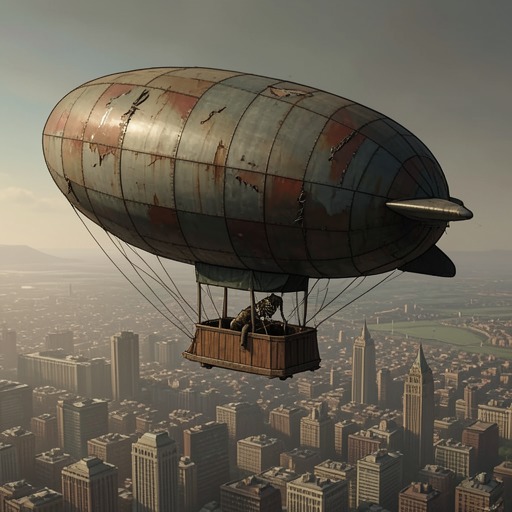
The sighting begins in the hours before dawn, as an oval shadow moves southeast from Iceland across the North Atlantic. Over Chelsea, the wind sweeps leaves, dust, and scraps of paper through the dark streets. A hunchbacked driver transporting a tarpaulin-covered load stops to secure the canvas; a ragpicker nearby looks past him and sees the dim outline of a dirigible, its ribbed gondola hanging beneath it. The aircraft’s humming is faint but pervasive. The driver hurries away as the craft drifts lower toward the West End.
By the time the dirigible passes above a market, the moon is sinking and a crowd has gathered. The gondola is briefly outlined against the moonlit clouds. Its wooden sides creak and shudder, and the sound of its propellers mingles with the wind. The pilot appears rigid, wearing a cocked hat and gripping the wheel, with his legs braced as if against a rolling vessel. The sighting’s central revelation is not simply that a dirigible is in the sky: the pilot is a fleshless skeleton, his wrists manacled to the wheel, which is itself lashed to a strut. The craft rights itself and continues east, toward Billingsgate Market and Petticoat Lane.
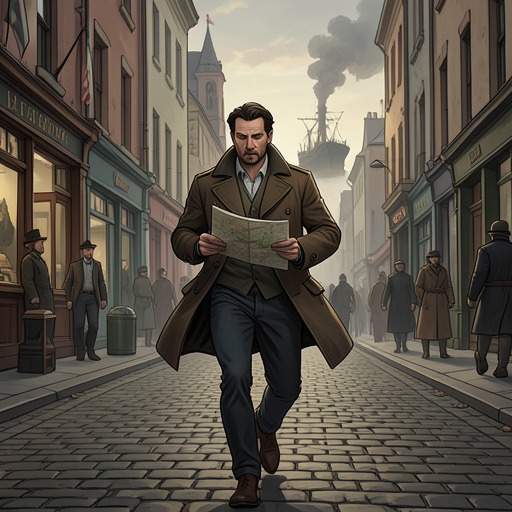
At dawn, the airship is seen over Billingsgate Market, where its gondola rocks in the wind above the carts and handbarrows. A fish seller briefly salutes its strange pilot before returning to work. In Petticoat Lane, people turn and point, but the daylight has diminished the craft’s earlier mystery. Langdon St. Ives, who has been searching for information about a crystal egg, abandons his negotiation and takes a cab after the dirigible. He follows its course along East India Dock Road until an updraft carries it into clouds toward Gravesend.
Witnesses and Uneven Responses
The event offers no single public reaction. The ragpicker is transfixed, the driver flees, and the fish seller responds with a gesture of respect. At the market, the crowd’s attention rises briefly with the craft and then returns to commerce. St. Ives reacts differently: he gives up an immediate inquiry and actively follows the dirigible, but loses sight of it when it disappears into cloud. The sequence makes the airship visible to many without giving any witness the knowledge needed to account for it.
That unevenness also shapes the event’s atmosphere. At night, the silhouette, the moon, the wind, and the humming make the craft seem at once present and difficult to grasp. By daylight, the same vehicle is still extraordinary, but its passage is less portentous amid the working market. The contrast is not a resolution: the daylight does not explain the skeletal pilot or identify the aircraft’s purpose. It only changes how readily observers treat the sight as an omen.
Shiloh’s Prophecy
For Shiloh, the passage becomes a religious sign. Years later, while preparing counterfeit coins for distribution through his followers, he remembers the dirigible as having appeared out of the west beneath a dying moon, with its animate pilot looking down from the sky. He dates the sighting to more than four years earlier and says the craft had passed in the early morning twice. His account makes the earlier spectacle part of a continuing prophetic timetable, rather than an isolated marvel. The promised apocalypse gives the sighting a meaning that its witnesses at the time could not establish.
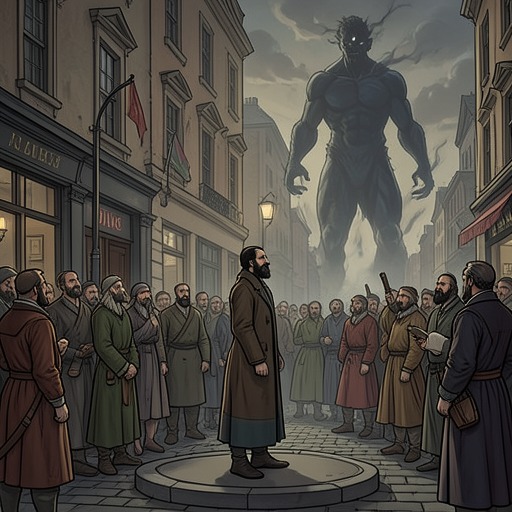
Shiloh’s interpretation has practical consequences. He has been waiting for the expected changes to disclose the truth of his birth and the identity of his father, and the dirigible strengthens his conviction that the appointed day is near. His apocalyptic preaching attracts followers: after one of the airship’s passages, he gains about a dozen converts. Later, he links the craft to his claims that the New Church can redeem the dead and to the appearance of a box containing a mummified head. The connection is his religious framing, not proof that the aircraft validates his doctrines.
The Sighting’s Afterlife
When the dirigible is expected to return, its earlier appearance informs both institutional concern and street-level speculation. The Royal Academy worries about the craft’s declining altitude and the possibility that it may come down near London; its representatives seek knowledge of Birdlip’s dirigible and of William Keeble’s engineering. At the same time, rumors describe the airship as carrying a sacred object or an alien presence. Shiloh’s followers gather around his displays, and his preaching helps draw a crowd toward the approaching craft. The old sighting has become one strand in a much larger contest over what the airship means and who has the authority to explain it.
Newspapers later place reports of the approaching dirigible beside accounts of the Pratlow Street corpses, encouraging readers to wonder whether the two crises are connected. Headlines invoke a man from Mars and an alien threat; Shiloh’s followers interpret the events through their own expectation of Armageddon. The 1870 passage itself does not establish those later claims. Its lasting force lies instead in the unresolved image it leaves behind: a strange machine crossing the city, a dead-looking pilot at its wheel, and witnesses whose explanations diverge as the craft disappears from view.