Mariatta’s miraculous pregnancy
KalevalaMariatta’s miraculous pregnancy transforms an encounter with a woodland berry into a conception and, ultimately, the birth of a child. The episode presents that change as an unusual causal sequence: Mariatta cannot pluck the woodland stranger, the berry nevertheless reaches her, and she later identifies it as the source of her pregnancy. Her anxious response gives the wonder a personal and social dimension, while the child’s birth in a woodland manger places the consequence of the event in a sacred register.
The Berry and the Conception
The episode begins with Mariatta described through the imagery of woodland fruit: her appearance is compared to a cranberry and her flavor to a strawberry. The scene then turns from resemblance to encounter. Although Mariatta cannot pluck the woodland stranger, the narrative does not leave the berry as an object she merely sought or failed to gather. Its movement toward her is traced in successive stages until it settles in her bosom. The conception is thus represented as something that happens to Mariatta through contact with the berry, rather than as the result of a stated courtship or marriage to a human suitor.
A charm-stick appears in the sequence after Mariatta’s failure to pluck the woodland stranger. The account supplies the gesture but does not explain what the stick is meant to do, so its significance remains limited to its place beside the encounter. The more explicit transformation comes afterward: the berry is named as the source of Mariatta’s condition, and she is described as having become a bride to the mountain-berry. That language gives the conception a startlingly personal form, but does not provide a further account of how the transformation works. The episode’s wonder rests on the movement from fruit to pregnancy, not on an explanation of its mechanics.
Waiting and Disclosure
The pregnancy unfolds over time rather than being presented only as an instantaneous marvel. Mariatta counts the days anxiously and waits for the dawn of trouble. Her attention is fixed on what is coming, and she eventually asks her mother about her condition. The sequence makes waiting part of the event: after the berry’s arrival, Mariatta must reckon with a change whose consequences are not yet resolved.
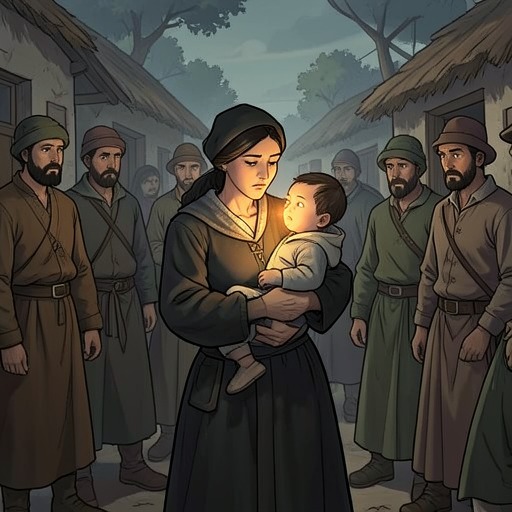
When Mariatta explains the cause of her trouble, she identifies the berry’s movement into her as the source of her dishonor. The account therefore distinguishes between the story’s explanation of conception and Mariatta’s understanding of its social meaning. The berry is the stated cause, but Mariatta’s language shows that she fears the condition will bring disgrace. Her distress is not presented as proof of wrongdoing; it is evidence of the pressure attached to a pregnancy that she cannot explain through an ordinary human marriage. The narration records both the marvel and the burden Mariatta associates with it.
Her mother is described as relentless after this disclosure. The supplied account does not establish the full course or reason for that response, and the description does not justify assuming what the mother says or does beyond it. Its placement nevertheless sharpens the contrast between Mariatta’s appeal to her mother and the strain that follows. The pregnancy is extraordinary in its cause, but Mariatta’s fear is articulated through family relations and the prospect of dishonor.
Birth and Sacred Register
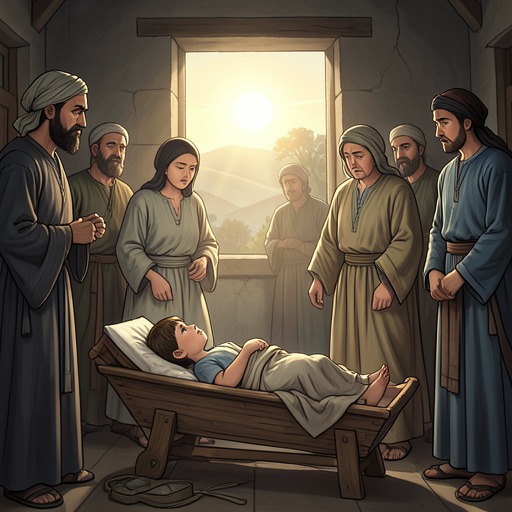
The pregnancy culminates in the birth of Mariatta’s child. The babe is born and cradled in a woodland manger, extending the episode’s woodland setting from the berry encounter to the child’s arrival. The location links the conclusion to the beginning without explaining the miracle: the berry initiates the pregnancy, while the manger becomes the place where its consequence is received.
The child is presented in language of purity and holiness. Mariatta is again identified as a virgin, and the newborn is described in terms that elevate the birth beyond an ordinary domestic event. Taken together, the references to a virgin, a babe, a manger, and holiness give the scene a sacred register. This emphasis changes the force of Mariatta’s earlier fear of dishonor: the account that first makes her pregnancy a source of anxiety ends by framing the child’s birth as hallowed. It does not erase the distress she has expressed, but places that distress beside a result the narrative treats with reverence.
Significance of the Episode
The episode’s structure depends on a sharp contrast between a small, natural object and an immense consequence. A berry, initially part of woodland imagery, becomes the cause Mariatta names for her pregnancy; the narrative then moves through anxious waiting and disclosure to childbirth. The stages are distinct: an encounter establishes the marvel, Mariatta’s account reveals how she experiences it, and the manger birth gives the event its culminating significance.
The account leaves important matters unstated. It does not identify a human father, explain the berry’s power, or supply a fuller account of the mother’s reaction. Those silences keep attention on the unusual cause and on Mariatta’s changing circumstances, rather than on a conventional courtship or a detailed explanation of supernatural mechanics. The pregnancy is therefore both a bodily state within the story and a hinge in its narrative: what Mariatta calls a source of dishonor becomes the beginning of a child’s sacredly framed life.