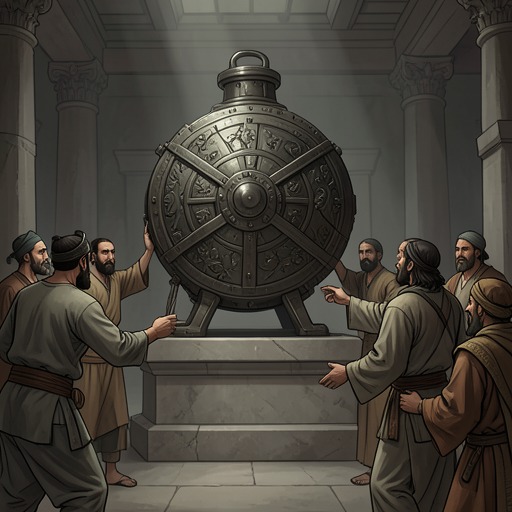
Sampo locked beneath Pohyola
KalevalaThe Sampo’s confinement in Sariola is established through an image of layered security: Louhi takes the wonder to the copper-bearing mountains, closes nine locks upon it, and surrounds it with roots driven deep into the earth. The arrangement binds the object to several parts of the landscape, making its guarded state one of the defining conditions of its presence in Pohyola.
Location and Custody
Louhi, hostess of Pohyola, carries the Sampo to the hills of Sariola, specifically to the copper-bearing mountains. The account presents her as the one who takes possession of it and puts it away; the act is deliberate and protective, not an incidental change of location. The Sampo is thus associated both with Louhi’s authority and with a particular northern stronghold.
The Sampo’s productive function provides a contrast to this act of confinement. Just before Louhi takes it away, it is described as grinding a second measure for the market and a third for the storehouse. The object is not merely a marvel under guard: it is a source of goods, and its removal places that productive wonder under Louhi’s control.
Locks and Roots
Louhi puts nine locks upon the Sampo. The number gives its security a formal, emphatic shape: the object is not left exposed or protected by a single barrier. The passage does not explain how the locks work or who might open them; it establishes their number and their role in sealing the Sampo away.
Three strong roots grow around it, extending nine fathoms into the earth. Their reach is distributed across three locations: one root lies beneath the mountain, one beneath the sandy seabed, and one beneath the mountain dwelling. The account therefore makes the Sampo’s anchorage larger than the place where it is stored. Its roots connect the mountain, the shore or seabed, and the dwelling, giving its confinement a deep and far-reaching physical structure.
Significance of the Confinement
The passage emphasizes both protection and entrenchment. Nine locks close over the Sampo, while the three roots fasten it into the surrounding world; the image is of a treasure guarded above and bound below. Because the Sampo is associated with grinding goods for market and storehouse, this secure placement also represents control over a source of abundance. Louhi’s action converts the Sampo’s productive power into something held within her territory and custody.