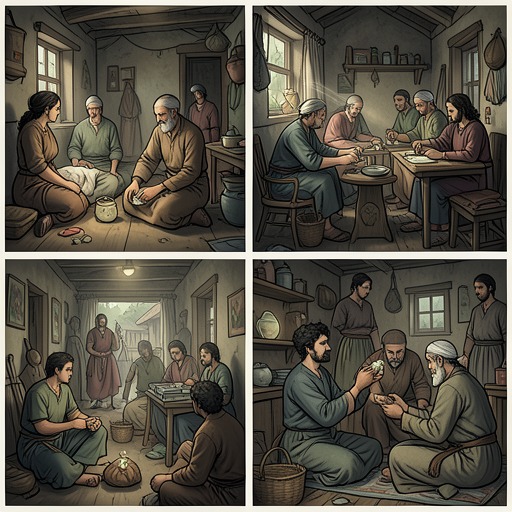
The nine diseases afflicting Wainola
KalevalaThe nine diseases afflicting Wainola are presented as the offspring of Lowyatar, not as an impersonal outbreak: each is named, and the children are sent among the people as agents of affliction. Their arrival sickens people across Wainola, from maidens to heroes, and threatens the community with destruction. Wainamoinen’s expulsion of the diseases and healing of the tribes brings the crisis to an end.
Origin and Naming
Lowyatar, described as blind and ancient, gives birth to nine children on a summer evening. The account places them in a cradle beneath golden covers, an image of careful shelter that contrasts with the harm they will bring. Their origin makes disease a family of beings with a mother and a shared history, rather than a condition without a face or cause.
Lowyatar names the nine Colic, Pleurisy, Fever, Ulcer, Plague, dread Consumption, Gout, Sterility, and Cancer. Naming gives the children distinct identities while keeping them together as a single destructive group. The list ranges across different forms of suffering; Sterility, in particular, names the loss of fertility rather than a fever or bodily pain. The passage does not explain each disease individually, but its precise enumeration makes the threat both particular and collective: Wainola faces nine named afflictions, not one undifferentiated sickness.
The account also sets the act of naming beside an image of care. Lowyatar tends the offspring as an artist cherishes and nurses what skilled hands have made, yet this familial attention does not protect their eventual victims. Instead, the contrast makes their origin unsettling: beings born into a scene of nurture become instruments of harm. The passage presents their destructive purpose through their actions and destination, not through a separate account of how each disease operates.
Dispersal and Threat
The text distinguishes the fate of the worst child from that of the others. Lowyatar quickly sends that child to bewitch the lowland people and engender strife and envy. Louhi, identified as the hostess of Pohyola, banishes the other children toward a fog-point in the ocean. The movement of the children therefore connects the familial origin of the diseases to a wider geography of threat, from the distant ocean to the communities they afflict.
The account then associates the fatal creatures with the people of Wainola and the youth of Kalevala, presenting their arrival as a danger to the destruction of the Kalew-tribe. This is more than an attack on isolated individuals: the named offspring are directed against a people and its future. The reference to youth sharpens that collective danger, while the earlier purpose of producing strife and envy links bodily affliction with disorder among people. The text does not supply a medical mechanism for their spread; it describes their agency through enchantment, banishment, and the deliberate sending of evil children among a population.
The Affliction of Wainola
The consequences become visible across the community. Wainola’s maidens quickly sicken, and the sickness extends to young and old, men and heroes. The progression in the account widens the crisis beyond any single age or social group: no class of person is presented as untouched. The inclusion of heroes alongside ordinary people also makes clear that strength or standing offers no stated protection against these diseases.
The account intensifies the danger by describing the afflictions as the worst diseases and as new and nameless. That description sits in tension with the earlier naming of the nine offspring. Their identities are listed, but the illnesses as experienced by Wainola are still characterized as unfamiliar and difficult to name. The resulting uncertainty adds to the sense of crisis: the people face suffering whose full character they cannot readily recognize. The summary that Wainola is sick and dying marks the outbreak’s collective consequence and brings the danger to its sharpest point before Wainamoinen acts.
Wainamoinen’s Intervention and the Ending
Wainamoinen enters the crisis as a wise and wonderful enchanter. The account identifies him by his knowledge and power of enchantment, qualities suited to a conflict in which the diseases themselves are supernatural offspring. He expels the nine diseases, also described as the evil children of Lowyatar, rather than merely treating one sufferer or one illness at a time. The action addresses the group at its source in the narrative: the beings sent among the people are driven out.
The consequences are stated in communal terms. Wainamoinen heals the tribes of Kalevala and saves his people from destruction; the outcome answers the earlier threat to Wainola and its youth. The episode thus moves from birth and naming, through distribution and widespread sickness, to expulsion and restoration. Its decisive contrast is between affliction imposed on an entire people and a healer whose song-magic can reverse that danger. The diseases are not shown disappearing through ordinary recovery: their removal depends on Wainamoinen’s intervention, after which the people are healed and the threatened destruction is averted.