The fish-bone harp lost in the sea
KalevalaThe fish-bone harp lost in the sea is the first harp made by Wainamoinen, a creation whose music brings joy before a storm takes it beyond his reach. Its loss is more than the disappearance of a crafted object: it breaks the minstrel’s connection to an instrument he made himself, and he declares that its music, pleasure, hope, and comfort have gone with it. Although he searches the seabed, the harp is never recovered; a later harp restores music to Wainola without undoing that loss.
The First Harp and Its Music
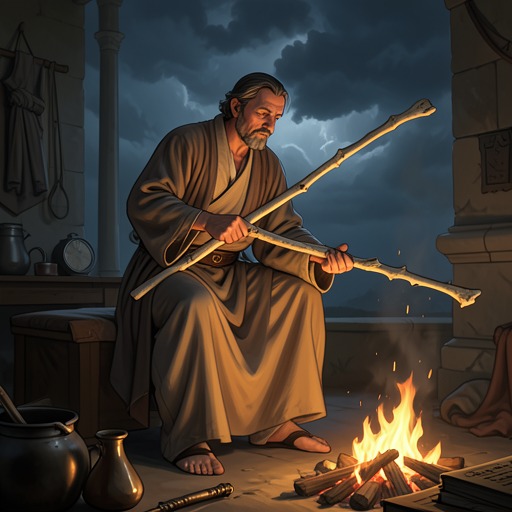
The harp belongs to the story of Wainamoinen’s first instrument, identified in the poem as the birth of the harp. Before the storm, it is presented as a work of beauty and pride: Wainamoinen’s playing carries harmony across hills and mountains, turning the instrument into a source of pleasure rather than merely an object he possesses. The music’s reach gives the harp a public life, linking the minstrel’s skilled performance to the landscape and to the people who hear it.
The scene also attaches feeling to the act of playing. As Wainamoinen performs, tears flow from his eyes. The music is therefore not depicted as simple entertainment: performance brings intense emotion to the surface, and the harp gives that emotion a form others can hear. This earlier abundance makes its later loss especially stark. The instrument that had sustained gladness and moved its maker becomes inaccessible beneath the sea.
The Storm and the Loss
The loss occurs amid a violent storm. Winds roar and lash the waters, and the waves rise in fury. The storm tosses Wainamoinen’s war-ship high into the air and casts away the fish-bone harp. The paired blows—the ship thrown aloft and the instrument swept off—place the loss within a crisis that overwhelms both the vessel and the things carried aboard it. The harp is not surrendered or deliberately discarded; it is taken by the force of the sea.
The poem describes the harp passing to the realm beneath the billows, associated with the people of Wellamo and the salmon’s hiding places. This destination sharpens the contrast between the harp’s former sound, which echoed across hills and mountains, and its new concealment under water. Its journey from audible, shared music to an inaccessible deep is also a change in its relation to Wainamoinen: he created it, but can no longer command its presence or recover its song.
Wainamoinen responds as its maker and as the musician who depended on it. Heavy-hearted, he speaks of having lost what he created and connects that loss to the departure of his pleasure, hope, and comfort. He also fears that the harp will never again enchant the hosts of Suomi. His lament thus gives the event two connected consequences: private grief for a creation that is gone, and the anticipated end of a music that had offered delight beyond the maker himself.
The Search and Its Failure
The loss returns as a problem in the later account of the second harp’s birth. Wainamoinen reflects that his first harp lies hidden on the bottom of the deep sea, among the salmon’s hiding places and the people of Wellamo. He treats its absence as final, saying that he will not regain it and that Ahto will not return it. The repeated recognition of irretrievability matters: the storm’s brief violence becomes a lasting condition, not a temporary interruption in the minstrel’s access to his instrument.
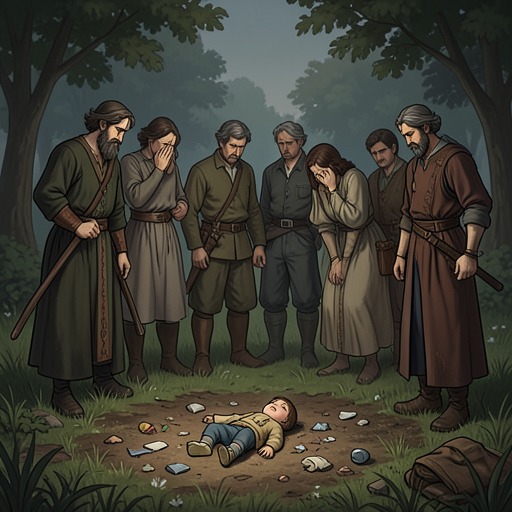
Even so, Wainamoinen makes an effort to find it. He descends to the waters and rakes the seabed, bringing up water-flowers, deep-sea shells, and colored pebbles. The search turns the sea floor into a field of possible recoveries, but none of the objects he gathers is the harp. Its absence is confirmed by the concrete result of the labor: he leaves without the instrument, which is described as lost forever to Wainola. The contrast between the abundant things raked from the bottom and the single missing harp makes the failure unmistakable.
What the Loss Leaves Behind
The first harp’s disappearance is followed by the making of a second. That later instrument is finished as a sacred harp and becomes a source of lasting pleasure for the people of Wainola. The sequence therefore distinguishes replacement from recovery: Wainamoinen can create another instrument and music can return, but the fish-bone harp remains lost. The new harp changes what is possible for the community without restoring the object that carried the earlier music.
The loss also gives the harp narrative a clear reversal. First the instrument’s sound spreads pleasure; then the storm removes it, and Wainamoinen fears that music and comfort have vanished with it; finally he searches unsuccessfully before making another harp. The arc holds creation and irretrievability together. Wainamoinen’s skill can produce a new source of music, but it cannot undo the sea’s taking of the first one. In that distinction, the lost harp remains significant even after the second harp is complete: it marks the boundary between what the minstrel can make anew and what he cannot reclaim.