The Sun and Moon imprisoned in Pohyola
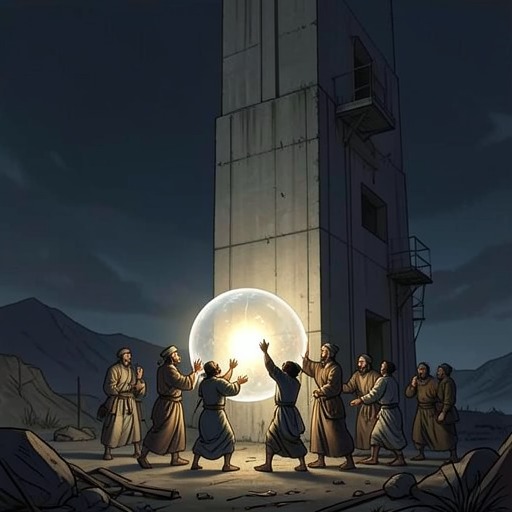
KalevalaThe Sun and Moon imprisoned in Pohyola is a state of cosmic captivity imposed by Louhi: the lights that should shine in the sky are seized, carried to Northland, and hidden away. The episode turns the heavens into a place of absence. Its details make that absence physical—one light is shut inside a many-colored rock, the other within an iron-banded mountain—and the captives’ continued confinement becomes a challenge that Wainamoinen must confront.
Louhi takes the lights from the sky
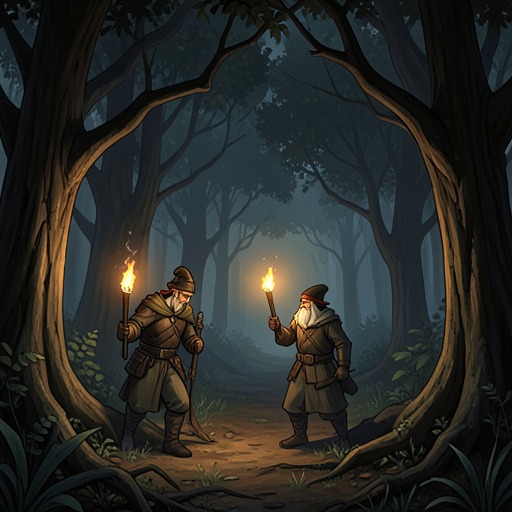
Louhi enters the episode as the hostess of Pohyola and an old, toothless wizard. The surrounding scene places her among those who come to listen to Wainamoinen’s singing and harp; against that setting of music, her action is a stark interruption. She makes the Sun and Moon her captives, not merely obscuring them but taking them from their places in the world.
The account gives each seizure its own image. Louhi takes the Moon, described as fair Luna, from a cradle in a birch tree. She calls the Sun down from its station among the bending branches of a fir tree. The two are thus removed in different ways and from distinct arboreal settings. The sky’s lights are presented as beings that can be approached and carried off, while their displacement makes the cosmic order vulnerable to Louhi’s power.
Confinement in Northland
Louhi carries the captives to upper Northland, to the darksome Sariola. There she hides the Moon in a rock of many colors and the Sun in an iron-banded mountain. The materials and enclosures distinguish their prisons: the Moon is enclosed by the variegated rock, while the Sun is shut behind iron. Their separation gives the captivity a concrete geography rather than leaving the darkness as an unexplained condition.
The stated effects are absolute. The Moon is hidden and no longer glimmers; the Sun is hidden and no longer shines. Their imprisonment therefore changes more than the prisoners’ location: it removes their light from the world. The contrast between the radiant bodies and the enclosing rock and iron makes captivity a reversal of their natural function. What ought to be visible and life-giving is made inaccessible and dark.
The captivity is confirmed
The danger becomes explicit when Wainamoinen asks where the Sun lies hidden and where the golden Moon is sleeping. The answer comes from the evil sons of Pohya, who say that both lights are hidden in the rock of many colors, in the stone-berg of Pohyola. Their account identifies the prison as the place of confinement and confirms that the lights have not simply vanished from sight.
Their answer also intensifies the threat: they declare that the captives will never gain their freedom and will never again shine in Northland. This is a claim made by the sons, not an account of a completed or permanent outcome. The narrative has already named separate hiding places for the Moon and Sun—the rock and the iron-banded mountain—whereas the sons describe both as hidden in the many-colored rock. The episode preserves both details, first establishing the distinct enclosures and then presenting the captors’ bleak report of the pair’s confinement.
Narrative significance
The captivity converts a cosmic disruption into a known crisis. Louhi’s seizure supplies the cause of the missing light; the sons’ answer supplies Wainamoinen with the reported location and the captors’ claim that release is impossible. After hearing them, he begins to respond to the possibility that the Sun will remain uncovered. The scene thus turns concealment into a problem that can be confronted: the lights are absent from the world, but their hiding place has been spoken aloud.
The episode’s structure sharpens the contrast between song and silence. It opens in the company of listeners gathered for Wainamoinen’s harp, then gives the lights’ disappearance a sequence of deliberate acts—taking, carrying, and hiding. Later, a question and an answer make the hidden state public. Against the sons’ declaration of endless darkness, Wainamoinen’s response signals that the captivity is not simply a description of the world but a crisis demanding action.