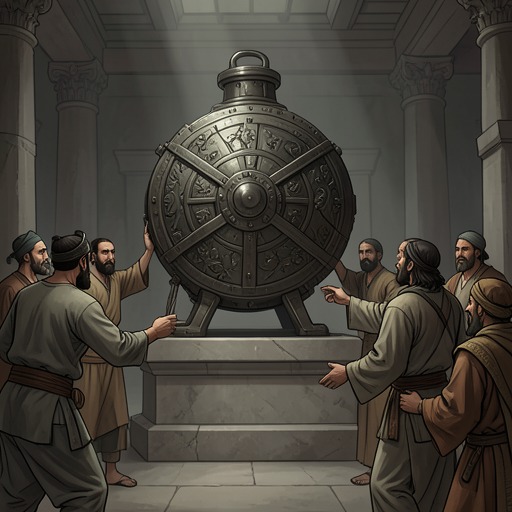
Sampo shattered and lost in the sea
KalevalaThe Sampo shattered and lost in the sea is not simply an account of an object destroyed. Its fall divides its value between the ocean and the land: fragments sink and scatter through the Alue Waters, enriching Ahto’s domain, while others drift to Wainola and are read by Wainamoinen as the seeds of future plenty in Kalevala. The Sampo is broken, but the passage makes its brokenness productive, transforming loss into a dispersed source of abundance.
The Sampo’s Fall and Fragmentation
The decisive movement begins when Eagle, likened to a hawk leaving birch or aspen and a falcon leaving linden, grasps the Sampo with one talon. It drags the treasure out over the water and drops its “magic lid in colors” from the red rim of the war-ship toward the deep sea. The vivid, particular image of the colored lid falling gives the loss a physical shape: what had been a treasure held together is now an object descending into depths beyond ordinary reach.
At the bottom of the sea, the Sampo breaks into pieces. The account emphasizes not a single recovered or recoverable whole, but scattering: the fragments spread through the Alue Waters and lie in the mighty deeps. The loss is therefore also a change in the Sampo’s condition and location. It no longer functions as one intact treasure; its remains enter the waters as many separate pieces, with consequences extending beyond the moment of its fall.
The Wealth of the Deep
The fragments’ first stated consequence is an increase in the ocean’s treasures. They become treasures for the hosts of Ahto, and the passage projects this enrichment into an enduring future: the Ahto-nation will not lack richness while moonlight brightens the waters of the Northland. The account thus gives the broken Sampo a second life beneath the surface, where its scattered substance becomes part of the sea’s continuing wealth.
That outcome does not undo the loss of the intact Sampo. Instead, it changes the terms of what the loss means. The treasure has passed from a single, graspable form into a dispersed resource, and its benefit is no longer confined to the possession of a whole object. The deep sea receives one share of the fragments; the continuing richness promised to Ahto makes this redistribution a lasting consequence rather than a momentary consolation.
Fragments Reaching Wainola
Other pieces remain afloat. Many fragments of the Sampo and pieces of its colored lid are rocked by winds and waves across the waters of Suomi, carried by rolling billows to the sea-sides of Wainola. Their movement supplies a counterpoint to the descent into the deep: some of the treasure is lost beneath the surface, while some is borne back toward inhabited shores. The text does not restore the Sampo, but it brings remnants of it within sight of Wainamoinen.
Wainamoinen sees the fragments and responds with rejoicing. His response turns the scattered remains into signs of what may follow. He says, “Thence will come the sprouting seed-grain,” then names “The beginning of good fortune” and “The unending of resources.” The prospect he draws from the debris is concrete: sunshine over the fertile plains of Suomi and abundance on the meads of Kalevala. Rather than treating the Sampo’s broken pieces as useless wreckage, he connects their arrival on shore with renewed growth and material provision.
Loss Transformed into Plenty
The passage holds destruction and promise together without pretending that the original treasure has been restored. The Sampo breaks; its fragments scatter; the deep receives some, and the waves carry others toward Wainola. From those opposed destinations arise distinct forms of abundance: enduring riches for Ahto’s hosts beneath the sea, and the prospect of seed-grain, good fortune, and resources on land. The lost whole is replaced not by another whole, but by a distribution across different places and communities.
This outcome also gives the fragments a role in the narrative beyond marking an ending. Their movement connects the sea’s wealth to the fertility of the land, and Wainamoinen’s interpretation makes the shoreward pieces a promise of future sustenance for Kalevala. The change is both material and interpretive: the Sampo cannot be gathered back together, yet its remains continue to matter. Its fall closes the possibility of possessing the treasure intact while opening a different prospect, in which broken pieces become sources of abundance in the sea and on the fertile plains.