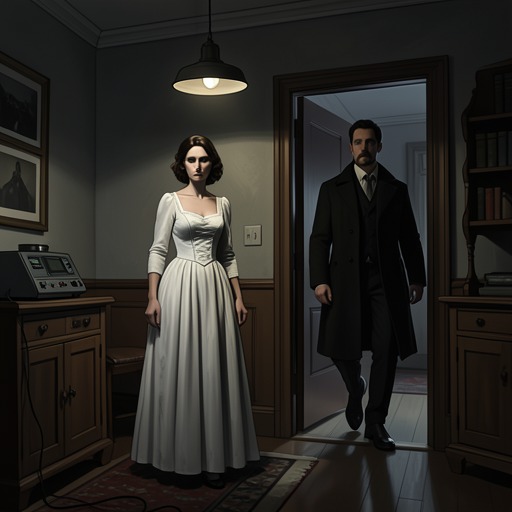
Andrea and Lilia's marriage plans
LeilaAndrea Trento and Lelia Camin’s marriage plans reveal both the tenderness and the imbalance of their young relationship. Andrea imagined a shared life and believed Lelia wanted it as he did, but her assent had been shaped more by gratitude and the experience of being admired than by a fully returned passion. His death turned their intended future into the grief and obligation that bound her to his family.
Origins and Obstacles
Lelia was not related to Marcello Trento, but after Andrea’s death his parents took her into their household. They had firmly opposed the marriage while Andrea was alive; afterward, they sought to keep the girl he had loved safe from what they regarded as the corruptions of the world. Their welcome also answered a private remorse: they had caused their son pain by resisting his wish. The narrative describes their arrangement with Lelia’s father as effectively buying her into their care, making the planned marriage inseparable from the money and family power surrounding her.
The plans had been discussed before Andrea’s death, not merely imagined in the aftermath. About a year before he died, Andrea and Massimo Alberti talked beneath an old chestnut tree about Lelia’s family and the need to keep her father at a distance after the wedding. Andrea believed she wanted that separation as much as he did. He also spoke of her exceptional intelligence and nobility of character, qualities he admired with a humility that made him underestimate his own worth.
A Future Imagined
Andrea’s confidence that the marriage could be achieved rested on hope rather than parental agreement. He trusted that his mother would eventually yield to his wishes and then help obtain his father’s consent. To his parents, he misstated Lelia’s age: she was about sixteen, though he said she was eighteen. The discrepancy records how young the prospective bride was and how urgently Andrea wanted his family to regard the match as viable; the evidence does not establish that the parents ever consented.
He could picture the home they would share at the Montanina villa: three rooms and a terrace on its western side. In Massimo’s recollection, that precise domestic prospect sharpens the loss. The rooms and terrace remain part of an unrealized future, while the surrounding mountains, woods, and voice of the Posina continue unchanged after Andrea is gone.
Unequal Affections
Lelia had accepted Andrea’s love, but not with the same emotional certainty he brought to his plans. She had been grateful to be loved, pleased by the attention of a young man who admired and desired her, and willing to accommodate him; she had not yet felt a corresponding depth of love. Andrea, in turn, seemed too young and cheerful to comprehend the moral drama she carried within herself. His sincerity and generous admiration could not by themselves make their feelings equal.
That difference appears again in Andrea’s regard for Massimo, his older friend, whom he admired for his intellect, learning, and disciplined character. Andrea even told Lelia that Massimo would be a more worthy husband for her. Lelia, proud and unwilling to understand love as a question of comparative suitability, declined to meet him. The remark exposes Andrea’s self-effacement, but it does not mean he had abandoned his own wish to marry her: he continued to speak of the wedding and the life he expected them to build.
Death and the Unlived Marriage
Andrea’s death ended the plans before they could become a marriage. Lelia’s grief then magnified her sense of how much she had loved him; she did not distinguish cleanly between love and pity for the dead. When her father presented the Trento family’s proposal that she live with them, she first recoiled at the arrangement’s financial and familial implications. Her disgust with her father’s conduct and her memory of Andrea nevertheless led her to accept.
The Trentos’ later care for Lelia thus preserves something of Andrea’s intended future while also replacing it with a different relationship: she becomes the cherished, bereaved girl in his parents’ home, not his wife. The unrealized marriage is consequential precisely because it leaves no shared life to remember. Instead, its afterlife is carried by Massimo’s recollection of Andrea’s confidence, by the practical details of the home he imagined, and by the household that took Lelia in after his death.