Benedetto’s Funeral and Burial at Oria
LeilaBenedetto’s Funeral and Burial at Oria returns Piero Maironi, known in religious life as Benedetto, to the place from which he disappeared years earlier. The funeral is at once a communal act of gratitude and a test of Massimo Alberti’s divided loyalties: beside Benedetto’s coffin, Massimo confronts his own estrangement from the Church and resolves not to abandon the dead man’s memory. Don Aurelio’s eulogy, meanwhile, distinguishes Benedetto’s religious witness from theological claims that Church authority might reject.
Background and Arrival
The funeral procession begins amid uncertainty. Massimo waits at Porto Ceresio for Don Aurelio and their companions, who are bringing Benedetto’s body from Milan, but the expected train is late and no one arrives with it. After speaking to the stationmaster, Massimo waits by the lake. The delay leaves him alone with memories of Benedetto’s last counsel and with the thought that he had neglected Sunday Mass for the first time. He recognizes that it has been easier to break with the Church in thought than in worship, where inherited practice and the memory of the dead still bind him.
The special steamer eventually arrives crowded with people from Albogasio. They have paid for it themselves to meet the body of a man they regard as a benefactor. More than a hundred people have come with their parish priest; some have brought food, while those who have provisions share them with people who have none. Massimo and the priest arrange for bread, and the villagers accept the long wait with patience. Their presence gives the funeral a public meaning beyond the circle of Benedetto’s friends: local gratitude has become a collective religious observance.
As they wait, villagers recall the years-old disappearance of Piero Maironi from Oria and the many explanations that failed to solve it. They also remember the foreign priest who worked to ensure that the charitable provisions Maironi had made were carried out. The body now returning to the lake is therefore not simply that of a revered religious figure; it is the body of a man whose absence had become part of local memory. After five o’clock, a telegram from Don Aurelio confirms that he and the Roman friends are on their way with the coffin. Massimo walks alone by the lake for nearly three hours as evening falls.
Procession Across the Lake
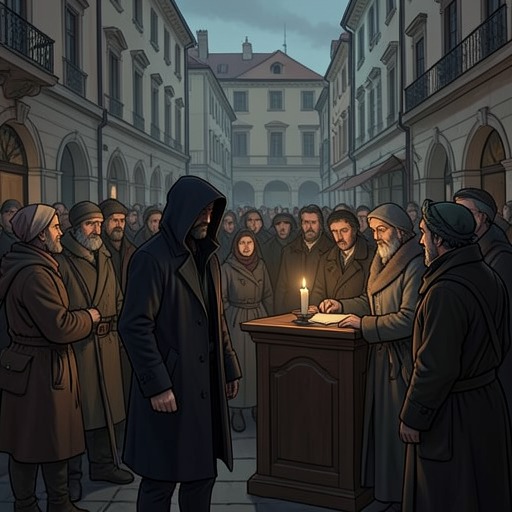
The train finally arrives in deep darkness beneath storm clouds. People from Albogasio fill the station with torches and candles, led by their parish priest in surplice and stole. Don Aurelio and the Roman companions descend in silence. Massimo, trembling and biting his lip to hold back sobs, joins five other young men in carrying the coffin from the baggage car. A veiled woman and her companion follow the funeral party onto the steamer, unknown to the crowd; only Massimo and Don Aurelio suspect who the woman may be, and they keep their suspicion to themselves.
The coffin is placed at the bow beneath a black cloth with silver fringe. Candle-bearers line the deck, and Don Aurelio stands with Massimo and the young men beside the priest. Without a formal command, the gangways are drawn in and the boat is pushed away from shore. As it turns toward the upper lake, the parish priest begins the rosary and the assembled people answer. The rhythm of prayer mingles with the pounding engines, turning the steamer into a moving funeral procession through the darkness. The narrative likens it to a ghost ship, its two rows of funeral lights breaking the stillness of the lake and its sleeping shores.
Massimo keeps his eyes on the coffin’s black covering. His grief is entangled with remorse: he remembers the slanders and insults directed at Benedetto, and recognizes that he himself had deserted the faith while others beside him had remained loyal to the dead man’s memory despite public contempt. Unable to contain the turmoil, he withdraws to the stern and goes below deck to weep. His inward appeal to Benedetto is a turning point in the funeral: he insists that he will not abandon him and that he is returning to him.
Eulogy and Burial
The steamer reaches Oria after passing Gandria. On shore, people from Oria, Castello, and San Mamette wait in silence. The lights moving over the dark water, the electric beams on the mountainside, and the waiting crowd make the arrival feel like a solemn event shared by the landscape and the community. The veiled woman and her companion leave last, after the coffin, the candle-bearers, and the rest of the mourners. The procession goes toward the church where, years before, a priest had learned of Maironi’s flight; now the missing man is carried inside for his funeral. The two women take places at the back, and no one in the congregation knows their identities.
Don Aurelio’s graveside address presents Benedetto as a fallible man rather than declaring him a saint. He acknowledges that Benedetto spoke often about religion and could have advanced ideas that Church authority had reason to reject. But, he argues, the defining purpose of Benedetto’s work was to call people of every condition back to the spirit of the Gospel as embodied in life, feeling, and action. Don Aurelio stresses that Benedetto had professed obedience to the Church and the Holy See, and that he would have welcomed the chance to demonstrate that loyalty publicly. The eulogy thus defends Benedetto’s religious seriousness without claiming that every theological proposition he expressed was correct.
Don Aurelio also asks the mourners to forgive those who falsely accused, mocked, or insulted Benedetto, reminding them that human ignorance limits anyone’s right to judge another. His address turns the burial into an appeal for prayer, humility, and compassion. The coffin is lowered beside the grave of Elisa Maironi; after the final prayers, the grave is closed. The rite gives Benedetto a resting place among the dead of his family and community, while Don Aurelio’s words place his disputed life within the Church’s larger practice of prayer for the dead.
Aftermath and Significance
After the mourners leave the cemetery, the veiled woman asks that the gate remain open for a few minutes. Only then does Massimo receive a letter that had been brought from San Mamette. Written by Lelia Camin, it says that their friend is seriously ill and asks him to come as soon as he can. The message abruptly carries the funeral’s emotional reckoning into a new obligation: Massimo must turn from Benedetto’s grave toward the living.
The episode joins individual conversion to collective ritual. The people’s paid-for steamer, shared food, candles, rosary, and procession make their gratitude visible, while Massimo’s silence, tears, and remembered failure expose the personal cost of his distance from the Church. Don Aurelio’s eulogy holds two truths together: Benedetto’s religious ideas were not beyond correction, yet his life was marked by devotion to the Church and a call to live the Gospel. The funeral does not resolve every dispute around him; it gives grief a public form and makes remembrance an act of religious and communal responsibility.