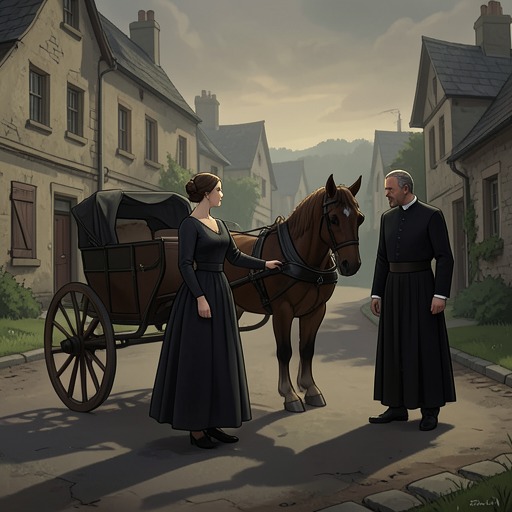
Death of Donna Fedele Vayla di Brea
LeilaDonna Fedele Vayla di Brea’s death closes her role as Lelia Camin’s self-appointed protector and Massimo Alberti’s trusted friend. A sudden infection leaves her no time to recover, but she remains conscious, arranges for Lelia’s future, and waits anxiously for Massimo. Her final words to Lelia carry an unresolved grief and hope; her last apparent words, as understood by Don Aurelio, are of happiness. The scene joins personal affection, religious ritual, and the recurring roses into a conclusion presented as both a death and the fulfillment of a spiritual offering.
Circumstances and responsibilities
Donna Fedele’s final illness unfolds after she has taken charge of Lelia’s departure from Valsolda. She considers the girl’s return to Velo unacceptable, while Lelia dreads it and is not yet of age to be independent. Donna Fedele agrees that Lelia may stay with her cousin in Santhià, trusting the household’s safety and the father’s previous deference to her. The plan is for Donna Fedele and Lelia to travel to Turin together, with Cugina Eufemia accompanying Lelia onward and letters redirected to Santhià. The decision is not simply logistical: Donna Fedele knows she is exercising a maternal authority she does not formally possess, and recognizes that this makes her responsibility especially weighty.
She also sets limits on the immediate reunion between Lelia and Massimo Alberti. Though the two have come to an understanding, Donna Fedele insists that Lelia cannot remain in Valsolda and asks Massimo to return to Dasio, allowing the young pair to meet later in her presence. Her judgment combines concern for propriety with a wish to protect Lelia’s prospects and security. By the time her health collapses, she is still trying to arrange other people’s lives around their obligations and vulnerabilities.
Sudden illness and last rites
The deterioration begins almost suddenly after midday. Donna Fedele has no pain, but her fever becomes extremely high; the doctor identifies the onset of a general infection and considers further treatment futile. She understands that death is near and, fully conscious, immediately asks for a priest and the viaticum. By five o’clock the parish priest of San Mamette has administered the last rites, including anointing. The narrative emphasizes not only the medical finality of her condition but also her composure and active choice to prepare for death through the rites of her faith.
A telegram from Massimo Alberti, sent from Porto Ceresio, visibly disappoints her. She does not complain, but Lelia understands that Donna Fedele thinks the journey could have been spared. Even after receiving religious consolation, she makes Massimo’s return her chief concern, asking repeatedly when he will arrive and apologizing to Lelia for her anxiety. Her final hours therefore turn on two kinds of expectation: the certainty of her own death and the uncertain arrival of the person she still hopes to see.
The message for Massimo
With the doctor and Cugina Eufemia briefly outside the room, Donna Fedele calls Lelia to the bedside and asks her to kneel so she can put an arm around her neck. She entrusts Lelia with a message: Lelia must tell Massimo that, thinking of him and his poor mother, Donna Fedele died with both grief and hope. The message is intimate but deliberately unexplained. Lelia believes she can guess the grief and hope behind it, yet cannot make them her own; she fears using a deathbed request to exert pressure on Massimo. At the same time, refusing would feel unbearable. Her reluctant assent does not deceive Donna Fedele, who sighs and admits that she has more to say but lacks the strength.
Donna Fedele takes a crucifix into her hands and falls silent. At nine, she asks again for Massimo. When a light appears in the distance, the doctor recognizes the special boat and reports that it is coming. She then loses her sense of time and place, asking from minute to minute first whether the boat has arrived and then whether Massimo has reached Oria. Only after eleven does the innkeeper announce that he is coming. Massimo arrives with Don Aurelio; the familiar voice and face of the priest, marked by kindness, revive Donna Fedele. Don Aurelio bends close and speaks to her in a whisper that the others cannot hear. Her short replies carry an unmistakable note of surprise and joy, but the content of their exchange remains private.
Death and religious consolation
In her final moments, Donna Fedele signals toward the roses. Cugina Eufemia misunderstands and tries to take them from the vase, but Donna Fedele indicates that the flowers should not be brought to her on the bed. Massimo Alberti and Lelia Camin understand that she wants them scattered after her death; Don Aurelio gives voice to that understanding, and Donna Fedele thanks him with her eyes. The gesture makes the roses part of her leave-taking rather than a comfort she seeks to possess in life.
Her large brown eyes close, and her hands grow still on the crucifix. Don Aurelio is not yet sure that she has died, because her eyelashes move slightly. When he asks whether she is suffering, her lips stir; he believes he hears her say that she is happy. He repeats this interpretation to those present, then asks them to kneel. They remain in silence for two minutes before he affirms that she is happy and calls them to rejoice and adore. The scene offers no independent explanation of her final experience: its meaning is conveyed through Don Aurelio’s reading of her faint movement and through the shared act of prayer.
The roses and the completed offering
At sunrise, Donna Fedele lies dressed in black, the crucifix between her hands. With the faded roses from the villa are many fresh roses from Valsolda. The contrast gathers the recurring flower imagery into a final image of continuity between her earlier life and this last vigil. The narrator describes her closed eyelids and pale lips as still bearing her gentle smile, and names her the White Lady of the Roses.
The closing account frames her death as the completion of a beneficent life and of a supreme offering. It connects that offering to a promise she made while praying at Marcello Trento’s deathbed. That link gives her death a larger devotional arc without spelling out the promise’s precise terms: the narrative presents her care for others, her prayerful readiness, and her final surrender as parts of one completed act. The roses do not erase the grief surrounding her death, especially Lelia’s burden of carrying the message to Massimo. Instead, they stand beside the crucifix and the dawn, making the ending at once intimate in its relationships and explicitly religious in its hope.