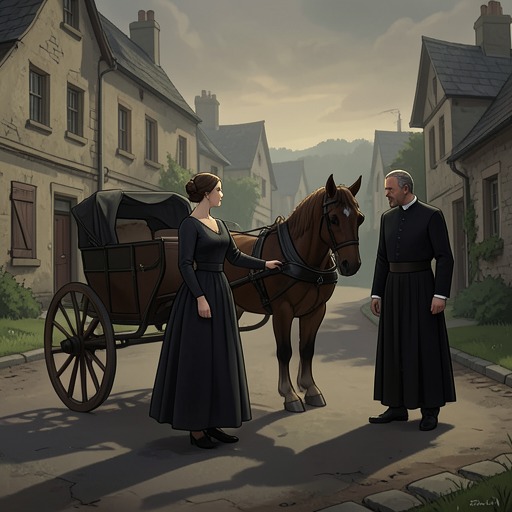
Il viaggio di donna Fedele in Valsolda
LeilaDonna Fedele’s journey to Valsolda is at once a rescue mission and a deliberate renunciation of her own medical hopes. After learning that Lelia Camin has left to confess her love to Massimo Alberti, Fedele postpones an operation in Torino and sets out to reach her. The journey brings the two women together, but also makes Fedele’s declining strength impossible to ignore: she arrives exhausted, helps determine Lelia’s next steps, and soon faces the illness that will end her life.
The Decision to Go
The immediate cause of the journey is Lelia’s letter. Writing as she sets out from Vicenza toward Dasio, Lelia tells Fedele that she intends to admit her past wrongdoing and offer herself to Massimo if he will have her. She has concealed her plans from her father and asks Fedele to forgive and bless her. The letter transforms Fedele’s understanding of the situation: Lelia is no longer simply absent or in need of shelter, but is undertaking a perilous reconciliation on her own.
Fedele responds by sending a telegram to Massimo with a brief moral charge: he must be a Christian and a gentleman. She also instructs her agent in Torino to postpone arrangements at the Mauriziano hospital because of unforeseen circumstances. The decision is not presented as confidence that treatment can wait without cost. Fedele believes the operation would not certainly cure her; nevertheless, she gives up the planned journey for it and redirects her remaining strength toward Lelia.
Alone at the window, Fedele understands the choice as an offering to God. She imagines giving her life so that two people who have moved away from God might return to Him, and so that Lelia, whom Marcello Trento had loved partly through his continuing devotion to the memory of Andrea Trento, might come safely through the danger ahead. This intention makes the journey more than an act of friendship: Fedele accepts the possibility that her care for Lelia may be the final service of her life.
Departure and the Route North
Fedele initially considers taking her cousin Eufemia along, then decides that Eufemia should go to Santhià while she travels alone. She believes her solitary arrival, in her frail condition, will make a stronger impression from afar. Yet at the station she directs that Eufemia’s trunk be sent to Santhià and says that they are going to Milano for the day. Eufemia protests, but Fedele insists; the trunk is dispatched separately, and the two women board the train. Don Emanuele passes along the carriages, notices Eufemia, and hurriedly turns away. As the train leaves, Fedele closes her eyes rather than watch the place she is leaving, with no hope of returning.
The outward journey is physically taxing. At Porto Ceresio, the first sight of the lake tells Fedele that she is near her destination, but excitement and anxiety leave her struggling to stand. A porter has to accompany her and her modest luggage—a valise, a bag, and an umbrella stand—to the café. She asks him to return when it is time to board. The crossing toward Lugano is still pending, and the wait by the water becomes a measure of the effort the trip costs her: she can barely taste the milk she has ordered, while the still lake and surrounding mountains offer a peace she cannot share.
Reunion and the Decision About Lelia
When Fedele reaches the lodging in Valsolda with Eufemia Magis, Lelia learns who has arrived from the white-haired visitor’s inquiry about whether Massimo is also staying there. She rushes downstairs and finds Fedele seated in the small entrance. The reunion is immediately shaped by concern for Fedele’s condition. Supported by Lelia and Eufemia, she climbs the stairs only with great difficulty, stopping every two steps. As Lelia helps undress her, she is appalled by Fedele’s emaciation and partial bodily deformity. In front of Eufemia the two exchange only ordinary remarks; once they are alone, Lelia kneels beside the bed and kisses Fedele’s hand through tears.
Fedele does not accept Massimo’s offer to take charge as a doctor. She says that the medical role belongs to her, for both him and Lelia, though not yet. Her immediate concern is what the pair intend to do. Lelia has written to her father and is waiting for an answer, but Fedele judges that refusal is virtually certain and that Lelia cannot stay in Valsolda regardless. She is prepared to take the girl back to her own home or, at least, to the villa for a few days.
Massimo explains that Lelia’s letter to her father may make a negative answer less certain, and tells Fedele that he hopes to obtain a post as a local doctor in Valsolda. Fedele is glad to hear of the possibility, but still insists that Lelia must leave with her. Lelia begs to remain, hoping Fedele can rest there and later accompany her to Torino; she dreads returning to Velo and is only months away from adulthood. Fedele counters that Torino would leave her without support. After discussion, she proposes a temporary stay with her cousin at Santhià if Lelia’s father permits it.
The practical arrangement reflects the limits on Lelia’s freedom as well as Fedele’s protective resolve. Fedele will rest that day, consult the doctor the next morning, and—if he authorizes it—travel with Lelia to Torino. Eufemia is to meet Lelia at Santhià, while letters arriving for her at San Mamette are to be forwarded there. Fedele yields on the need for paternal permission, trusting the safety of her cousins’ home and knowing how strongly Lelia rejects a return to Velo. She also asks Massimo to leave for Dasio and to see Lelia only in her presence that evening, acknowledging that her voluntarily assumed maternal responsibility constrains her differently from the authority of a real mother.
The Cost of the Journey
The journey does not restore Fedele’s health. At the doctor’s visit, she refuses the complete examination he says is necessary to understand her condition. She speaks of going to Torino for the operation, but makes clear that she will not leave without his permission; outside the room, he tells Lelia that Fedele’s heart is very weak and that he fears for her life. Her arrival has therefore altered the immediate direction of Lelia’s story without resolving the danger to either woman.
After midday, Fedele worsens almost suddenly. Her very high fever signals a general infection, and the doctor can do nothing more. Fully conscious of her condition, she asks for a priest and the viaticum; the parish priest of San Mamette gives her the last rites. Even after receiving them, she repeatedly asks when Massimo will return from Porto Ceresio. She regrets his absence but understands that his telegram means he cannot arrive sooner, and fears she may not have time to tell him what she wishes. The trip she undertook to protect Lelia thus ends not in a return to Torino, but in the last phase of Fedele’s life, with her attention still fixed on the people she has tried to bring back to one another and to faith.