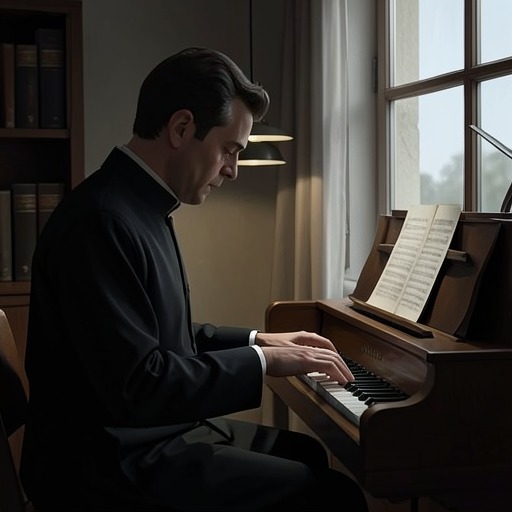
Marcello briefly loses consciousness
LeilaMarcello briefly loses consciousness in his study, and the episode becomes an ominous echo of his father's final illness. Although he dismisses it as a spell of sleep, the same sequence had once preceded a diagnosis of Arteriosclerosi in his father; the resemblance gives this small domestic incident a grave significance without establishing a diagnosis for Marcello.
The Episode in the Study
Teresina brings the correspondence to Marcello as usual and sees him suddenly tip his head backward, then toward his right shoulder. His eyes close, open with their whites showing, and close again. Alarmed, she sprinkles water on his face and sends a servant to fetch Lelia. Marcello then gives a deep sigh, composes himself, and says that he has merely suffered an attack of sleep. He turns to the newspapers and letters, leaving Teresina uncertain whether to stay or ask him anything; she eventually withdraws but listens outside the study, hearing only papers being handled.
A short while later, the bell summons Teresina back. Marcello asks why his hair is wet, and she admits that she feared he had fallen ill and splashed water on him. He first calls her foolish, then says he had guessed what happened. His sharpness yields to an unusual tenderness: he dismisses her kindly and calls her dear. In twenty-two years of service, he had used that endearment only twice before—once casually when she entered his service, and once in grief after his only son, Andrea, died. The third instance, quiet rather than impulsive, registers the episode's emotional aftershock as well as Teresina's continuing devotion to him.
The Family Resemblance
Once alone, Marcello rises slowly and turns toward the window. He joins his hands as if in prayer, looking into the dark sky above Mount Torraro and toward the chestnut-covered slopes descending to the Posina ravine. His lips do not move; the gravity of his gaze conveys the solemnity of his thoughts. At seventy-two, he is the age his father had been when a similar spell struck during a conversation: the older man had tipped his head, rolled his eyes, and recovered believing that he had fallen asleep.
The parallel has a specific and unsettling history. A doctor told Marcello's family that his father's episode indicated Arteriosclerosi and that they should prepare for the worst. Five months later, his father was found dead in bed, beside the same brass lamp that now illuminates Marcello's desk. The lamp links the two scenes as a family object carried from one generation to the next, while the repeated gesture makes Marcello's explanation of sleep feel precarious. The narrative presents the resemblance as a warning, not as a confirmed diagnosis of Marcello.
Foreshadowing and Consequence
The scene gives Marcello's apparent recovery two meanings at once. To Teresina, the episode is frightening enough to prompt an immediate attempt to revive him; to Marcello, it is something to dismiss. Alone, however, he understands it through the memory of his father. His prayerful posture and the narrator's image of the lamp seeming to remember transform the event from a private physical lapse into a moment of foreboding.
The later account of Marcello's death deepens that foreshadowing without proving that the first spell and the fatal one have the same cause. After tending his cyclamens outdoors in the rain, he is struck by vertigo while rising from the earth. The vertigo returns violently in bed; he feels a shock run from the nape of his neck to his legs, tries to form a final prayer, and dies. The earlier spell therefore stands at the beginning of a narrative pattern in which bodily warning, family memory, and Marcello's religious awareness converge.