Massimo’s Return to the Church
LeilaMassimo Alberti’s return to Christ and the Roman Catholic Church takes place amid the public mourning for Benedetto, but its decisive moment is inward: grief, guilt, and remembered instruction bring a long religious conflict to a head. The funeral does not simply commemorate a dead mentor. It becomes the setting in which Massimo recognizes his estrangement from worship and openly tells Don Aurelio that he has come back.
Background to the Crisis
As Massimo waits at Porto Ceresio for the boat carrying Benedetto’s body, his thoughts settle on three figures: Lelia, the gravely ill Donna Fedele, and Benedetto, whom he both loves and fears. Their different claims gather inside the same still moment. His attachment to Lelia and concern for Donna Fedele are present alongside the spiritual authority Benedetto retains for him, even in death.
Benedetto’s remembered words sharpen that authority. Massimo feels again the dying man’s hand on his head and recalls his injunction to become holy and to fulfill the duties of worship as prescribed by the Church, in strict justice and perfect obedience. The recollection is not abstract: Massimo realizes that the previous day, a Sunday, he had failed to attend Mass for the first time in his life. The omission gives his crisis a concrete measure. He had found it easier to break with the Church in thought than to abandon its outward worship, shaped by long habit and by the memory of the dead.
That small failure of practice unsettles him because it exposes a split between belief and action. He tries to use his will against feelings he regards as insufficiently governed by reason. Yet the contest has been intensifying for days, and the news of Benedetto’s approaching body has made it acute. Reason’s power weakens under repeated reversals, while feeling presses back with an energy that does not rest. Massimo is not merely deciding what he thinks about the Church; he is confronting whether he can continue to live apart from the practices that have formed him.
The Funeral as a Turning Point
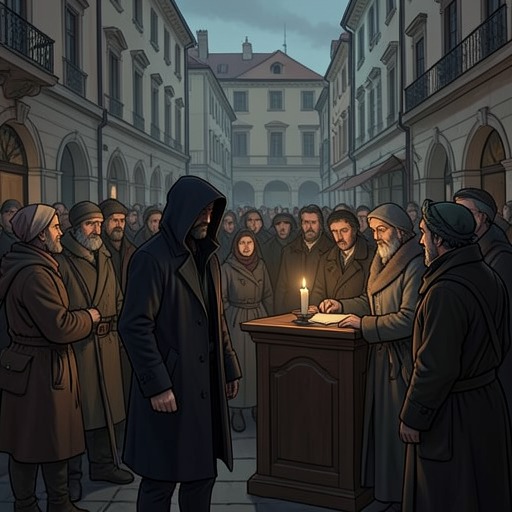
The funeral makes this private conflict visible through shared ritual. More than a hundred people from Albogasio have traveled on a special boat, paid for by the villagers, to meet the body of a man they regard as a benefactor. At the station, Massimo joins five other young men in carrying the coffin. The mourners then cross the dark lake beneath torches and candles, answering the parish priest’s rosary as the boat’s engines and wheels sound beneath the prayer.
Massimo keeps his eyes on the coffin’s black cloth with silver fringe. He thinks of the tenderness he feels for the person who had lived within it, of the calumnies and insults directed at Benedetto, and of his own desertion while the Roman companions beside him remained faithful to their dead friend’s memory despite public contempt. Love, grief, and remorse become impossible for him to contain. He withdraws toward the stern, goes below deck, and weeps, his sobs mingling with the boat’s noise. In that breakdown he promises Benedetto that he will not abandon him and will return to him.
The procession carries this movement from private anguish into communal worship. At Oria, the villagers and visitors accompany the coffin to the church. Massimo kneels and prays throughout the funeral service, while the veiled woman seated near the back does the same. The church is full, the congregation answers the priest, and the ritual gives Massimo a place within the religious community from which he has felt himself departing. The ceremony does not erase his grief or resolve every question; it brings his divided loyalties to a point at which he can act.
The Declaration to Don Aurelio
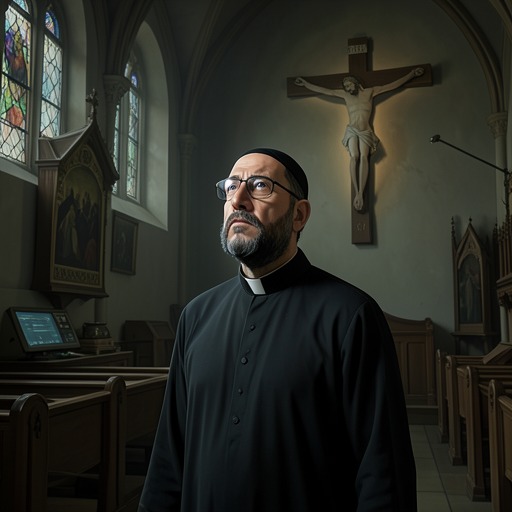
After the funeral, Massimo asks Don Aurelio whether he will speak with him. The priest understands that the young man wants to say something more, and Massimo tells him, trembling, that he has returned to Christ and the Church. He adds that the return has happened now. The admission is direct, personal, and addressed to the priest who has been spiritually close to him; it turns the inward resolution into a declared change.
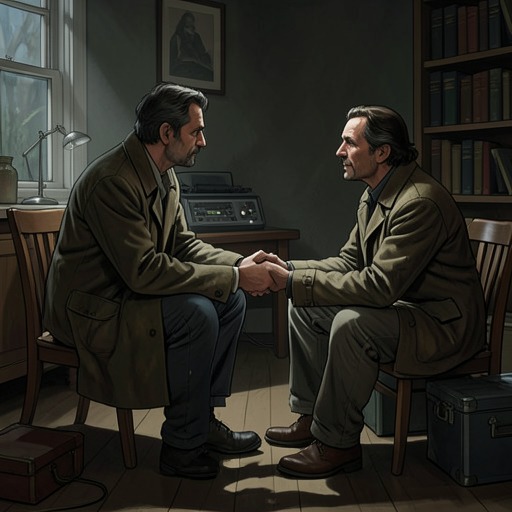
Don Aurelio embraces him tightly and answers with joy, saying that Massimo has lifted a great weight from his heart. His response shows that the crisis has not been Massimo’s alone: the priest has feared for him and receives the declaration as relief. Their embrace makes reconciliation bodily as well as verbal, contrasting with the isolation of Massimo’s earlier struggle.
Don Aurelio also speaks approvingly of the young men who came from Rome. He says that the excesses of certain innovators and their contemptuous talk about Benedetto have produced a salutary reaction in them. He even remarks that, had it not been too late, he would have preferred to entrust one of them with the funeral address. The comment places Massimo’s return within a wider dispute over religious allegiance and the treatment of Benedetto, while distinguishing the mourners’ fidelity from the attitudes that had wounded the dead man.
Meaning and Immediate Consequence
The scene makes Massimo’s return a convergence of memory, ritual, and choice. Benedetto’s counsel supplies the remembered demand; the missed Sunday Mass reveals how far Massimo’s conduct has shifted; and the funeral surrounds him with acts of prayer and fidelity. None alone is presented as a mechanical cause. Together they bring the conflict between reason and feeling to its acute point, and Massimo’s confession gives that crisis a definite outcome.
The return is also bound to grief rather than set against it. Massimo’s renewed allegiance emerges as he confronts his failure to stand by Benedetto and watches others honor him. After the burial, the coffin is laid near Elisa Maironi’s grave, and the last prayers are said. Massimo’s declaration has already occurred, but the funeral’s final act gives his decision its immediate setting: he has returned to the faith and community whose rites accompany Benedetto to his resting place.