Russia’s economic and social collapse in the 1990s
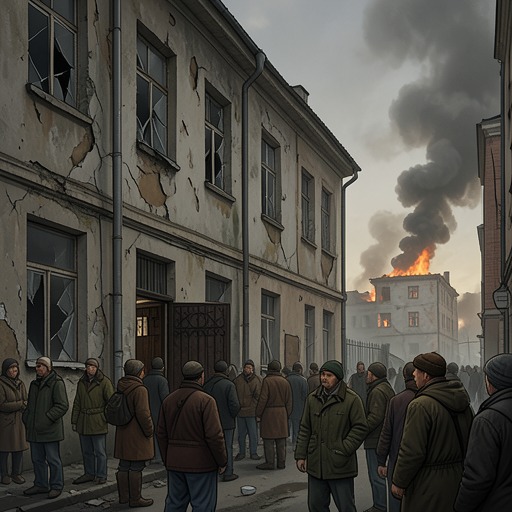
LimonovRussia’s economic and social collapse in the 1990s was not simply the painful cost of changing systems: it was a violent redistribution of wealth and security, carried out at a speed that let a small group seize national assets while millions watched their savings and livelihoods disappear. The book sets the glittering new consumer world against empty shops, impoverished pensioners, privatized coercion, and a population unsure how to judge its own recent history. The upheaval discredited both the old order and the promised democratic alternative, helping turn economic grievance into political anger and making the search for authority itself a defining question of post-Soviet Russia.
Reform and the shock of privatization
Boris Yeltsin, aware of his lack of economic expertise, entrusted the transition to Yegor Gaidar, a young reformer from the Communist nomenklatura who believed fervently in liberalism. With Russia having little experience of a market economy, Yeltsin and Gaidar nevertheless judged that reform had to be imposed quickly, before opponents could block it. They called their approach shock therapy. The name described not only the speed of the policy but the scale of the jolt delivered to ordinary life.
Price liberalization came first. Inflation reached 2,600 percent, wiping out the practical value of the parallel voucher-privatization scheme. On September 1, 1992, every Russian citizen over the age of one was sent a voucher worth ten thousand rubles, intended to represent a share of national wealth. The policy was meant to turn people accustomed to working for the collective into investors and to encourage private businesses and property. By the time the vouchers arrived, however, inflation had made them nearly worthless: a recipient might exchange one for a bottle of vodka, and people sold them in large numbers for little more.
The distribution of opportunity was radically unequal. Boris Berezovsky, Vladimir Gusinsky, and Mikhail Khodorkovsky were among the enterprising buyers who became multibillionaires within months. The account presents them as a shorthand for the emerging oligarchs: young, capable men suddenly permitted to pursue business in a country with no settled rules, effective laws, functioning banking system, or reliable tax structure. The opening was real, but it was also an institutional vacuum. Russia’s new wealth did not first emerge within a stable market; it accumulated where rapid transfer of assets met weak public safeguards.
Two economies in one country
For Eduard Limonov, returning to Moscow every few months between journeys to the Balkans, the transformation was almost disorienting. Streets once named for Bolshevik figures regained their pre-Revolutionary names, while neon signs crowded the city like those of Las Vegas. Traffic jams formed among old Ladas and black Mercedes with tinted windows. Goods that foreign visitors had once packed in their suitcases for Russian friends—including jeans, CDs, cosmetics, and toilet paper—were now on sale. McDonald’s on Pushkinskaya Square was followed by a fashionable disco; restaurants that had once offered little beyond long menus and unavailable dishes began serving Kobe beef and oysters flown in from the coast of Brittany.
The visible abundance became part of a new mythology. The new Russian appeared as a figure with bags of money, beautiful companions, a taste for display, and the brutality and boorishness that accompanied sudden power. A joke about two businessmen boasting over identical suits—one bought in Paris for five thousand dollars, the other for ten thousand—made extravagance itself a measure of status. Yet the spectacle of consumption concealed how few people could participate in it.
While a million people enriched themselves through shock therapy, the account says, 150 million others were plunged into misery. Prices rose while salaries remained fixed. Limonov’s father, a former KGB officer, could scarcely afford two pounds of sausage on his monthly pension. Another former intelligence officer, repatriated from Dresden after East Germany ceased to exist, lost his job and home and resorted to driving an unlicensed cab in Leningrad. That officer was Vladimir Putin. Like Limonov, he regarded the end of the Soviet empire as the twentieth century’s greatest catastrophe, a shared judgment that placed later political conflict against the lived insecurity of the transition.
The decline was measurable as well as visible: Russian men’s life expectancy fell from sixty-five in 1987 to fifty-eight in 1993. The old lines outside empty shops gave way to elderly people selling possessions in underground passageways. A pensioner might offer pickles, a tea cozy, or old issues of Krokodil; an army general might sell tanks or aircraft, while judges sold verdicts, police officers their tolerance, and bureaucrats their stamps of approval. A veteran of the Afghan wars might sell his capacity to kill, with murder contracts negotiated for ten thousand to fifteen thousand dollars. In Moscow, fifty bankers were shot dead in 1994. The account also notes the attrition of an earlier criminal gang: by then, barely half its members remained alive, and its leader, Yulian Semyonov, was dead.
Privatized violence and political anger
As economic assets changed hands, coercion became another commodity. Large players fought over industrial combines and mineral deposits; smaller operators fought over kiosks and market stalls. Businesses at every level needed a roof, the term for protection that might amount to a protection racket: refusal could mean being shot. Oligarch-owned holding companies such as those of Gusinsky and Berezovsky employed private armies commanded by senior former KGB officers. Further down the hierarchy, protection services drew on Georgian, Chechen, and Azeri criminal groups as well as police, which had become one mafia among many. The state had not simply withdrawn from economic life; its personnel and instruments could be privatized and redeployed for private gain.
The account makes that arrangement concrete through the experience of Jean-Michel, a Frenchman who moved to Moscow after his wife died in the crash of TWA Flight 800 in 1995 and built a business in restaurants, bars, and nightclubs. One night, masked elite troops armed with Kalashnikovs raided one of his clubs, forcing staff and customers to the ground. Their commander then removed his balaclava, ordered a drink, and told Jean-Michel that his existing protection was unreliable. The new arrangement, he said, would be more expensive but safer; the police would provide it. The transfer went ahead without the promised trouble, and the commander left behind a CD recorded by his men’s rock band. In this episode, the police are not a force standing outside the racket: the commando is the police, turning public authority into the next provider of protection.
The casualties and dislocations fed a political argument about who had benefited from reform and who had paid for it. The proverb that chopping wood sends chips flying had once helped justify collectivization, famine, and purges by treating victims as an unavoidable cost of progress. Under shock therapy, the promise of a free market replaced the promise of the dictatorship of the proletariat, but the same logic continued to excuse those broken by the project. The difference was that the newly injured no longer feared Siberia for saying so. Moscow demonstrations brought together impoverished retirees, unpaid soldiers, nationalists furious at the liquidation of the empire, Communists mourning a time when everyone had been poor but equal, and people bewildered by the reversal of their historical certainties. They were left asking how to distinguish heroes from traitors when the October Revolution was still commemorated even as it was described as a crime and a catastrophe.
Elections and the conversion of wealth into power
The 1996 presidential election exposed the political consequences of the crisis. The first wave of privatization and the disastrous effects of shock therapy had left the country in chaos; many Russians regarded events since 1989 as a historic calamity, and Boris Yeltsin appeared to have lost control. He withdrew into the Kremlin with his family and security chief Alexander Korzhakov, endured severe black moods, and drank heavily. The book describes the embarrassment caused by his drunken behavior at the Berlin celebrations of the 1945 victory, where he nodded, began keeping time with the military band, and eventually rose as if conducting it before other heads of state.
The principal electoral challenge came from the Communists. Five years earlier, Yeltsin had outlawed their party, but public discontent with democracy, the market, and the injustice accompanying them had grown so strong that polls indicated a potentially overwhelming Communist vote. Gennady Zyuganov did not campaign on restoring the Gulag or rebuilding the Berlin Wall. He presented himself instead as a cautious opponent of corruption, a proponent of national pride and Russian Orthodoxy, and a defender of the poor. The prospect that a Communist victory could threaten oligarchic fortunes gave the wealthy an immediate stake in keeping Yeltsin in power.
That stake had sharpened with the loans-for-shares scheme. The oligarchs’ banks lent money to an indebted state, taking shares in valuable, not-yet-privatized assets—including natural gas and petroleum—as collateral. If the state did not repay the loans within a year, the lenders could take possession of the assets. Because repayment would come due after the election, the oligarchs had reason to fear a president who might repudiate the arrangement. After a warning from George Soros at the Davos World Economic Forum that the oligarchs faced danger, Berezovsky contacted the six most powerful others and urged them to set aside their rivalries, including the violent conflict between his own forces and Gusinsky’s. The seven then pooled their financial and media influence behind Yeltsin.
Newspapers, radio, and television carried a stark electoral choice: Yeltsin or chaos, or a leap backward. To discourage nostalgia for Communism, the campaign was accompanied by documentaries about the Gulag, the famine organized by Joseph Stalin in Ukraine, and the Katyn Massacre, as well as commissioned fictional films about the purges. The campaign demonstrated how economic concentration could become political leverage: oligarchs who had benefited from privatization could use their media reach to shape the contest that would determine whether their bargains survived. At the end of Yeltsin’s second term, Berezovsky would again help shape the succession, promoting the little-known former intelligence officer Vladimir Putin as a loyal candidate for leadership.
Disillusionment and the search for belonging
The crisis also created a constituency for oppositional movements whose appeal was not reducible to a policy program. Limonov attended demonstrations whenever he was in Moscow. Recognized by readers of Dyen, he was welcomed by people who believed that figures like him meant Russia was not lost. At one rally, invited by his comrade Viktor Alksnis, he took the megaphone and denounced the supposed democrats as profiteers who had betrayed the blood shed by their fathers in the Great Patriotic War. He argued that people had suffered more in a year of democracy than in seventy years of Communism and warned that anger might lead to civil war. The crowd applauded after each sentence. For Limonov, the response fulfilled a long-standing desire to feel calm, powerful, and borne aloft by people who shared his sense of grievance.
The National Bolshevik Party translated some of that disorientation into a disciplined community. Branches appeared in cities including Krasnoyarsk, Ufa, and Nizhny Novgorod. When Limonov visited Zakhar Prilepin’s city with a small group of followers, party members met them at the station, found lodging for visitors, and spent whole nights listening to him speak. Prilepin admired Limonov but also felt uneasy in his presence, describing a man who was alert and forceful but without softness or kindness. By contrast, he trusted the other party members, whose loyalty and willingness to risk prison or death for a comrade offered an alternative to the corruption and confusion of the post-Soviet world. Limonov’s imprisonment had already contributed to his image as a heroic figure who endured without buckling; now that legend could be converted into followers’ devotion.
At the party convention, several hundred delegates arrived from across Russia, though the organization had seven thousand members in total. Some came early and stayed in a bunker; the others were accommodated in a workers’ hostel. Finding a venue was difficult because owners repeatedly withdrew their offers, apparently after police warnings, and organizers feared a bomb scare, harassment, or an outright ban. When the meeting finally opened, Limonov stood on the podium, beaming at the people who had emerged from years of distributing the party paper to provincial train stations. The delegates were not the grand, idealized figures imagined by Alexander Dugin, but poor adolescents from the provinces, often embarrassed by their appearance and short of money. For many, the party had supplied a meaning, style, and ideal that their damaged surroundings had not. The convention showed how social collapse could generate not only protest but also a small, intensely loyal political culture.
That culture did not reverse the wider political imbalance. By the time of the 2008 political contest described later in the book, Garry Kasparov had not run, The Other Russia no longer existed after its failure in the presidential elections, and Limonov had turned to Strategy 31, named for the constitutional right to demonstrate. Supporters gathered on Triumfalnaya Square on the thirty-first of months containing that date; there were generally about a hundred demonstrators and five times as many police, with dozens of arrests. Limonov regularly spent days in prison. The later arrests belong to a different period, but they carry forward the 1990s legacy: a mass experience of impoverishment and disillusionment had made dissent compelling, while the political order that followed increasingly narrowed the space in which dissent could act.