Post-communist Russian social order
LimonovPost-communist Russian social order is depicted through a collision between political upheaval and the routines of institutional power. As communism collapses, Eduard Limonov’s once-provocative nostalgia becomes political militancy; after his return to Russia, the former émigré writer leads the National Bolshevik Party and is imprisoned. The prisons and camp that follow do not form one uniform system: they impose isolation, crowding, and exhausting work in different ways, while Limonov adapts to each through self-discipline and practical attention to its rules.
Rupture after communism
The collapse of communism divides the earlier image of Limonov from the figure his acquaintances come to see. He had evoked Soviet life with wry nostalgia and seemed to treat his praise of Stalin as provocation. After the political order changes, however, his support for a firing squad for Mikhail Gorbachev no longer appears merely theatrical. His long absences in the Balkans and his fighting on the Serbian side deepen the break between his former Parisian circle and his new political commitments. A BBC documentary shows him firing on besieged Sarajevo under the watch of Radovan Karadžić, a Bosnian Serb leader identified in the account as a war criminal.
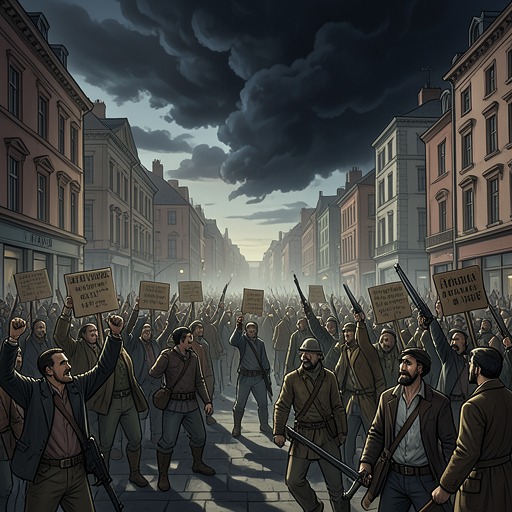
Back in Russia, Limonov creates the National Bolshevik Party. Television images of its young, shaven-headed marchers make the movement’s challenge visible in a deliberately jarring combination: a raised-arm salute, a clenched fist, black clothing, and flags modeled on the Third Reich’s design but bearing the hammer and sickle. Their slogan, Stalin! Beria! Gulag!, invokes a return to the repressive past. The former friend admired by bourgeois youths now stands at the head of a movement that makes Soviet symbols and political violence part of its public identity. The contrast is not resolved into a simple account of personal transformation; the narrative instead presents Limonov’s life as a way to investigate what the postwar and post-communist periods have made possible.
From political leader to prisoner
In 2001, Limonov is arrested, tried, and imprisoned on obscure charges associated with arms trafficking and an attempted coup in Kazakhstan. The Paris circle that had once celebrated his unruliness does not rush to sign a petition for his release. His arrest thus registers not only as a state action but as a further measure of his distance from his former milieu. The book leaves the charges indistinct in this account, while making the consequences of imprisonment concrete: his movement from public political leadership into spaces governed by confinement and surveillance.
At Lefortovo Prison, near Moscow, the uncertainty begins with secrecy. Limonov and his companions do not initially know what they are accused of; he has not seen a lawyer, cannot receive visitors, and does not know when the trial will begin or whether people outside know where he is. The prison is clean, white, and not overcrowded, unlike many Russian prisons described in the narrative, but its order rests on enforced isolation. Inmates may watch television throughout the day, an unstructured routine that can lapse into apathy and depression. Exercise takes place in separate fenced squares on the roof, with loud music preventing prisoners from hearing one another. The apparent cleanliness and relative physical safety do not soften the institutional separation.
Limonov resists that separation by insisting on his daily half-hour outdoors, even in winter at minus twenty-five degrees. While other prisoners stay in bed and the guards expect a quiet morning, he runs on his small square of concrete, doing push-ups and sit-ups and boxing the cold air. The guards are irritated at having to leave their warm room for one prisoner, but impressed by his persistence and manners. Their nickname for him, Professor, registers how his education and even temper become legible within the prison’s routines. Self-training gives him a repeated action that the institution has not dictated, though it takes place entirely inside the space the institution controls.
Crowding, camp labor, and adaptation
Saratov reverses Lefortovo’s defining condition. Its cells are built for four but may hold seven or eight, and every bed is occupied when Limonov arrives. He accepts a mattress on the floor without protest, reasoning through his conduct that the latest arrival should bear the discomfort. The gesture helps unsettle the suspicion attached to his reputation as an intellectual, political prisoner, and celebrity. Rather than claim status, he learns the shared rules: he does chores, shares packages, avoids useless talk, and helps fellow inmates with letters or crossword puzzles. He declines cards and chess to read or write, but his solitude does not prevent practical solidarity. Within a week, the other prisoners consider him a good man.
The narrative then distinguishes camp life from both prisons. At Engels, Limonov encounters a work camp where labor is presented as rehabilitation but often serves no practical purpose. After heavy rain floods buildings, the administration requires dry ground for three daily roll calls, on pain of losing television. Prisoners spend the day emptying puddles with drinking glasses, only for the water to return. Limonov initially considers improving the drainage with masonry, then recognizes the task as part of a camp tradition of futile labor: exhaustion and demoralization are themselves among its effects. At sixty he is exempt from forced labor, but is still kept from his books and notepads until evening and assigned cleaning. Given four hours for work that could take one, he scrubs each of four rows of toilets repeatedly, making no effort to escape the task through daydreaming.
The order revealed by routine
Across these settings, post-communist order is conveyed less through abstract political description than through the control of space, time, communication, and work. Lefortovo isolates prisoners while appearing orderly; Saratov makes them negotiate overcrowding through shared conduct; Engels uses purposeless labor to wear them down. Limonov’s responses differ in form but recur in discipline: he claims the exercise allowed by regulations, accepts the floor mattress, observes unwritten prison norms, and completes the absurd cleaning assignment with exacting care. These routines make the social order palpable without making the institutions interchangeable. They also complicate a purely heroic portrait: his resourcefulness is real, but it operates inside systems whose constraints remain firmly in place.